The interim Syrian government is prioritising reconstruction of the national army after the fall of Bashar al-Assad, launching rapid recruitment and structural reforms to create forces loyal to the state. Major obstacles include rushed vetting, a shortage of experienced officers, dependence on Russian equipment and doctrine, and deep mistrust from minority communities. International partners such as the US and Turkey provide training and intelligence support, but analysts warn that failure to unify and properly vet forces could lead to fragmentation or renewed violence.
Syria’s Fragile Rebuild: Can the Interim Government Forge a Unified National Army?
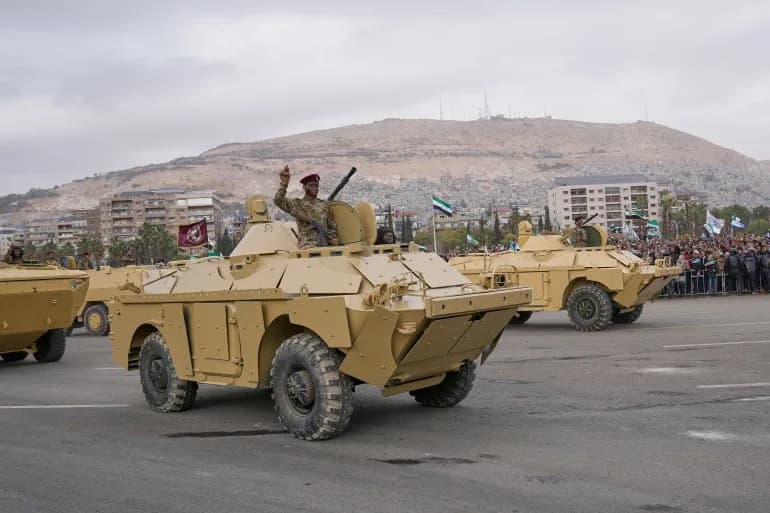
Syrian army soldiers stand on their armoured personnel carriers during a parade [Hussein Malla/AP Photo]
One year after the collapse of Bashar al-Assad's regime, Syria faces a complex and fragile task: rebuilding national armed forces and internal security institutions from a fragmented landscape of militias, depleted equipment, and deep societal mistrust. The interim government has launched rapid recruitment and restructuring efforts aimed at creating forces loyal to the state rather than to individual factions, but analysts warn the road ahead is long and uncertain.
Background: Collapse and Immediate Damage
The fall of al-Assad on December 8, 2024, precipitated the disintegration of the previous security apparatus. Many personnel fled, hid, or surrendered their arms; Israel carried out extensive air strikes in the immediate aftermath. On December 10 the Israeli military said it had destroyed roughly 80 percent of Syria's strategic military capabilities, and officials report more than 600 strikes across the country during the subsequent year. Those attacks, together with the new administration's purge of many regime-era officers, left Syria's conventional capabilities severely degraded.
Government Response and Recruitment Drive
The interim government, led by President Ahmed al-Sharaa, formally dissolved the former army and began integrating multiple anti-Assad factions into a unified security architecture. Defence Minister Murhaf Abu Qasra has described the effort as a nationwide restructuring to produce an army "that represents Syria and is able to face the challenges." Ministries of Defence and Interior now oversee armed forces and internal security respectively, while recruitment has been opened widely to replenish ranks.
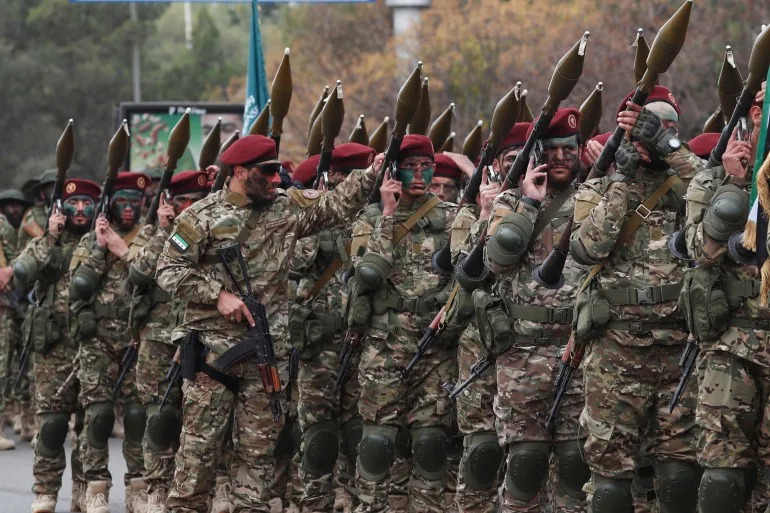
Fighters from the new Syrian army march with rocket-propelled grenade launchers during a parade [Omar Sanadiki/AP Photo]
Rapid Recruitment: Necessity and Risk
Officials recruited tens of thousands of new personnel quickly to fill capability gaps. Analysts say the urgency created two central problems: rushed or incomplete vetting, and an inflow of young recruits motivated as much by scarce economic opportunities as by civic commitment. Samy Akil of the Tahrir Institute called it a delicate balance: rapid expansion was necessary, but longer-term selection and quality control will be essential.
Key Structural Challenges
- Vetting and Integration: Converting disparate militias into professional units requires rigorous vetting, common doctrine, and command cohesion. Estimates suggest only about 3,000 regime-era soldiers have been readmitted after vetting, leaving a shortfall of experienced mid- and senior-level officers.
- Doctrine and Equipment: Large parts of Syria's remaining hardware and training are built around Russian doctrine and systems. That creates logistical dependence on Russian spare parts and training models and complicates relations with other international partners.
- Foreign Fighters and Political Constraints: Western governments have warned that foreign fighters should not hold senior positions. President al-Sharaa has reiterated that foreign combatants will not assume key roles, but managing their status remains sensitive.
- Potential Pro-Regime Forces: Media reports have linked figures from the old elite—including Rami Makhlouf and former intelligence leaders—to efforts to organize or fund pro-regime militias along the coast. Such developments, if confirmed, risk renewed armed opposition to the interim government.
- SDF Integration and Minority Trust: An agreement signed on March 10 aims to integrate Kurdish-led Syrian Democratic Forces into the Syrian Army by the end of 2025, but tensions and occasional clashes persist. Minority communities—especially in coastal and southern regions—remain wary because of past abuses attributed to security forces.
International Support and Strategic Constraints
Several external actors are already providing assistance. The United States has shared intelligence and helped bolster surveillance and reconnaissance capabilities, especially in the context of countering ISIS remnants. Turkey signed a bilateral defence agreement and reportedly began training 49 Syrian cadets in its academies. These partnerships can help rebuild capacity, but they also create competing influences and political dependencies.
Caroline Rose, New Lines Institute: If Syria fails to integrate armed groups into a unified army, it risks fragmentation and renewed violence.
Outlook
Syria's success in reconstituting a national army will hinge on several linked factors: thorough and credible vetting; reconstruction of command, logistics, and training structures; reconciliation and confidence-building with minority communities; and managing foreign influence over doctrine and equipment. Failure to resolve these issues could leave the country vulnerable to fragmentation, local flashpoints, and a possible return to widespread conflict.
Numbers to Note: reports cite roughly 40,000 fighters from Hay'at Tahrir al-Sham and allied groups; about 3,000 vetted regime soldiers readmitted; media and analysts have referenced larger figures for potential pro-regime mobilizations, but such claims remain contested and should be treated as reported rather than confirmed.
Help us improve.