
Gaza City — As Gaza enters the third year since the outbreak of widespread fighting, residents describe two years of displacement, renewed bombardment after a brief 2025 ceasefire, and a tightening blockade that has turned scarcity into starvation. Supermarket shelves have emptied, families ration staples and cook over open fires, and even short periods of abundance provoke anxiety. The psychological cost is profound: prolonged survival has eroded mental and emotional strength, leaving ordinary joys out of reach.
A New Year in Gaza: Can Life Ever Return After Two Years of War?

Maram Humaid’s son Iyas has lived most of his life in war [Maram Humaid/Al Jazeera]
Gaza City — For more than two years we have lost track of seasons, days and the steady passage of time. The life we once knew has been erased by relentless violence, displacement and scarcity. What remains are fragments of routine and a constant, exhausting fight for survival.
At the start of 2025 a fragile hope returned when many families went back to parts of northern Gaza during a January ceasefire. For a few weeks people tried to rebuild, to sweep rubble into piles, to return to damaged family homes and to reclaim the small rituals of daily life. Then, just six weeks later, the fighting returned — in mid-March the bombardment intensified and access to supplies and humanitarian aid was sharply restricted. Alongside bombs and destruction, starvation became an added weapon: supply routes were blocked, and food, fuel and medicine grew scarce.
And so the pattern resumed: bombardment, blood, hunger and a scramble for a single meal. Festivals and holidays passed with empty tables. Eid came and went without cookies, coffee or chocolates. People traded water sparingly and avoided receiving guests to hide their hunger.
A vendor displayed a tray of thin, home-made sweets — sugar, sesame and flour pressed into fragile sticks — and sold a single piece for 10 shekels (about $3). Sugar and flour were being counted by the gram like gold. I walked the streets with my children searching for any sign of celebration, surprised at myself for hoping that a holiday might change our reality. But in Gaza, a holiday is often just another day under the sky of bombs.
I turned back instead of visiting family in the north. It was not only that transport had become nearly impossible — I had waited more than an hour and a half without finding a car or even an animal-drawn cart — but joy itself felt dead. I returned home broken; I had money to buy new clothes but not a single cookie to give my children. I collapsed onto a couch and watched the world carry on while famine tightened its hold on us.
Daily Survival and the Erosion of Hope
Day-to-day life narrowed to inventorying staples: how much flour, rice and sugar remained. I cooked lentils over an open, smoke-filled fire and worried about the last of our yeast and where to find firewood. I craved a cup of coffee as if it were a dream, and scrolled through old photographs of abundant tables as if remembering another life.
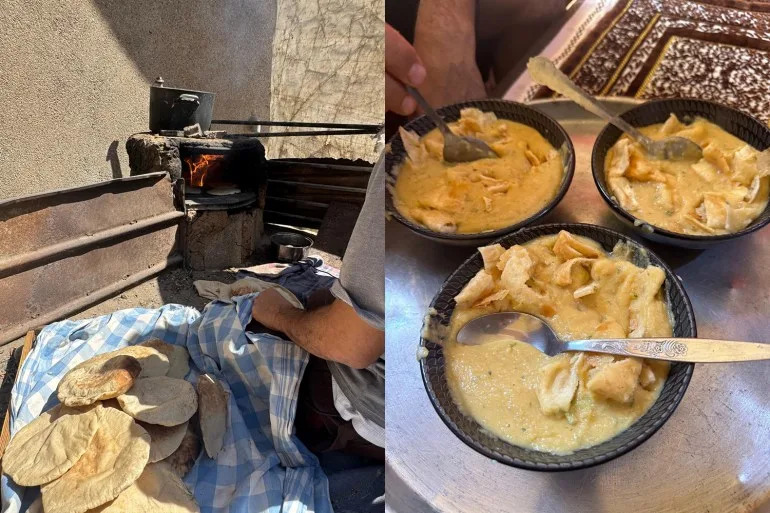
Hunger, the weapon we never expected in Gaza [Maram Humaid/Al Jazeera]
People fought and even died over a bag of flour or a single food parcel. At night, desperate crowds gathered at aid distribution points. All the while, the psychological cost mounted. I lost the energy to report, to write, even to listen: what was the point of telling another story of hunger and massacre when the world seemed to have grown numb?
Still, the longing to leave Gaza never left me — it only sharpened. I began to dream of taking my children somewhere food was not rationed, where they could choose what to eat. I decided to name these memories: “So We Do Not Forget.” How could I forget the moment in late September when supermarket shelves briefly filled? I entered on impulse and bought a little of everything — canned goods, chocolate, chips, cream cheese — feeling guilty and elated at once.
But abundance is quickly followed by fear. Every visit to a grocery store now fills me with anxiety: buy what you need and what you might need tomorrow. Years of deprivation condition the mind to expect empty shelves and severed supply lines. The trauma is not a hatred of food, but a terror around it.
“Every slammed door, every shaken rug, every passing truck or burst of gunfire throws us back into a state of emergency. We live waiting for the next missile.”
Endings, Laughs, and the Limits of Endurance
Near the end of the year we tried to mimic a social-media ritual: gather, light candles and announce achievements. We had no cake and only dim LED lights because electricity had been cut for months. When it was my turn I said, half-joking, that my greatest achievement was keeping my mental and psychological faculties. My relatives erupted in laughter.
“Who told you that you still have your mental and psychological faculties?” my sister said between laughs. We laughed together — partly out of relief, partly out of sorrow — because the truth is that prolonged survival at this level gnaws away at souls and minds. It is not defiance or heroism; it is exhaustion and erosion: day after day, our humanity is worn down until life itself feels like more than we can bear.
This is Gaza’s new year: not a blank page of renewal, but another chapter in a long season of loss. And yet we continue — because there is no other option but to keep moving forward, even as we carry the weight of what we will never forget.
Help us improve.


