
Months after a 12‑day Israel‑Iran confrontation, renewed protests in Iran and a forceful U.S. warning have raised regional tensions. Analysts say Washington still has a range of non‑military tools — from restoring internet access to disrupting surveillance systems — that could support protesters and influence Tehran. Human rights groups report several protest‑related deaths, dozens injured and over 100 arrests amid severe economic distress, while rights monitors allege a sharp rise in executions since June. The mix of internal unrest and external pressure heightens the risk of miscalculation and renewed violence.
Iran Crackdown Deepens Regional Risks — Analysts Say U.S. Has Non‑Military Options

The U.S. and Iran have traded threats, and Trump warns the U.S. may step in if Iran kills protesters.
Months after a 12‑day confrontation between Israel and Iran, the region is on edge as Iranian security forces have killed protesters, Israel considers additional strikes, and U.S. President Donald Trump has signaled the United States might intervene. The convergence of internal unrest and external pressure has increased fears that a fragile pause could give way to renewed confrontation.
U.S. Warnings and Non‑Military Options
President Trump intensified pressure on Tehran, warning on social media that "If Iran shoots and violently kills peaceful protesters … the United States of America will come to their rescue," and saying U.S. forces were "locked and loaded." While the rhetoric suggested a willingness to use force, analysts emphasize that Washington retains a range of measures short of direct military intervention.
"If Iran shoots and violently kills peaceful protesters … the United States of America will come to their rescue," — President Donald Trump (social media)
Former U.S. Ambassador to Israel Daniel Shapiro urged rapid steps to restore internet access for demonstrators and to prepare for possible political transitions. Richard Goldberg, a senior adviser at the Foundation for Defense of Democracies, highlighted non‑kinetic tools such as facilitating secure information flows to protesters and degrading the surveillance and targeting capabilities of Iran’s security forces.
Domestic Repression and Humanitarian Concerns
Human rights groups report between five and eight deaths linked to the recent unrest, more than 30 injured and over 100 arrests as demonstrations spread to dozens of cities. Rights monitors also say that since the June conflict there has been a sharp escalation in state repression, with some organizations alleging between 1,500 and 2,000 executions — many reportedly secret — though figures and attributions vary by source.
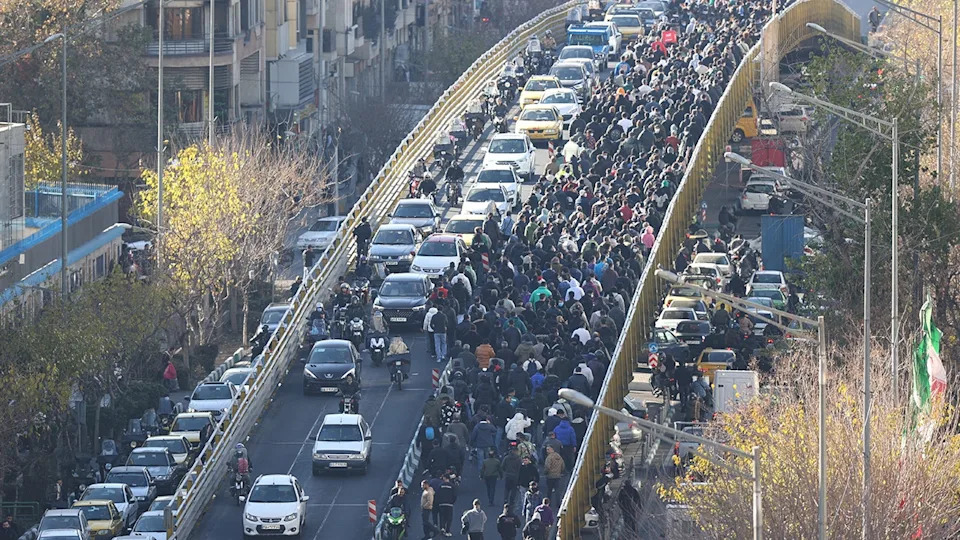
Protesters march in downtown Tehran, Iran, Dec. 29, 2025.
Iranian authorities acknowledge the economic grievances driving protests but have quickly framed the unrest as foreign‑instigated, a narrative amplified by hard‑line figures after international calls of concern. Officials such as Ali Larijani warned that foreign interference could destabilize the region, while parliamentary speaker Mohammad Bagher Ghalibaf declared that U.S. bases in the region would be legitimate targets if Tehran were attacked.
Economic Pressure and Military Balance
The protests are rooted in severe economic strain: the Iranian rial has plunged to record lows against the U.S. dollar, and inflation was reported at 42.2% in December. International sanctions and long‑term mismanagement are compounding the hardship fueling public anger.
Although Iran’s defenses were significantly damaged during the June fighting — including harm to nuclear and missile infrastructure and losses of senior commanders and scientists — Tehran still retains the capacity to retaliate indirectly via missile launches or proxy groups. Israeli officials have warned that any Iranian effort to rebuild nuclear or ballistic missile capabilities would cross established red lines, and Prime Minister Benjamin Netanyahu reportedly discussed a new round of strikes with President Trump.
Risk Of Miscalculation
Analysts warn that the mix of internal unrest, international pressure and strong rhetoric raises the risk of miscalculation. U.S. defense officials have not announced major changes to force posture in the region, but American troops and assets remain on heightened alert following the June conflict. Observers say non‑kinetic measures — information access, targeted sanctions, diplomatic pressure and support for secure communications — could be powerful tools to influence outcomes without triggering a wider war.
Bottom line: The situation remains fluid. Tehran faces internal economic and political strain while regional actors weigh responses. Non‑military U.S. measures are being advanced as potentially effective alternatives to direct force, but escalatory rhetoric and contested narratives increase the danger that the current pause could unravel.
Help us improve.


