
Future Perfect reviewed its 2025 forecasts and recorded 19 correct calls, four incorrect calls, and two undecided outcomes — a .800 winning percentage. Major developments included aggressive tariff use by the Trump administration, deep personnel cuts at the Department of Education without formal abolition, and significant health-care cuts under the One Big Beautiful Bill Act that fell short of an ACA repeal. Global security risks rose: Iran’s enriched-uranium stock expanded substantially though no 90% enrichment or test was publicly observed; the war in Ukraine remained active and unresolved; and H5N1 intensified as an animal panzootic while stopping short of a human pandemic. The review highlights forecasting successes and where analysts underestimated political resilience and the speed or scale of certain trends.
Which 2025 Forecasts Came True — And Which Missed The Mark

It’s the familiar year-end ritual: each January 1 the Future Perfect team published a slate of forecasts for the coming 12 months, and on December 31 we review how those bets fared. In 2025 our predictions produced 19 correct calls, four incorrect calls, and two undecided — a .800 record if ties count as half a win. The exercise is less about keeping score than learning where our reasoning succeeded, where it failed, and how to sharpen our forecasting for next year.
How We Scored The Predictions
Each forecast was posed as a positive claim and assigned a probability to reflect our confidence. We marked a forecast a “correct call” when a prediction with probability >50% came to pass, or when a prediction with probability <50% did not occur. The inverse outcomes were recorded as “incorrect calls.” If an outcome could not be resolved because of missing or delayed data, we marked it “undecided.”
Highlights And Takeaways
Tariffs And Executive Action
Most tariff news in 2025 came from presidential action rather than Congress. The Trump administration used executive authority to impose sweeping new duties on many imports, and the resulting legal fights reached the Supreme Court. That outcome followed our prediction that Trump would act unilaterally on tariffs — a forecast that proved essentially correct.

Department Of Education: Gutting, Not Abolition
Our fine-print definition mattered here. Congress did not abolish the Department of Education, so the forecast did not qualify as “true” if defined that way. Instead, the administration issued an executive order instructing the secretary to "take all necessary steps to facilitate the closure" of the department where permitted by law, followed by sweeping staff cuts. Courts adjudicated many of these moves, and the solicitor general explicitly noted that only Congress can legally dissolve the agency.

Health Care And The One Big Beautiful Bill Act
The One Big Beautiful Bill Act delivered roughly $1.1 trillion in health-care savings over a decade, with most cuts to Medicaid and about $226 billion affecting ACA exchange coverage (including new immigrant ineligibilities). But it fell short of the multi-pronged legal changes we had defined as a true repeal of the Affordable Care Act: employer mandates, subsidies into HSAs, and protections for preexisting conditions remain largely intact. By our criteria, the ACA was not repealed in 2025.

Federal Reserve And Jerome Powell
President Trump repeatedly threatened to remove Fed Chair Jerome Powell and even attempted to oust another governor — a move the Supreme Court later blocked. Despite public threats and theater, Powell remained chair through 2025; his term as chair runs until May 2026, and he may remain a governor on the board through January 2028.
Public Opinion And The Trump Presidency
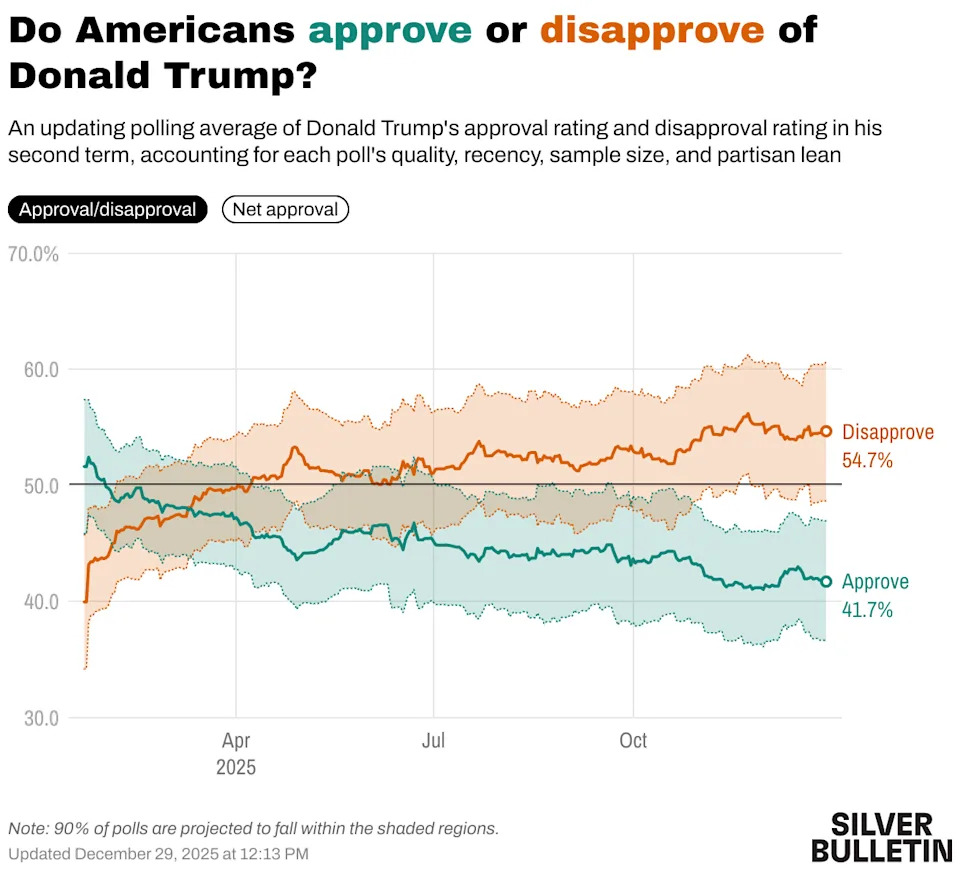
Polling aggregates showed Trump falling into net disapproval by a sizable margin by year’s end. While mid- to low approval is not unprecedented for modern presidents, the pace of the decline accelerated during 2025 amid controversies that captured national attention.

Musk And Trump: Strained Rapport
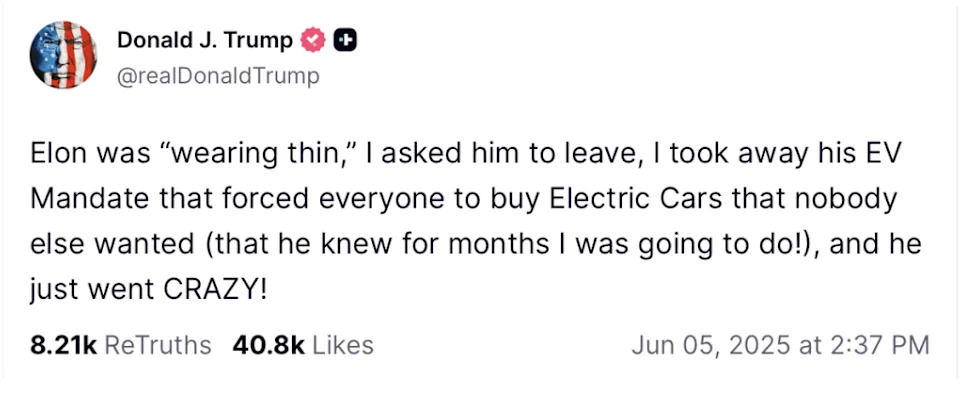
We defined “friendship” narrowly: three or more public, unambiguous disparaging incidents. The Musk–Trump relationship suffered a public rupture in 2025, largely over the One Big Beautiful Bill Act and dashed policy expectations. Although some reconciliation occurred later, the pair’s rapport was materially weaker by December.

Global Security: Iran, Ukraine, And More
Iran’s enriched-uranium stock grew alarmingly in 2025: IAEA estimates for 60%-enriched material rose from roughly 275 kg in early 2025 to about 441 kg by midyear — an amount that, if further enriched, could be enough for multiple simple fission devices. However, Iran was not publicly observed enriching to 90% or testing a nuclear device, and inspections were constrained.

The war in Ukraine did not yield the durable ceasefire some of us expected. By the end of 2025 the conflict remained Europe’s largest since World War II, with massive casualties and Russia occupying roughly one-fifth of Ukrainian territory. Diplomacy continued, but core disputes over territory and legitimacy blocked any comprehensive settlement.

H5N1 And Zoonotic Risk
H5N1 did not convert into a human pandemic in 2025, but the virus became more deeply entrenched in birds, farmed mammals and U.S. dairy cattle. The U.S. recorded its first H5N1 human death early in the year and roughly 70 human infections since April 2024, mostly among those exposed to infected animals. Vaccine development advanced, including late-stage funding for mRNA candidates, but the animal panzootic heightened ongoing risk.
Technology, Markets, And Energy
There were no credible AGI claims in 2025. Electric vehicles made up about 10.5% of new U.S. car sales in Q3 2025 — a number likely boosted by buyers rushing to claim a $7,500 federal tax credit before it lapsed at the end of September. With that credit gone and regulatory headwinds for chargers and efficiency standards, U.S. EV adoption faces new challenges.
Bitcoin traded wildly all year: it briefly reached a new record above $125,000 in October but retreated markedly by December 29, finishing well below its level at the presidential inauguration.
Food, Agriculture, And Regulation
Bird-flu losses were severe: nearly 54 million birds culled by mid-December, producing egg shortages and price spikes. The U.S. Department of Agriculture resisted broad vaccination of flocks over trade concerns. Antibiotic sales for livestock increased far more than anticipated in 2024 (a 15.8% jump), raising public health concerns about antimicrobial resistance.
On alternative-protein regulation, several states moved to block lab-grown (cell-cultivated) meat: Mississippi, Montana, and Nebraska passed indefinite bans, while Texas and Indiana adopted two-year moratoria. These measures are politically consequential but have limited immediate market impact because large-scale products are not yet widely available.
Other Notes: Sports, Psychedelics, And Culture
Sports betting scandals continued to surface: Cleveland Guardians closer Emmanuel Clase was placed on nondisciplinary paid leave after an arrest tied to alleged pitch-rigging for prop bets; Chauncey Billups faced separate betting allegations. Psychedelic therapies did not receive FDA approval in 2025, and the agency did not use emergency authorizations to reschedule MDMA or psilocybin. The release of updated U.S. dietary guidelines was delayed into January amid political and scientific complexity.
What We Learned
Overall, the review shows both solid forecasting and notable misjudgments. We successfully anticipated strong executive action on trade and several major political dynamics, but we underestimated the persistence of conflict (Ukraine), the speed of certain technical developments (Iran’s enrichment), and the magnitude of some trends (antibiotics use in livestock). We’ll carry these lessons into our 2026 forecasts.


