
Flight-tracking app Flighty analyzed about 22 million flights (roughly 78 million hours) to compile the most delayed airlines of 2025. Frontier topped U.S. carriers with 28% of flights delayed, while JetBlue and Southwest tied at 25%. Internationally, Ryanair, easyJet and Air France each recorded 29% delay rates. The global average delay was 23 minutes, and delays cost roughly 3.9 million hours worldwide.
This Was 2025’s Most Delayed Airline — Surprising Winners, Losers and What Caused the Chaos

GettyStock photo of people sitting in an airport
The year 2025 brought more than a few headaches for air travelers. Flight-tracking app Flighty analyzed roughly 22 million flights (about 78 million hours of air travel) to identify which carriers experienced the most delays and why.
Key Findings
Delay Definition: Flighty counted a flight as delayed if it arrived 15 minutes or more after its scheduled ETA.
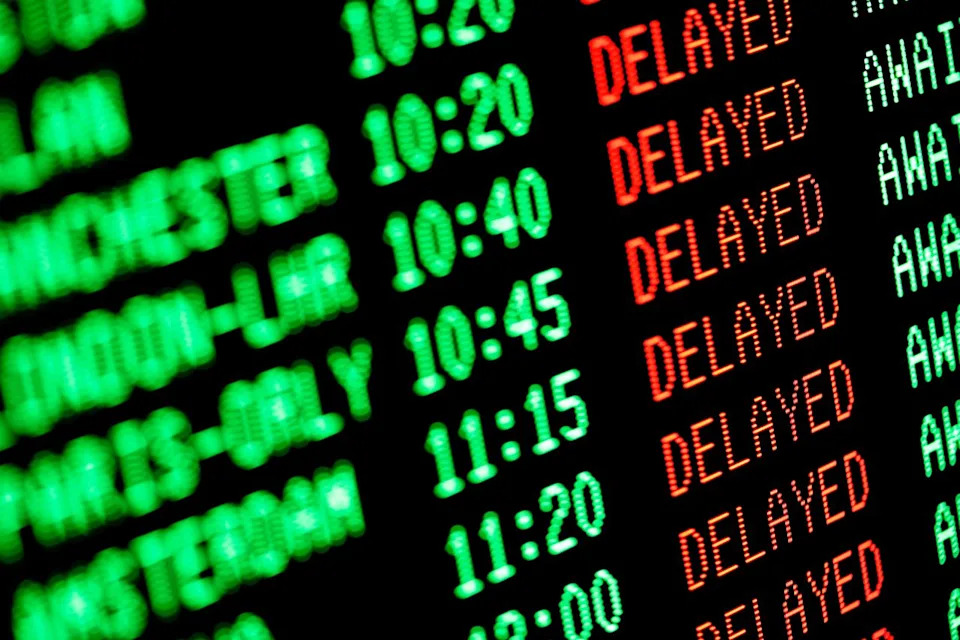
Gettystock photo of a delayed departures board
- Top U.S. Carrier: Frontier led domestic airlines, with 28% of flights delayed.
- Close Behind: JetBlue and Southwest tied, each with 25% of flights delayed.
- Other U.S. Results: American reported 24% and Alaska 23% delayed flights.
- International Leaders: Ryanair, easyJet and Air France each had 29% of flights delayed, the highest rates in Flighty’s dataset.
Global Impact
Across all carriers and regions, the average delay was 23 minutes. Collectively, delays added up to about 3.9 million hours lost worldwide in 2025. Of that total, passengers spent roughly 1.4 million hours simply waiting for departures — equivalent to approximately 164 years of waiting time.
Common Causes
Flighty identified several recurring causes of delays: gates not being ready, taxiway congestion, holding patterns, runway queues, crew or equipment issues, and weather restrictions. In the U.S., operational disruptions such as the recent government shutdown also worsened delays by increasing wait times at Transportation Security Administration (TSA) checkpoints.
Gettystock photo of an airplane departing an airport
Stressful Airports
Delays aren’t the only travel frustration this year. Australian research firm iSelect named Newark Liberty International Airport (EWR) the most stressful airport globally, citing factors like access, delays, cancellations, security wait times and baggage handling. EWR’s average departure delay was reported at 21.4 minutes, and its cancellation rate was 1.43%. Lisbon’s Humberto Delgado Airport and Manchester Airport followed on iSelect’s list; New York’s JFK and Chicago O’Hare (ORD) rounded out the top five most stressful airports.
What Travelers Should Know
While some causes (like weather) are unavoidable, many delays stem from operational bottlenecks that can ripple across networks. Travelers can reduce disruption risk by allowing longer connection times, signing up for airline notifications, and checking airport queues and security wait-time tools before heading to the airport.
Bottom line: 2025 saw meaningful disruption to schedules worldwide — some carriers fared worse than others, but the impact was felt by passengers and airlines alike.


