Many former U.S. Department of Education officials displaced by recent leadership changes and mass layoffs are moving into state education roles, bringing technical expertise in grants, data and pandemic recovery to local systems. Their arrivals are reshaping how states manage federal funding, interpret compliance rules and deliver services to students and families.
Superintendent Cindy Marten’s team at the Delaware Department of Education includes several former staff members at the U.S. Department of Education. (Delaware Department of Education)
Experienced Federal Staff Join State Teams
Cindy Marten, who spent four years as deputy secretary during the Biden administration, now leads Delaware's education agency. She says the past year has been chaotic for state leaders trying to interpret shifting federal guidance and court rulings: “The money’s coming. The money’s not coming.… We’re going through total D.C. chaos right now.” To steady the ship, Marten tapped Adam Schott—who oversaw distribution of roughly $122 billion in relief funds at the department—to serve as her associate secretary for student support. She calls him “phone-a-friend on speed dial.”
From Washington Back To The States
Schott is part of a broader wave of federal experts—policy designers, grant managers and data specialists—moving into state positions. Many were either displaced or chose to leave amid efforts to downsize the federal agency. State leaders say these hires inject practical knowledge that helps decode complex federal rules and accelerate program implementation.
“There’s just so much knowledge that’s now looking for a place to land,” said Kiara Nerenberg, a former National Center for Education Statistics data expert now working in Maryland.
Delaware also added Denise Carter, a longtime federal official who served as acting secretary and later as acting chief operating officer for Federal Student Aid. Maryland—because of its proximity to D.C.—has recruited multiple ex-department staff and even ran a hiring campaign aimed at displaced federal employees.
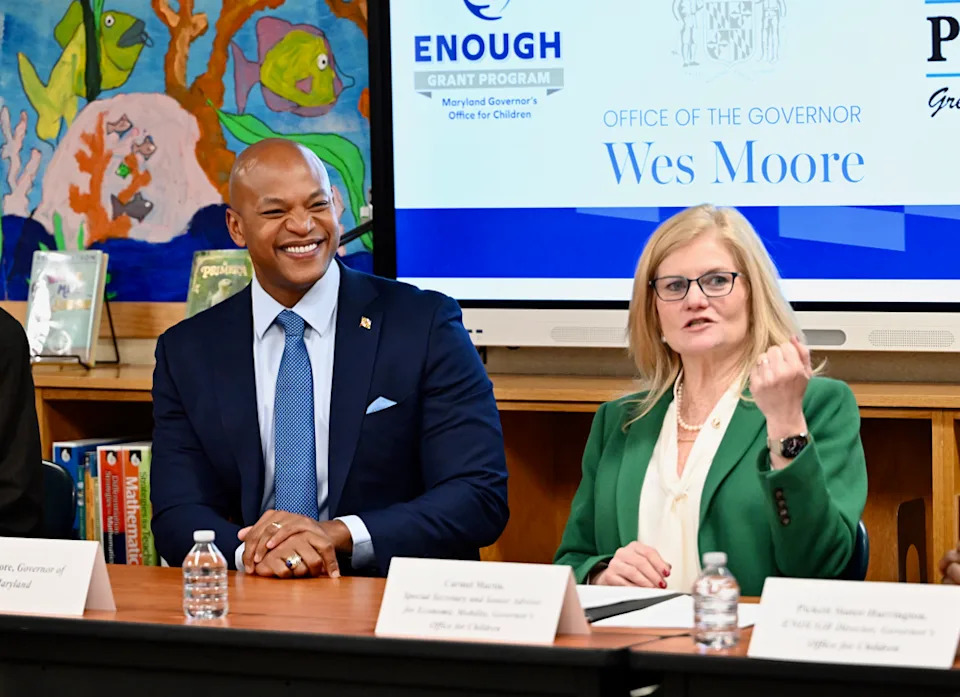
Maryland Gov. Wes Moore’s Office for Children, includes former Biden administration officials like Carmel Martin, right. She served as a domestic policy adviser to Vice President Kamala Harris and as an assistant secretary in the Education Department during the Obama administration. (Office of Gov. Wes Moore)
Local Impact And New Roles
Former NCES staffer Kiara Nerenberg now helps Maryland align career and technical education with labor-market needs, using her experience mapping school locations and neighborhood demographics. Tara Lawley, another laid-off NCES veteran, relocated to Illinois to lead policy, research and fiscal analysis for the Board of Higher Education after a major, family-moving transition.
Elizabeth Ross, now assistant superintendent of teaching and learning in the D.C. Office of the State Superintendent of Education, served at the Education Department during the Obama administration. (D.C. Office of the State Superintendent of Education)
Others have moved into broader child-focused work. Sarah Mehrotra, who administered pandemic recovery efforts at the department, joined Maryland Gov. Wes Moore’s Office for Children to lead targeted anti-poverty initiatives in high-need neighborhoods. She says federal experience is valuable for blending funding streams and supporting grantees.
Debate Over Federal Role
Some state leaders and conservative officials argue that reduced federal oversight gives states room to innovate. McKenzie Snow, Iowa’s education director and former aide to Betsy DeVos, supports rolling federal funds into state block grants. Critics counter that progress varies across states and that federal coordination remains important—especially when families move across state lines or when state leadership turns over.
Leadership churn is real: this year alone state chiefs changed in Florida, Massachusetts, Nevada, Oklahoma and Utah, and more than 30 states have replaced superintendents since early 2023. That instability can make federal expertise particularly valuable at the state level.
Why It Matters
Officials with federal backgrounds can act as a bridge between Washington and communities—translating policy into practice, troubleshooting complex grant rules and ensuring federal dollars reach the students who need them. As states absorb this wave of talent, the balance between local innovation and national coordination will shape how education recovery and improvement efforts unfold.