
GRB 250702B, detected by NASA's Fermi telescope on July 2, 2025, emitted gamma rays intermittently for more than seven hours — the longest burst on record. Follow‑up observations with Gemini, VLT, Keck and Hubble located the source in a dust‑shrouded galaxy about 8 billion light‑years away in Scutum, visible only in infrared and X‑rays. The burst produced a jet moving at ≥99% of light speed and does not match existing GRB models; proposed origins include a collapsing massive star, tidal disruption by a black hole, or a black hole–helium star merger.
Unprecedented Seven‑Hour Gamma‑Ray Burst Defies Existing Models — GRB 250702B

An artist's impression of GRB 250702B, a high-speed jet of material being launched from a very dusty galaxy. . | Credit: NOIRLab/NSF/AURA/M. Garlick
On July 2, 2025, NASA's Fermi Gamma-ray Space Telescope detected an extraordinary gamma-ray burst that persisted in intermittent emission for more than seven hours — far longer than any previously recorded event. Gamma-ray bursts (GRBs) are the most energetic explosions in the universe since the Big Bang and are typically brief, lasting seconds to minutes. GRB 250702B stands apart both for its unprecedented duration and for the observational challenges it posed.
Rapid Global Follow-Up
Fermi's alert triggered an international observing campaign. Ground- and space-based telescopes including the twin 8.1‑meter Gemini telescopes (Chile and Hawaii), the European Southern Observatory's Very Large Telescope (Chile), the Keck Observatory (Hawaii), and the Hubble Space Telescope were used to hunt the burst's afterglow across the electromagnetic spectrum.
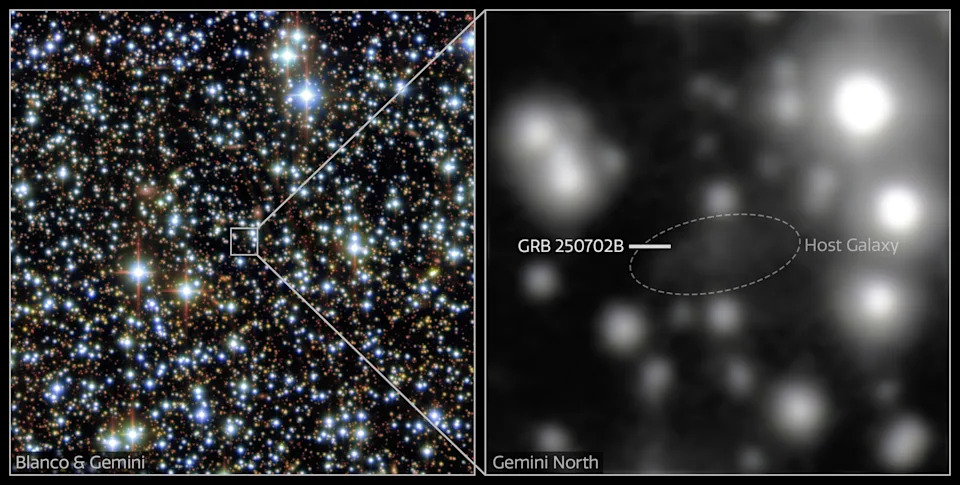
In October, the infrared James Webb Space Telescope zoomed in on GRB 250702B's host galaxy, offering the clearest view yet. | Credit: NASA, ESA, CSA, H. Sears (Rutgers). Image processing: A. Pagan (STScI)
Where It Came From
Analysis places GRB 250702B in a massive, dust‑enshrouded galaxy roughly 8 billion light‑years away in the direction of the constellation Scutum. Thick dust in the host galaxy effectively blocked visible‑light emission, so astronomers relied on infrared and high‑energy X‑ray observations to characterize the source.
What the Data Show
Researchers report that the burst launched a narrow jet of material pointed roughly toward our solar system and moving at least 99% of the speed of light. Because the event's duration exceeds expectations from standard GRB models, the team — led by Jonathan Carney, a doctoral student in physics and astronomy at the University of North Carolina at Chapel Hill — says GRB 250702B does not fit neatly into existing progenitor categories.
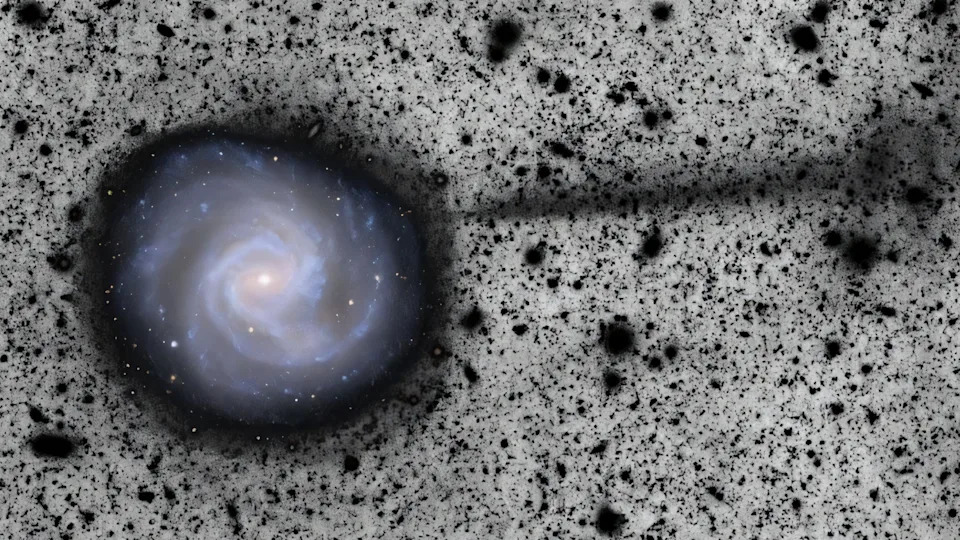
An image of a spiral galaxy on a splotchy black and white background with a stream of black material emerging from the galaxy
"This was the longest gamma‑ray burst that humans have observed — long enough that it does not fit into any of our existing models for what causes gamma‑ray bursts," said Jonathan Carney, lead author of the study published Nov. 26 in The Astrophysical Journal Letters.
Possible Origins
The authors outline several plausible explanations that remain consistent with the data: the core collapse of a very massive star, the tidal disruption of a star by a black hole, or a merger in which a black hole spirals into the core of a helium star and triggers an explosion from within. At present, no single scenario is conclusively favored.
Why This Matters
GRB 250702B will serve as a unique benchmark for future long‑duration or dust‑obscured GRBs. When similar events are discovered, astronomers will compare their properties against this record‑setting burst to determine whether they share a common mechanism or reveal new physics. The detection also underscores the importance of rapid multiwavelength follow‑up — especially infrared and X‑ray observations — when optical light is obscured by dust.
Key reference: Study published Nov. 26 in The Astrophysical Journal Letters. Lead author: Jonathan Carney (UNC Chapel Hill).


