
Professor Jonathan Allen has cared for a ribbon worm nicknamed "B" for about 20 years. Genetic analysis identified the specimen as Baseodiscus punnetti and established a conservative minimum age of 27 years, making B the oldest ribbon worm documented by science by more than 23 years. Because nemerteans lack hard parts for traditional ageing, this accidental long-term observation fills a major gap in understanding their lifespans and could change how researchers view their ecological roles as benthic predators.
A Pet Ribbon Worm Sets a Longevity Record — 27 Years and Counting

William & Mary Biology Professor Jon Allen holds the world’s oldest ribbon worm on record for a class of W&M students.
Jonathan Allen, a biology professor at The College of William & Mary, has cared for an unusual long-term companion for about two decades: a ribbon worm he calls Baseodiscus the Eldest, or simply "B." Ribbon worms (phylum Nemertea), also known as nemerteans, are famous for extreme lengths in some species, but B has become remarkable for a different reason — its age.

Willian & Mary students get an up-close look at Baseodiscus the Eldest during a biology laboratory.Image: Stephen Salpukas
Genetic ID and a Conservative Age Estimate
Genetic testing performed by collaborators at the University of California, Irvine and the Oregon Institute of Marine Biology identified B as Baseodiscus punnetti. Allen reports that B entered his care in 2005 as an animal already at least seven years old. Because Allen has maintained continuous care since then, the research team places a conservative minimum age of 27 years on the worm — a figure that exceeds prior longevity estimates for ribbon worms by roughly an order of magnitude.
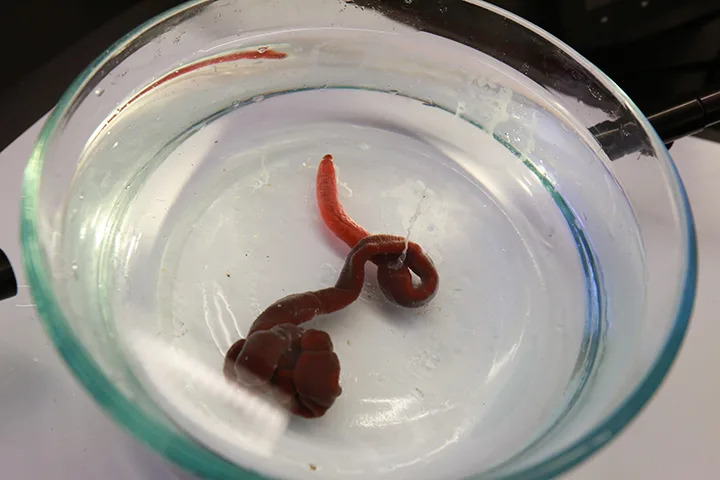
Willian & Mary students get an up-close look at Baseodiscus the Eldest during a biology laboratory.Image: Stephen Salpukas
Why This Discovery Matters
While some nemerteans are famous for extraordinary length (an 180-foot specimen reported from Scotland in 1864 is often cited), lifespan data for the group have been scarce. Determining age in ribbon worms is difficult because most species lack hard parts or growth rings that would allow standard ageing techniques. As Allen explains, "Some species do have a stylet (a calcified harpoon of sorts) but not our animal," making long-term observations like this one essential for understanding nemertean life history.
"They are gorgeous animals," Allen told Popular Science. "And they are ecologically very important predators in nearly all marine systems."
Ecological and Scientific Implications
The finding that at least some ribbon worms can live for decades may reshape how scientists view their role in benthic food webs. Nemerteans are important predators on the seafloor, and multi-decadal lifespans could alter models of population dynamics, predator-prey interactions, and ecosystem resilience. The case of B illustrates how patient stewardship combined with modern genetic tools can reveal surprising life-history traits in understudied marine groups.
What Remains Unknown: It is still unclear how common long lifespans are across nemertean species, and whether long-lived individuals like B are typical or exceptional. Broader sampling and continued observations will be needed to place this discovery in context.


