
Comet C/2025 A6 (Comet Lemmon) brightened dramatically after its October 2025 closest approach and was captured in November 2025 above Mauna Kea on Hawaii's Big Island. The comet reached roughly Uranus's apparent brightness and was visible to the naked eye from many locations. With an orbital period of about 1,350 years, Lemmon's appearance is a once-in-a-millennium event for modern observers.
Comet Lemmon Lights Up Mauna Kea as the Milky Way Glows Behind It — Space Photo of the Day, Dec. 12, 2025

Comet Lemmon can be seen as a faint streak of white on the right side of this image. . | Credit: International Gemini Observatory/NOIRLab/NSF/AURAImage processing: M. Rodriguez (International Gemini Observatory/NSF NOIRLab) & M. Zamani (NSF NOIRLab)
Comet C/2025 A6, commonly known as Comet Lemmon, provided a rare celestial show for observers in Hawaii when it brightened against the backdrop of the Milky Way. The striking image — captured in November 2025 from near the summit of Mauna Kea on Hawaii's Big Island — shows the comet's diffuse glow and faint tail framed by the band of our galaxy.
Discovered in January 2025, Lemmon made its closest approach to Earth in late October 2025. By November it had brightened to roughly the same apparent magnitude as the planet Uranus, making it visible to the unaided eye from many suburban locations as well as dark-sky sites.
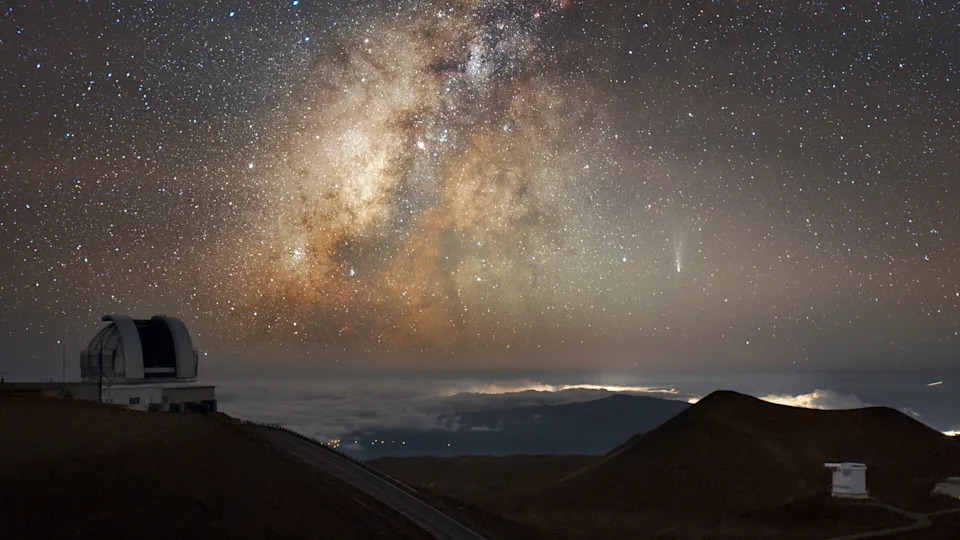
Comet Lemmon could be seen with the naked eye as it streaked across the sky. | Credit: International Gemini Observatory/NOIRLab/NSF/AURAImage processing: M. Rodriguez (International Gemini Observatory/NSF NOIRLab) & M. Zamani (NSF NOIRLab)
Comets can be unpredictable, so Lemmon's unexpected brightness was a welcome surprise for amateur and professional skywatchers alike. Photographers at high-altitude, low-light-pollution sites such as Mauna Kea have an advantage for capturing both faint celestial objects and the Milky Way, producing images that highlight the comet against our galaxy's glow.
Astronomers estimate Comet Lemmon's orbital period at about 1,350 years, which places its next return near the year 3375. That makes this appearance effectively a once-in-a-millennium event for human observers today.
Why Mauna Kea? The summit's elevation and relatively dark skies reduce atmospheric disturbance and light pollution, improving visibility of faint objects like comets and the Milky Way. The photograph above serves as a lasting souvenir of a transient visitor that will not return for many generations.


