
Hubble’s latest image of NGC 4535 — the so-called “Lost Galaxy” in Virgo — reveals bright blue star clusters and pink–red H II regions that mark active star formation. Located about 50 million light-years away, the galaxy’s spiral arms are resolved into numerous star-forming knots. This image supports NASA’s PHANGS effort to catalog roughly 50,000 H II regions, helping astronomers map where stars form and how newborn stars affect surrounding gas.
Hubble Reveals the ‘Lost Galaxy’ NGC 4535: A Star-Forming Spiral in Virgo

Spiral galaxy NGC 4535 is populated with young star clusters. . | Credit: ESA/Hubble & NASA, F. Belfiore, J. Lee and the PHANGS-HST Team
The Hubble Space Telescope has captured a striking new view of a faint spiral galaxy nicknamed the “Lost Galaxy”. Officially cataloged as NGC 4535, this galaxy lies in the constellation Virgo and appears much richer in structure and star-forming activity in Hubble’s high-resolution image than in amateur telescopes.
Bright blue star clusters pepper the galaxy’s spiral arms — compact groups of young, hot stars that stand out against the galactic disk. Surrounding many of these clusters are soft pink–red glows from ionized hydrogen gas, known as H II regions. These glowing pockets act like neon signs of recent star birth: massive newborn stars emit intense ultraviolet radiation and strong stellar winds that energize and ionize the surrounding gas, causing it to shine.
NGC 4535 sits roughly 50 million light-years from Earth in the Virgo constellation. What once looked like a faint smudge through ground-based telescopes now resolves into detailed spiral structure and dozens of distinct star-forming knots in Hubble’s view, giving astronomers a clearer picture of where stars are forming within the galaxy.
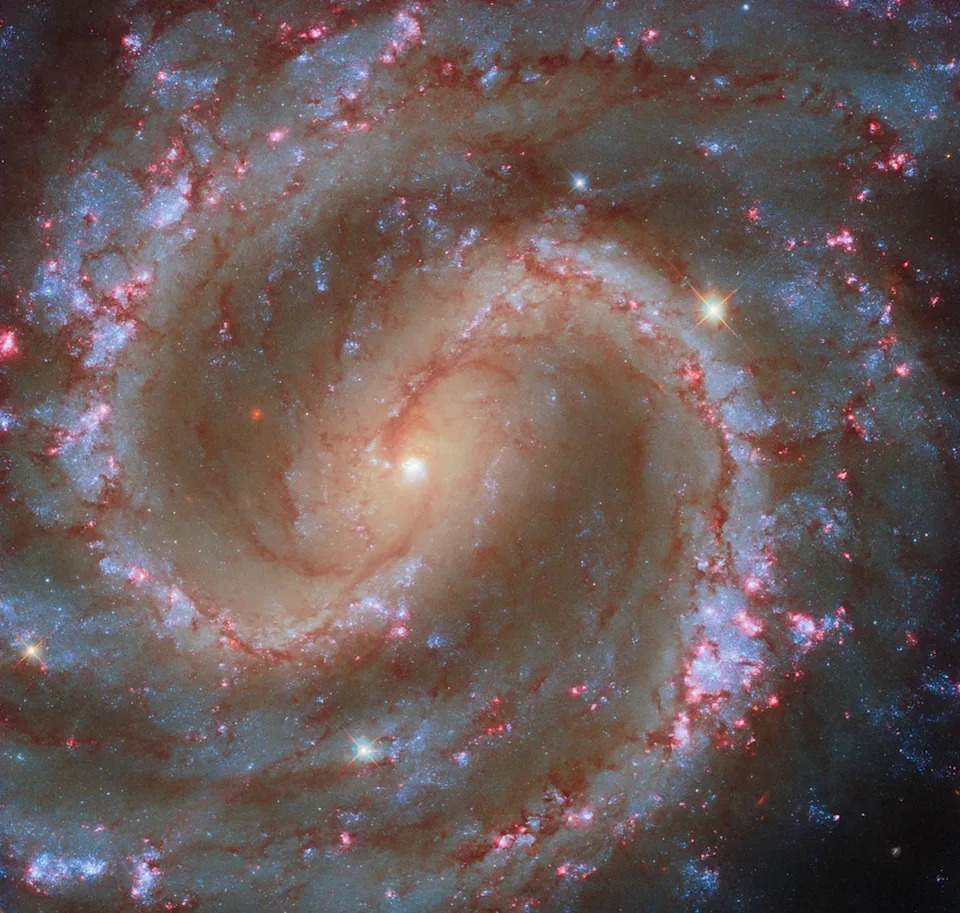
The "Lost Galaxy" is full of H II regions. | Credit: ESA/Hubble & NASA, F. Belfiore, J. Lee and the PHANGS-HST Team
Why This Image Matters
This observation contributes to a larger astronomical effort to catalog about 50,000 H II regions across nearby star-forming galaxies. By systematically mapping these glowing regions in systems like NGC 4535, researchers working with NASA’s PHANGS program can better understand:
- Where and how stars form within galactic disks
- How long star-forming regions persist and evolve
- How stellar feedback from newborn stars (radiation, winds, and supernovae) influences the cold gas reservoir
Rather than remaining “lost,” NGC 4535 is emerging as a laboratory for studying galactic star formation and feedback — key processes that determine how galaxies build their stellar populations over time.
Learn more: Explore Hubble’s work and PHANGS research to see how modern telescopes reveal the life cycle of stars and the structure of nearby galaxies.


