
NASA astronaut Jonny Kim and Roscosmos cosmonauts Sergey Ryzhikov and Alexey Zubritsky returned to Earth near Zhezkazgan, Kazakhstan, on December 9 after 245 days aboard the ISS. On his first ISS mission (Expeditions 72/73), Kim served as flight engineer and flight surgeon and completed 3,920 orbits — nearly 104 million miles. The crew is undergoing routine post-mission medical checks; Kim highlighted that the people aboard were the mission’s most important element.
Jonny Kim Returns to Earth After 245 Days and 3,920 Orbits of the ISS
Dec 11

Three ISS astronauts returned aboard a Soyuz spacecraft on December 8 in Kazakhstan.
After 245 days aboard the International Space Station (ISS), NASA astronaut Jonny Kim and Roscosmos cosmonauts Sergey Ryzhikov and Alexey Zubritsky landed safely near Zhezkazgan, Kazakhstan, on December 9. The crew is now undergoing standard post-mission medical checks following their long-duration stay in orbit.
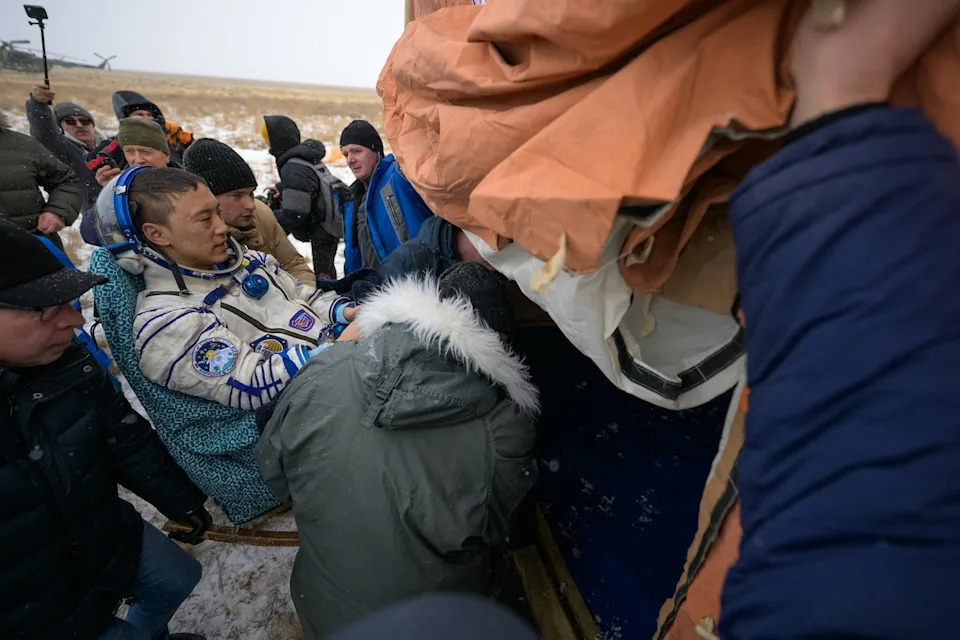
NASA astronaut Jonny Kim is carried to a medical tent shortly after he, and Roscosmos cosmonauts Sergey Ryzhikov, and Alexey Zubritsky, landed in their Soyuz MS-27 spacecraft near the town of Zhezkazgan, Kazakhstan on Tuesday, Dec. 9, 2025. The trio returned to Earth after logging 245 days in space as a members of Expeditions 72 and 73 aboard the International Space Station. Credit: NASA / Bill Ingalls(NASA/Bill Ingalls)
Mission Highlights
Kim — who joined NASA’s astronaut corps in 2017 — made his first trip to the ISS as part of Expeditions 72 and 73. During the eight-month mission he served as a flight engineer and the mission’s flight surgeon, contributing to a wide range of scientific and technology investigations.
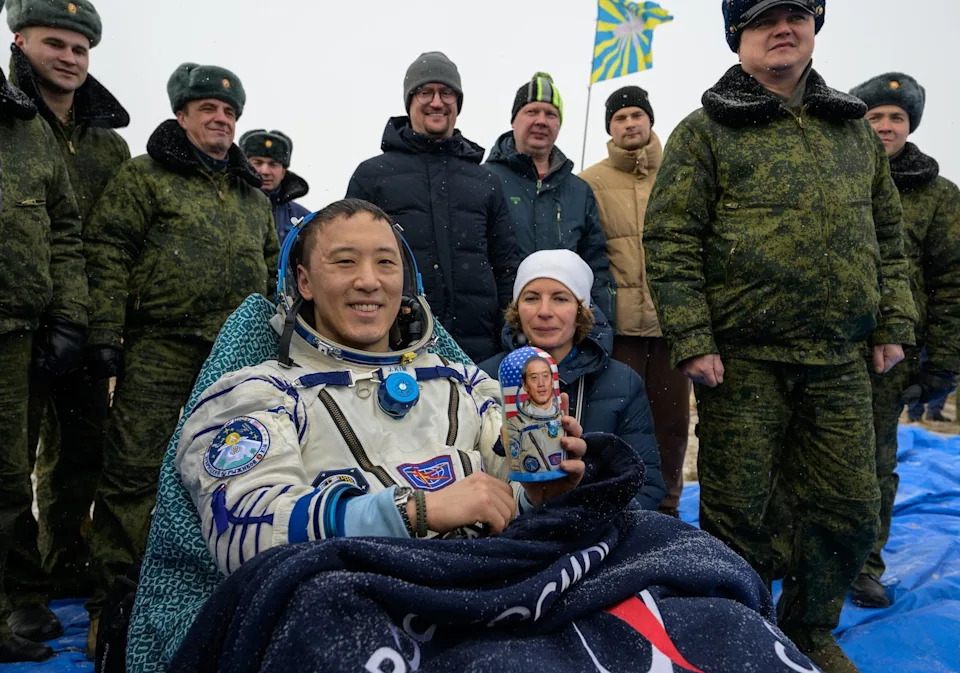
NASA astronaut Jonny Kim is seen outside the Soyuz MS-27 spacecraft, with a gifted Matryoshka Doll, after he landed with Roscosmos cosmonauts Sergey Ryzhikov, and Alexey Zubritsky in a remote area near the town of Zhezkazgan, Kazakhstan on Tuesday, Dec. 9, 2025. The trio returned to Earth after logging 245 days in space as a members of Expeditions 72 and 73 aboard the International Space Station. Photo Credit: NASA / Bill Ingalls(NASA/Bill Ingalls)
By the time the crew undocked on December 8, Kim had completed 3,920 orbits of Earth, traveling nearly 104 million miles. The mission combined long-duration research activities with routine station operations and international crew coordination.
Training and Background
Kim’s preparation included two years of intensive astronaut candidate training covering ISS systems and procedures, flight instruction, wilderness survival training, and coursework in robotics, field geology and the Russian language. Before joining NASA, Kim flew in more than 100 combat operations as a Navy SEAL and earned a Doctor of Medicine degree from Harvard Medical School.
Shortly before departing the station, Kim reflected in a social-media video: “When I think about what was most important during the mission, I don’t think about the science. It kind of goes back to that old saying, ‘It’s the people you’re with that’s really important.’”
The crew’s safe return marks the successful completion of the expedition’s science goals and routine station operations. Post-flight health screenings and debriefings will help researchers understand how long-duration missions affect crew health and performance.


