The September jobs report added only 29,000 positions, while wage growth continues to lag behind inflation, squeezing household budgets. Polls show weak approval for the president's handling of the economy and cost of living, with just 17% support on that issue. Manufacturing employment has fallen since he first took office, while healthcare and social assistance have accounted for nearly all net job growth since January 2025. Rising fuel costs have compounded pressures on rural households and commuters.
The Unmanly Truth: Trump's Jobs Record Falls Short — 29,000 New Jobs, Manufacturing Decline
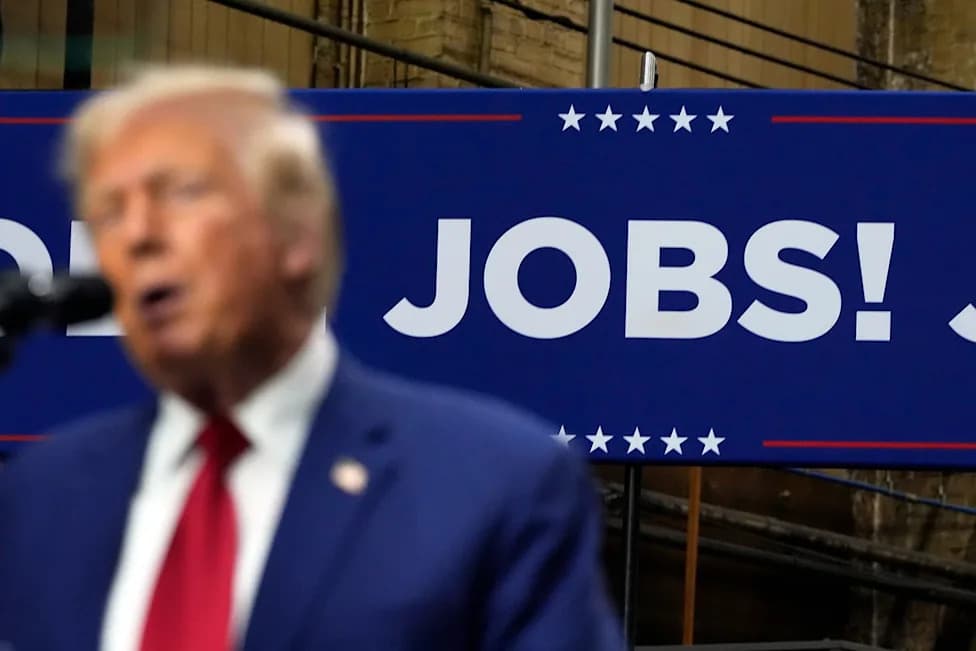
Republican presidential nominee former President Donald Trump speaks at a campaign event at Precision Components Group, Monday, Aug. 19, 2024, in York, Pa. (AP Photo/Julia Nikhinson)
The latest Bureau of Labor Statistics report delivered a disappointing headline: just 29,000 jobs added in September. While mass layoffs are not the central story, this is a weak labor report for job seekers — especially recent graduates — and wage growth continues to trail inflation, eroding household purchasing power.
Polling And Public Perception
Public sentiment mirrors the economic weakness. The president's average approval on the economy sits in the low 30s, and approval for handling the cost of living is alarmingly low — just 17% in recent AP/NORC and Reuters/Ipsos surveys. Notably, a majority of respondents in those polls who identify as Republican also said they disapprove of his handling of the cost-of-living issue.
Promises Of Manufacturing Revival Versus Reality
One of the central themes of the president's message has been a return to a manufacturing-led economy — a promise that many working-class and rural voters embraced. That revival, however, has not materialized: manufacturing employment is lower now than when he first took office. Jobs exist in many rural and Rust Belt communities, but they are often low-paid, lack benefits and are typically nonunion positions.
Energy Costs Hit Rural Households Hard
Rural voters have been disproportionately affected by energy-price shocks. Many live farther from work and drive larger vehicles: the ten states with the highest pickup-ownership rates are strongly Republican. A common example, the Ford F-150, averages about 20 mpg (some configurations as low as 12 mpg). At current prices, filling a 36-gallon tank can top $150, a real burden for commuters hoping to reach higher-paying manufacturing work that largely hasn't returned.
Where Job Growth Actually Occurred
There is one area of robust hiring, but it doesn't match the industrial image promoted on the campaign trail. Economist Justin Wolfers highlights that since the president returned to the White House, healthcare and social assistance have accounted for more than 100% of net job growth. Those sectors have added just under one million jobs since January 2025, while the rest of the economy has lost more than 220,000 positions.
Much of the rise in healthcare employment predates the current administration: compared with a decade ago, about three million more Americans work in healthcare. Many workers — including former coal miners and other displaced industrial workers — have retrained for nursing and other care roles, which are demanding, often well-paid, and difficult to automate.
Implications For Supporters And Young Men
The gap between promise and outcome has real political and social consequences. Many supporters who expected a return to secure, well-paid manufacturing jobs feel let down. For young men in particular, the cultural message about masculinity clashes with economic reality: most say providing for a family is central to manhood, yet stable jobs with good pay and benefits are increasingly found in caregiving and service roles rather than heavy industry.
Conclusion
The September jobs report and broader employment trends show that the postindustrial economy is reshaping opportunities. The administration’s pledge of an immediate manufacturing-led revival has not been realized, while healthcare and social assistance have become the primary engines of job creation. For voters hoping for a return to past blue-collar stability, the result is disappointment and mounting financial strain.
Help us improve.