A PNAS Nexus reanalysis finds Nazi Germany’s April 1945 B8 reactor assembly fell well short of criticality, with a modeled k-effective ≈ 0.94. The reconstruction used surviving uranium cubes, a 1947 heavy-water assay, and archived impurity data. A critical B8 would have required roughly 3,000–4,100 kg of uranium and 3,300–3,800 kg of heavy water—far more than Germany actually had—making heavy water shortages the decisive constraint.
New Analysis Finds Nazi Germany’s B8 Reactor Fell Far Short of Criticality
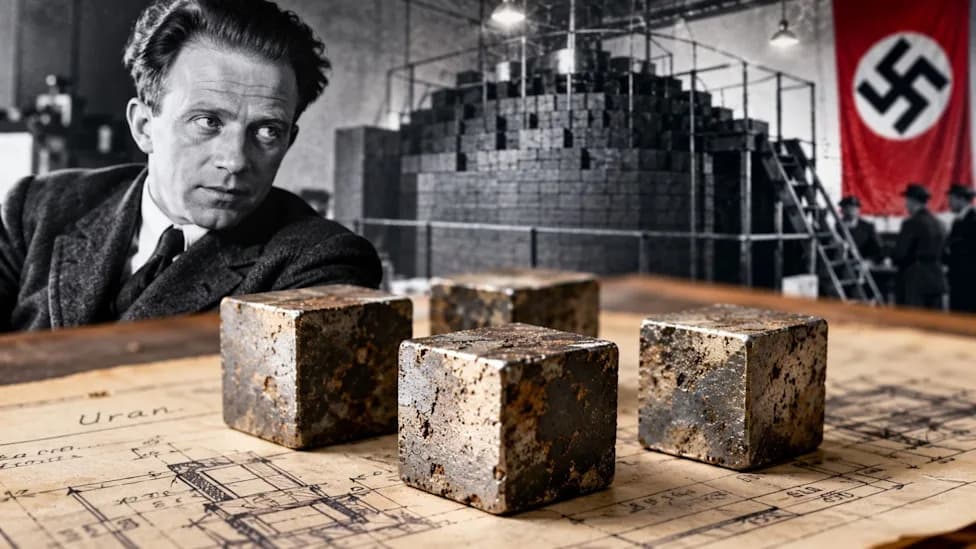
Image credit: Josh Kirschner/Techlicious via ChatGPT
A recent reconstruction using modern simulation tools shows that Nazi Germany’s final wartime reactor experiment, known as B8, would have needed far more material than was available to reach a self-sustaining nuclear chain reaction. The paper, published in PNAS Nexus and led by researchers at institutions including the University of Maryland and Pacific Northwest National Laboratory, revisits wartime measurements and archival material to settle a long-standing question about how close Germany came to building a working reactor.
What B8 Was
Assembled in April 1945 in Haigerloch after Allied bombing forced Heisenberg’s team to move from Berlin, B8 consisted of 664 natural-uranium cubes (each about 5 cm on a side) suspended in chains inside a tank holding roughly 1,400 liters of heavy water. The heavy-water tank was surrounded by layers of graphite and ordinary water. Heavy water moderates (slows) neutrons and makes fission more likely in natural uranium.
Reconstruction And Results
The team rebuilt B8 in a contemporary, validated nuclear simulation code using measured properties of two surviving wartime uranium cubes (one slightly porous and slightly less dense than pure uranium metal, the other confirmed natural uranium), a 1947 chemical assay showing the B8 heavy water was about 96.8% pure, and archived wartime graphite impurity analyses. The model reproduced Heisenberg’s original neutron measurements and yielded a k-effective of about 0.94—meaning each generation of neutrons produced roughly 6% fewer neutrons than the previous generation and the chain reaction would fizzle out. Even assuming perfectly pure heavy water increased k only to about 0.95.
Material Requirements Versus Availability
Bridging the gap to criticality would have required substantially more material than Heisenberg’s postwar claim of a modest shortfall implied. Depending on the reactor geometry, a critical version of B8 would have required roughly 3,000–4,100 kg of uranium and about 3,300–3,800 kg of heavy water. By contrast, B8 contained about 1,538 kg of uranium and 1,549 kg of heavy water. Germany’s total wartime inventory is estimated at about 2,572 kg of uranium and, at most, 1,836 kg of heavy water available by 1945. Even pooling all of these stocks would have brought the modeled B8 only to roughly k = 0.96.
Why Heavy Water Was Decisive
Heavy water scarcity was the main bottleneck. The only significant European source was Norsk Hydro’s Vemork plant in Norway, which produced approximately 2,840 kg of heavy water during the war but was disrupted and ultimately disabled by Allied operations. Accounting for seizures and losses (about 185 kg seized by France, 140 kg lost in a 1942 accident, and about 679 kg sunk in 1944), historians estimate at most 1,836 kg reached Germany by 1945. The researchers estimate a critical B8 would have needed roughly 1.8 times the heavy water Germany actually had.
Graphite Option Was Not Viable
Some historians have suggested Germany could have switched to a graphite-moderated design like the U.S. did. The simulations show that option was impractical with German materials: graphite made from Ruhr coal coke contained higher neutron-absorbing impurities (boron-equivalent) than the purified petroleum-coke graphite used by the U.S. The B7/B8 graphite is estimated at about 3.4 ppm boron-equivalent vs. roughly 1.4 ppm in U.S. graphite, and with available uranium and graphite Germany could not reach criticality in a graphite-moderated pile.
Cross-Check And Historical Implications
As an external check, the team compared their modeled material needs with Chicago Pile 3 (CP-3), a Manhattan Project heavy-water reactor that achieved criticality in 1944 using roughly 2.5 metric tons of uranium and 3.8 metric tons of heavy water—close to the model’s estimated requirements for a critical B8. The analysis therefore supports the conclusion that B8 fell well short of criticality and that heavy water shortages, rather than a mere modest uranium shortfall, were decisive.
Implications: The new reconstruction challenges Heisenberg’s postwar account that B8 needed only a relatively small additional amount of uranium to become critical. Instead, material constraints—especially heavy water scarcity and impure moderator—make it highly unlikely Germany could have completed a working reactor in time to support a bomb program during the war.
Help us improve.