San Bernardino is preparing to adopt a tougher anti-camping ordinance that would ban sleeping in parks and many public spaces, prohibit encampments within 500 feet of schools and certain health facilities, and require 72 hours' notice before clearances. Property collected during cleanups would be stored for 90 days, and violations could carry misdemeanor charges, fines or civil penalties. Officials say the changes align with the U.S. Supreme Court's 2024 ruling in City of Grants Pass v. Johnson and cite public-health and safety concerns, while also pointing to expanded shelter capacity, including a new 140‑bed Homekey-funded facility.
San Bernardino Tightens Anti-Camping Rules — 72‑Hour Notices, 500‑Foot Exclusion, 90‑Day Storage
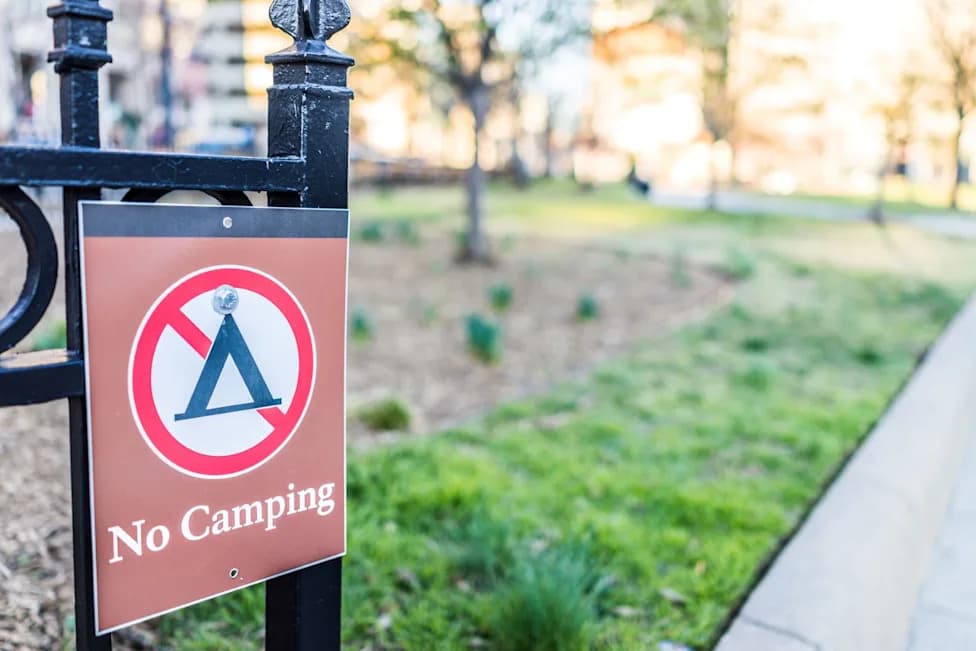
Photo Credit: iStock
San Bernardino, California, is moving to adopt a stricter anti-camping ordinance that would prohibit camping and sleeping in many public spaces across the city as officials seek to reduce encampments and address public-safety concerns.
The proposed measure, reported by The Press-Enterprise, would ban camping and sleeping in city parks and forbid people from lying on streets, sidewalks and benches. It would also create a 500-foot exclusion zone prohibiting encampment activity near colleges, schools, daycare facilities and cancer treatment centers.
Under the draft ordinance, the city must provide at least 72 hours' notice before clearing an encampment. Any personal property collected during a cleanup would be stored for 90 days. San Bernardino City Attorney Albert Maldonado said violations could result in misdemeanors, administrative fines or civil penalties.
"That Supreme Court decision allows for local agencies to take criminal actions against unhoused individuals when they are camping in public places and posing a threat to the life, health, and safety of those around them," Maldonado said, referring to the U.S. Supreme Court's 2024 decision in City of Grants Pass v. Johnson. "This ordinance brings it into alignment with what the county did."
The City Council unanimously approved a first reading of the ordinance on Sept. 16; a final vote was scheduled for Oct. 7, according to The Press-Enterprise.
Public-Safety Rationale and Enforcement
A city staff report described ongoing encampments as creating "significant risks to public health and safety, including increased fire hazards, accumulation of waste, obstruction of public access, and public health risks." City spokesperson Jeff Kraus said enforcement would be a coordinated effort among multiple departments, including Housing and Homeless outreach staff, Public Works, Code Enforcement and local police.
Kraus noted the city is working with county agencies, Veterans Affairs and nonprofits but did not specify whether additional resources will be provided to everyone displaced by future cleanups. "As a condition to receiving most services, an individual must adhere to a set of rules, meet with a case worker, and work toward case-specific goals and milestones," Kraus said.
Shelter Capacity and Support Efforts
The staff report said San Bernardino has pursued public-housing grants, partnered with local agencies and nonprofits, and developed city-owned shelters for vulnerable residents. In July, a 140-bed shelter opened after receiving a $34.9 million Homekey grant from the California Department of Housing and Community Development. The city also reports more than 1,000 emergency shelter beds and the ability to issue hotel vouchers.
Caution From Advocates And Experts
Advocates and public-health experts warn that criminalizing homelessness can make it harder for people to access stable housing and services. As Johns Hopkins has reported, continuing to offer housing-focused options—such as tiny-home villages and low-barrier shelter—and treating people with dignity can improve outcomes for people experiencing homelessness.
The San Bernardino proposal echoes a broader national trend toward tighter camping restrictions and more limited camping options: debates over who counts as homeless on public land in Utah, recent bans on free camping near Zion National Park, and local housing-policy fights such as rent-cap measures in Redwood City.
The ordinance, if adopted, would shorten the notice window before sweeps to 72 hours, formalize a 500-foot exclusion zone around certain institutions, and require 90-day storage of seized property, while leaving many enforcement and service-delivery details to city departments and partner agencies.
Help us improve.