Regavim has published Real Estate Under Occupation, a photography book documenting 100 privately owned Palestinian villas across the West Bank, featuring pools, fountains and landscaped estates. The NGO says the images challenge what it describes as selective international narratives that focus only on poverty and hardship. The project includes properties in villages such as Shuqba, Nahalin and Khirbet Zif and notes legal complexity in Areas B and C under the Oslo framework. Photographs are illustrative examples, not evidence of how widespread private wealth is across the Palestinian population.
Pools, Marble and Mansions: Inside 100 Palestinian Luxury Homes in the West Bank
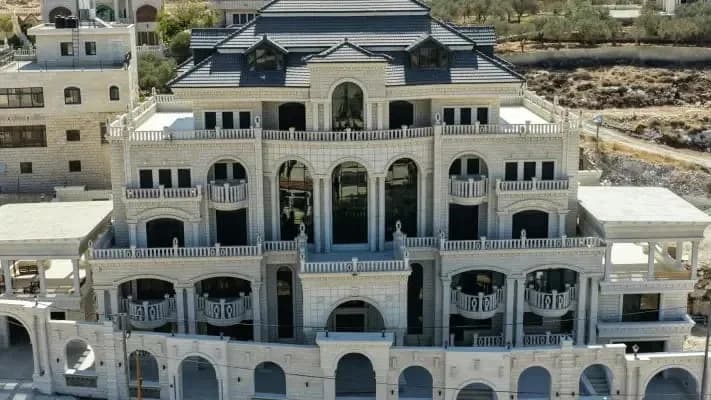
A property in Mukhmas, listed by Regavim at 2,400 square meters 2026. (photo credit: COURTESY/REGAVIM)
Regavim, an Israeli NGO that monitors land use and advocates construction enforcement, has published a photography book titled Real Estate Under Occupation documenting 100 privately owned Palestinian villas and estates across the West Bank. The collection highlights private homes with swimming pools, fountains, marble staircases and manicured grounds and argues these images complicate common international portrayals of daily life in the territory.
The book's photos were taken by Regavim field teams during a single day of documentation. The organisation supplied measurements for many properties; those figures should not automatically be interpreted as interior living-space measurements.
Notable examples featured include an estate in Shuqba northwest of Ramallah described by Regavim as covering 4,800 sqm with a central pool and landscaped grounds, and a neoclassical residence in Nahalin southwest of Bethlehem listed at 1,120 sqm with seven balconies, a turret, a fountain and an ornamental pool. Images from Khirbet Zif in the Hebron Hills show gated compounds with pools, gardens, guest flats, saunas, security cameras and private access roads; other properties feature stone columns, electric gates, orchards and private parking.
Building Permits and Legal Context
The properties shown are located in Areas B and C — the administrative categories created under the Oslo accords. Under that framework, Palestinian authorities hold civilian planning responsibilities in Area B, while Israel retained planning authority in Area C. Construction in Area C requires Israeli approval, so determining whether a specific property was built with permits requires checking its exact location and official permit records.
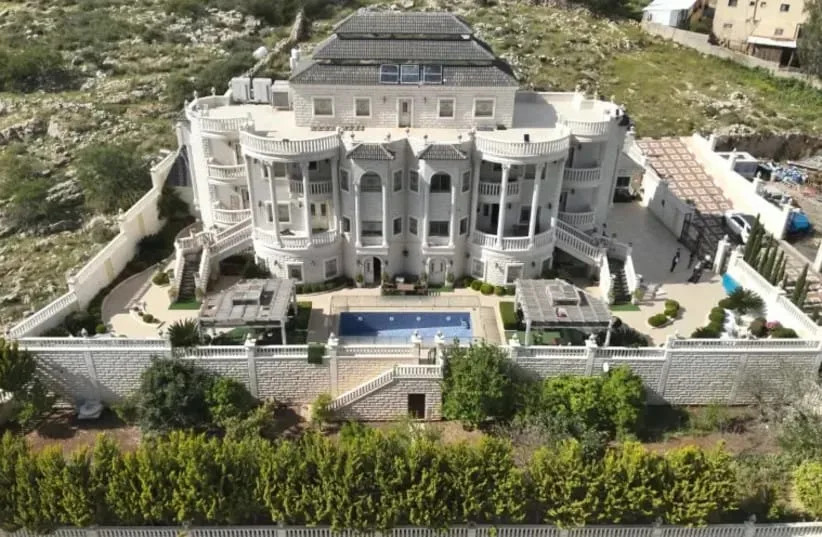
A villa in Shuqba 2026. (credit: COURTESY/REGAVIM)
The material reviewed for this project does not substantiate claims that a large share of the featured homes are illegal. UN humanitarian officials have previously documented the difficulty Palestinians face in obtaining building permissions in Area C, underscoring that legal assessments require case-by-case verification.
What the Project Shows — And What It Doesn’t
Regavim’s introduction uses a deliberately sarcastic tone, pairing terms such as "oppression," "severe deprivation" and "daily hardship" with photographs of luxury to argue that selective imagery can shape international opinion and foreign policy. Regavim said it sought to show a fuller picture while acknowledging that poverty and hardship do exist.
Naomi Kahn, director of Regavim’s international division, said: "For years, the international community has been fed a slanted picture that presents Palestinian life in the West Bank solely through the prism of poverty and oppression. We decided to turn the camera toward the reality on the ground... International policy must be based on facts and not on manipulation. 'Real Estate Under Occupation' invites decision-makers and the public to see the full picture with their own eyes."
Importantly, the photographs document individual examples of private wealth; they do not establish how common such affluence is across the Palestinian population. Several villages appear repeatedly in the book — including Mukhmas, Deir Dibwan and Turmus Ayya — and some large homes have apparent ties to Palestinian communities in the United States. Observers also noted that a number of properties appeared unoccupied when photographed; a single visit cannot determine whether a house is seasonally used or vacant long-term. Turmus Ayya’s mayor estimated roughly 80% of that town’s residents hold US citizenship, a local figure that should not be generalized to other communities.
Contextual economic data underline the broader picture: the World Bank's May 2026 update reported that economic activity in the West Bank remained substantially below its pre-October 2023 level despite modest growth in 2025.
Readers should treat the book as a visual dossier that challenges simplified narratives, while recognizing its limitations as a one-day photographic snapshot that does not replace systematic socioeconomic analysis.
Help us improve.