The discovery of massive stone circles above 3,000 meters in Argentina's Andes — first spotted on Google Earth by Carlos Gobbi — has prompted an archaeological investigation into a previously unknown geoglyph complex. Researchers reached the remote Cordillera del Tigre site in February 2026 and documented linked circular and rectangular stone enclosures measuring 27–35 meters across. No artifacts or signs of habitation were found, so investigators consider ritual or symbolic functions and possible Inca-era connections. Fieldwork beginning in December will use mapping, drones, remote sensing and sediment analysis, and will involve local Indigenous communities in interpretation.
Google Earth Reveals Giant Stone Circles High in Argentina's Andes — Unprecedented Geoglyph Under Investigation
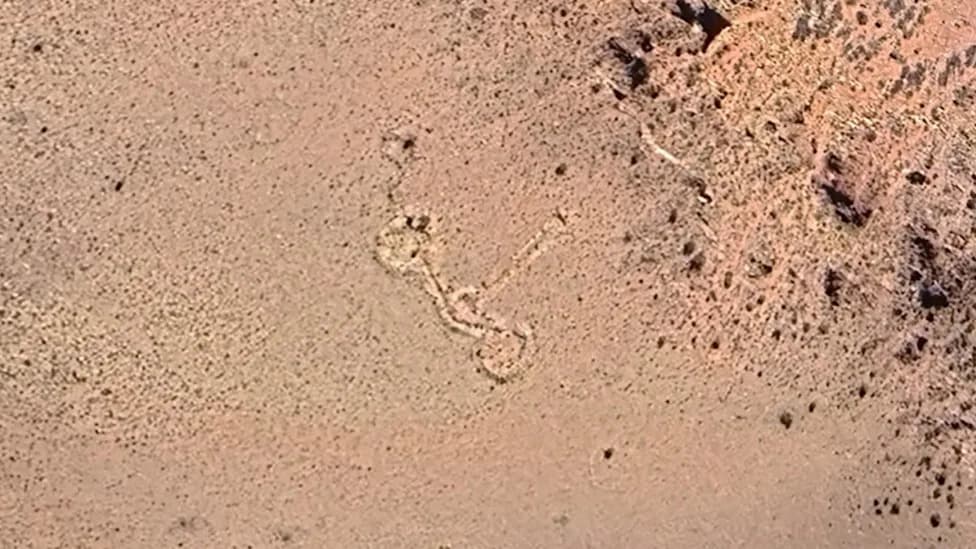
Rock structure in the Andes Mountains as shown in a May 7, 2023 Google Earth satellite imageImage credit: Google Earth/Airbus
A mountaineer scanning Google Earth has identified a previously unknown complex of enormous stone circles more than 3,000 meters (about 9,800 feet) above sea level in Argentina's Andes. Archaeologists who have begun examining the site say they know of nothing like it in the region and suspect the layout may be a geoglyph — a large ground design best appreciated from the air.
Carlos Gobbi, a climber from Mendoza who has spent nearly 30 years searching the high mountains for archaeological traces, first spotted the formations in satellite imagery in May 2025, according to Los Andes. The site lies in the Cordillera del Tigre, a remote mountain range that runs roughly 100 kilometers (62 miles) north–south across Mendoza and San Juan provinces.
Reaching the location proved difficult: two attempts in September and November 2025 failed, and Gobbi and his companions finally arrived on February 14, 2026 after almost four days of trekking. Gobbi described seeing the site in person as "really striking." On the ground, the team documented stone walls that form corridor-like passages and trenches either filled with or lined by rock.
From satellite imagery the complex appears as large circular enclosures linked by causeways, together with adjoining rectangular sectors that form a single composed figure. The circular features measure about 27 to 35 meters (roughly 89 to 115 feet) across. Importantly, these structures were built by piling stones on the surface rather than by cutting into the ground — a construction technique that sets them apart from Peru's Nazca Lines.
Horacio Chiavazza, an archaeologist at the National University of Cuyo and co-director of the ArqueoAndes project, notes that geoglyphs are also known in northern Chile but that the Mendoza site differs in design, construction and likely period. So far, researchers have found no pottery, food remains or other surface evidence of habitation; combined with the extreme altitude and a lack of nearby water sources, this points toward a ritual or symbolic function rather than a settlement.
The team considers an Inca-era origin (the empire the Incas called Tahuantinsuyo) or an earlier date possible. If confirmed as Inca, the complex would be among the southernmost geoglyphs associated with that empire and might relate to the nearby Tambo de Ranchillos waystation in the Uspallata Valley.
Fieldwork is scheduled to begin in December. Co-directors Horacio Chiavazza and Cristina Prieto-Olavarría (CONICET), together with Gobbi and specialists from Spain's University of Jaén, have permits from Mendoza's provincial heritage directorate and will carry out detailed topographic mapping, drone surveys, remote-sensing analysis, geochemical testing and sediment excavation to attempt direct dating of the structures. Spanish specialists will examine sediments and plant remains at microscopic scale to reconstruct past climate, water availability and human activity. The researchers also plan to consult and involve Indigenous communities from Uspallata in interpreting the site.
Key Unanswered Questions: Who built the complex, when was it constructed, and what was its purpose? Planned scientific fieldwork aims to address these questions through systematic mapping, sampling and analysis.
Help us improve.