Archaeologists at Lake Tagua Tagua in central Chile have found gomphothere bones with clear cut marks and associated stone tools dated to about 12,000–13,000 years ago, indicating early human hunting and butchery of megafauna. The well-preserved assemblage of bones, plant remains and artifacts offers unique evidence for human activity in the Southern Cone during the late Pleistocene. Laboratory analyses of bones and sediments are underway to refine the timeline and clarify how these early groups hunted and processed large animals.
13,000-Year-Old Butchered Gomphothere Bones at Lake Tagua Tagua Strengthen Evidence of Early Americans
Diversity of extinct mammals that lived around the ancient Lake Tagua Tagua in what is now Chile. | Credit: Mauricio Álvarez
Archaeologists working at the ancient Lake Tagua Tagua basin in central Chile have uncovered bones of gomphotheres—extinct, elephant-like mammals—that bear clear human-made cut marks and were recovered alongside stone tools. The finds, dated to roughly 12,000–13,000 years ago, add important evidence that some of the first people in southern South America hunted, butchered and consumed megafauna during repeated visits to the lake shore.
What the Excavations Revealed
Excavations conducted over the last two years exposed a dense assemblage of megafaunal remains, botanical material and lithic artifacts, researchers from the Catalan Institute for Human Palaeoecology and Social Evolution (IPHES-CERCA) reported in a Sept. 24 statement. Several gomphothere bones show unambiguous cut marks consistent with butchery by people, and stone tools were recovered in direct association with the faunal material. Radiocarbon and contextual evidence place the remains at about 12,000–13,000 years old.
Other Fauna and Evidence of Consumption
Previous and recent work in the Lake Tagua Tagua basin has also produced remains of now-extinct American horses and multiple deer species. Some of these bones exhibit cut marks and traces of burning, interpreted as evidence that ancient hunters were processing and cooking prey at the site.
Why This Matters
These discoveries join a short list of well-dated early South American sites. Monte Verde in southern Chile—often cited as one of the earliest widely accepted sites—has dates near 14,500 years ago. Other early localities, such as Huaca Prieta in Peru and Arroyo Seco in Argentina, have produced dates close to 14,000 years. The Lake Tagua Tagua assemblage provides additional, regionally significant data about how early humans interacted with large Pleistocene animals as they spread through the Southern Cone.
“The well-preserved assemblage of animal bones, plant remains and stone tools constitutes a record with no known parallels currently in South America,” IPHES-CERCA representatives said.
Next Steps for Research
Fieldwork at the site is complete. The research team will now carry out detailed laboratory analyses of the excavated bones, botanical remains and sediment samples to refine the chronology and better understand butchery practices, subsistence strategies and the environmental context of human activity at Lake Tagua Tagua.
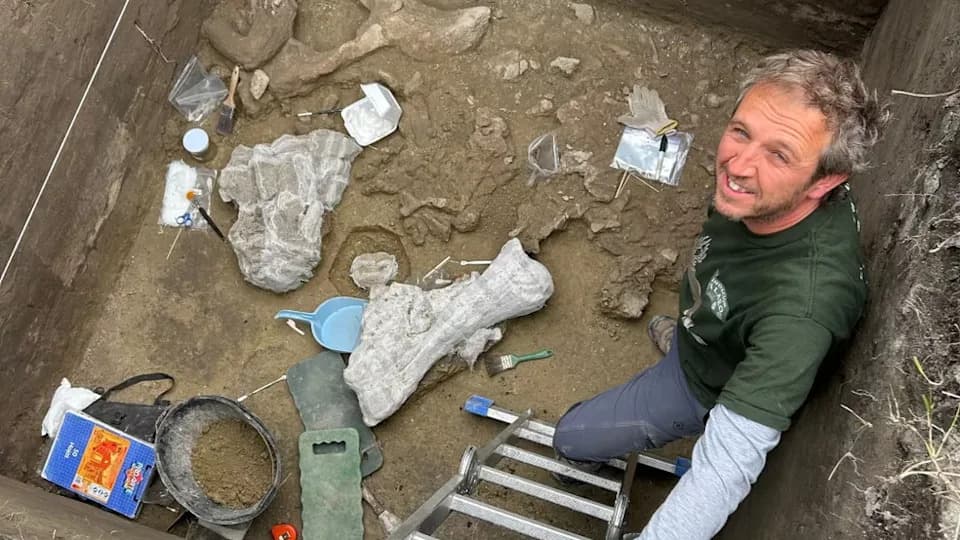
Project documentation: Project co-director Carlos Tornero was photographed working beside the gomphothere remains in the newly excavated area, illustrating the careful in-field recording of the discoveries.
Help us improve.