A Bay Area renter shared a one-bedroom electric bill showing a low rate of about $0.14 per kWh, prompting online envy because the account is with Alameda Municipal Power rather than PG&E. The bill was $38.85 for 85 kWh, well below both the U.S. average (~$0.20/kWh) and California average (~$0.36/kWh), per EnergySage. Commenters contrasted AMP’s smaller distribution network with PG&E’s expansive system and broadened the discussion to utility choice, policy and statewide energy costs.
Bay Area Renter’s Non‑PG&E Bill Shows $0.14/kWh — Sparks Widespread Envy
Photo Credit: iStock
A Bay Area renter’s posted electric bill for a one-bedroom, one-bath apartment drew widespread online attention after showing an electricity rate of about $0.139 per kWh. The total, including fees and taxes, was $38.85 for 85 kWh of usage — an amount an air conditioner could exceed in just two to three days during hot weather.
Why The Rate Is Lower
The bill was issued by Alameda Municipal Power (AMP), a community-owned public utility rather than an investor-owned utility like Pacific Gas & Electric (PG&E). AMP’s public-utility model and much smaller distribution network help explain the lower price: the original poster noted PG&E maintains more than 100,000 miles of overhead lines while AMP operates with fewer than 100 miles.
Reaction On Reddit
The image, shared in a Reddit thread, prompted a mixture of envy and curiosity. One commenter echoed a popular meme with the restrained line
'Congrats. Happy for you. Nice.'Others compared AMP’s low rate with their own bills — one user said their PG&E bill exceeded $500 in San Jose — and many lamented they lacked a municipal alternative.
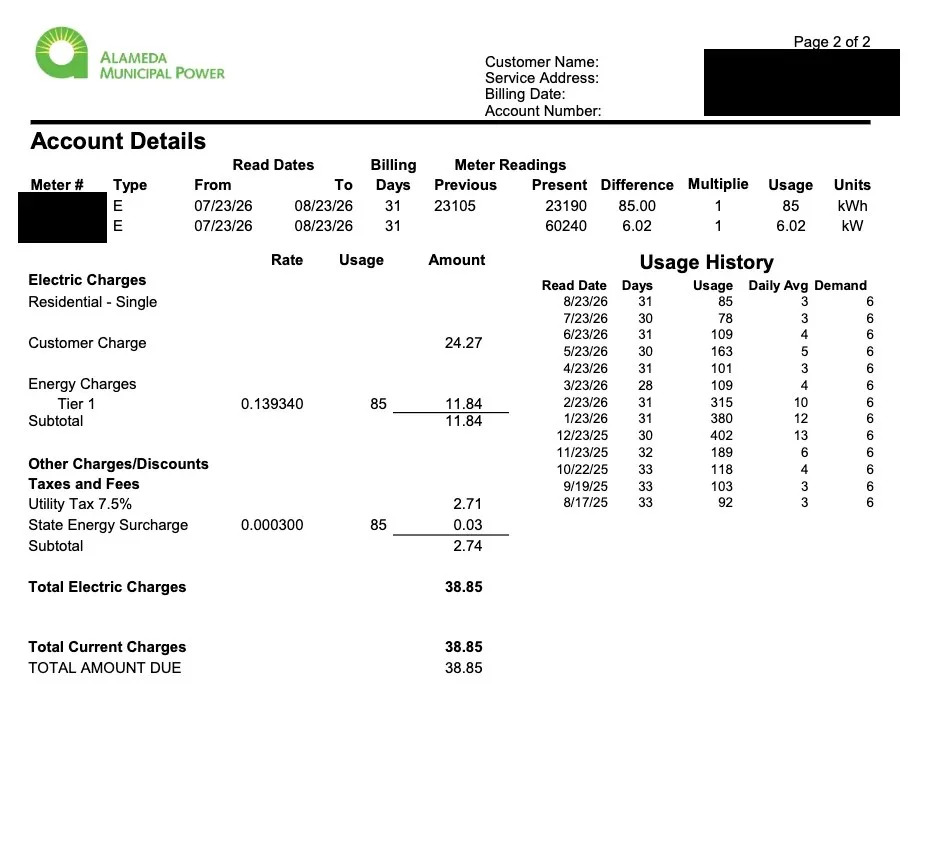
Photo Credit: Reddit
Broader Issues Raised
Several commenters pointed out that most residents can’t choose their electric provider: service territories are set by geography. The thread also turned political, with users asking how voters might pressure elected officials to expand municipal options or change utility oversight.
This snapshot ties into larger California conversations about electricity costs and access: projections that PG&E customers could pay roughly $840 more per year by 2030, possible changes to shared-solar rules that could reduce renter access to savings, and state or utility programs that may cut bills by about $350 during extreme heat.
Bottom line: The Reddit snapshot highlights how utility ownership and infrastructure scale can produce sharply different electricity prices within the same region — and why many Californians debate whether they should have more alternatives to large investor-owned utilities.
Help us improve.