Germany has ratified the UN High Seas Treaty, with Environment Minister Carsten Schneider calling it a major international environmental breakthrough. The BBNJ Agreement supplements UNCLOS by enabling large marine protected areas and requiring environmental impact assessments for certain activities on the high seas. The treaty covers areas beyond national jurisdiction — about two-thirds of the ocean — and will become binding for German actors on October 21, 30 days after accession.
Germany Ratifies UN High Seas Treaty — Minister Hails Major Environmental Breakthrough
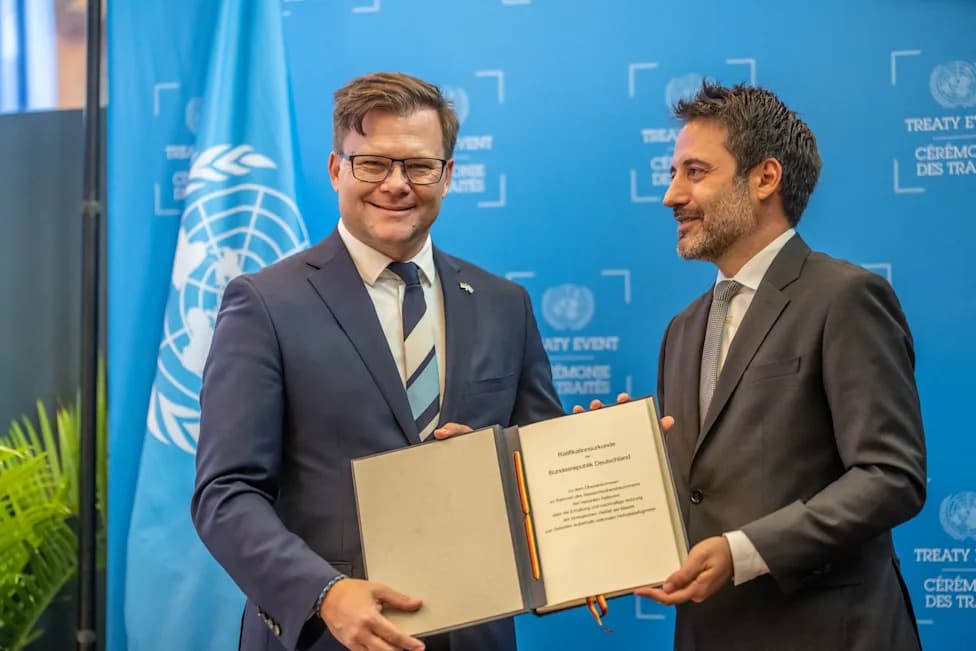
Carsten Schneider (L), German Minister for the Environment, Climate Action, Nature Conservation, and Nuclear Safety, presents the instrument of ratification for the BBNJ High Seas Protection Agreement to David Nanopoulos, Chief of the Treaty Section at the UN, on the sidelines of the UN General Assembly at the United Nations. (is associated with: «German environment minister hails UN High Seas Treaty as major success») Michael Kappeler/dpa
Germany has formally ratified the landmark UN High Seas Treaty, depositing its instrument of ratification at the United Nations in New York. Environment Minister Carsten Schneider described the move as the biggest international environmental policy achievement in recent years.
“The agreement proves that even in times of confrontation, the principle of international cooperation continues to enjoy broad support,” Schneider said on the sidelines of the UN General Assembly.
The treaty, formally known as the Agreement on Marine Biological Diversity of Areas Beyond National Jurisdiction (BBNJ Agreement), supplements the UN Convention on the Law of the Sea (UNCLOS). It creates a framework for the designation of large marine protected areas on the high seas and requires environmental impact assessments before certain activities that could affect the marine environment may proceed.
The treaty applies to ocean areas beyond national territorial waters (up to 12 nautical miles from the coast) and beyond exclusive economic zones (up to 200 nautical miles). These high-seas areas account for roughly two-thirds of the world's ocean surface and have historically lacked a coherent international governance mechanism.
Schneider warned that the state of the world’s oceans is poor: plastic pollution, overfishing, chemical contamination and climate change are placing marine ecosystems under growing pressure. He said designated protected areas and mandatory environmental oversight will be essential to give these ecosystems a chance to recover.
According to the German Environment Ministry, the treaty and Germany’s implementing legislation will become legally binding for German actors on October 21 — 30 days after accession. From that date, vessels registered under the German flag, German high-seas researchers and other German organisations and individuals subject to the law must comply with the treaty’s provisions.
What The Treaty Delivers
- Stronger, Coordinated Protections: Enables the establishment of large marine protected areas in regions beyond national jurisdiction.
- Preventive Environmental Oversight: Requires environmental impact assessments for specified activities that may harm high-seas biodiversity.
- Global Scope: Applies to roughly two-thirds of the ocean, helping conserve species and ecosystems in areas not governed by any single nation.
Germany’s ratification strengthens international momentum to conserve the high seas and could encourage additional states to join the agreement. Effective implementation will depend on transparent national legislation, international cooperation and enforcement in the years ahead.
Help us improve.