The Air Force completed vertical stacking of an inert LGM-35 Sentinel missile at Vandenberg after a four-month campaign that validated stages, propulsion, shroud and field-handling procedures. The 719th Test Squadron finished the first flight test design review, confirming design maturity and safety readiness for flight testing planned in 2027. Leaders say Sentinel remains on track for Milestone B and initial capability in the early 2030s, while final cost estimates are still under review.
Sentinel ICBM Completes Vertical Stacking at Vandenberg, Clearing Path Toward 2027 Flight Tests
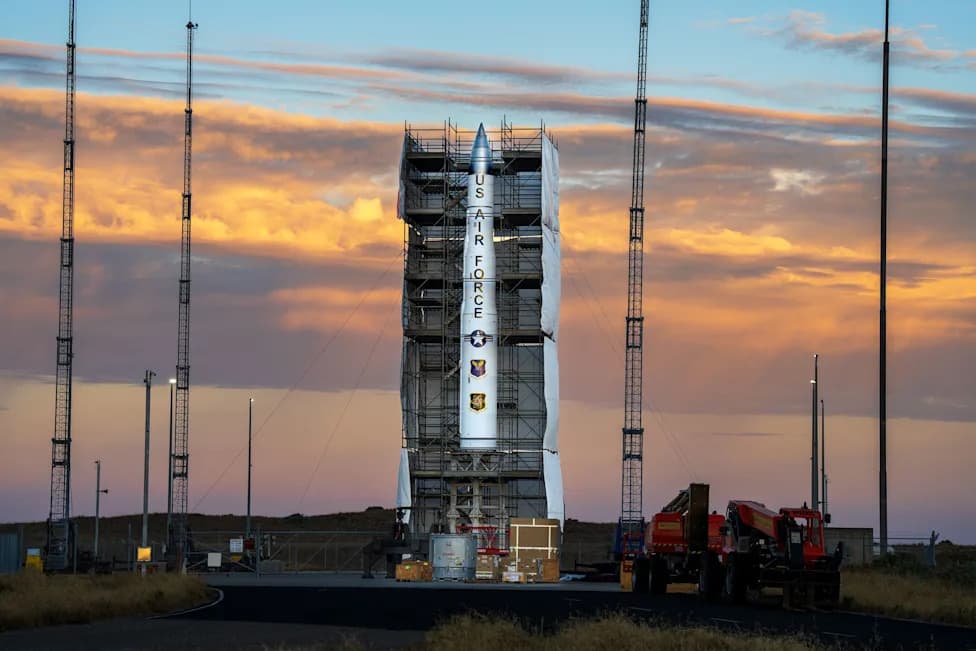
An inert LGM-35A Sentinel intercontinental ballistic missile on a test-ped at Vandenberg Space Force Base, California. (Northrop Grumman)
The U.S. Air Force's LGM-35 Sentinel intercontinental ballistic missile program has completed the vertical stacking of an inert missile at Vandenberg Space Force Base, concluding a four-month verification campaign that demonstrated subsystem integration and operational readiness ahead of planned initial flight tests in 2027.
What the Campaign Showed
The campaign evaluated each missile stage, propulsion elements, the protective shroud and associated subcomponents when assembled into a single test-pad configuration. Teams also exercised cross-country transport, specialized crane lifts, precision interface checks and other handling procedures to validate personnel skills and field assembly processes across segments of the weapon system's operational lifecycle.
"From cross-country transport and specialized crane lifts to precision interface checks on the pad, bringing all of these elements together validated our technical baselines and proved Sentinel is ready to support the next phase of development," Maj. Gen. William S. Rogers, Air Force portfolio acquisition executive for Intercontinental Ballistic Missiles, said in the release.
In parallel with on-pad integration, the Air Force Test Center's 719th Test Squadron completed the first flight test design review. That review found the missile's design maturity and hardware testing meet safety and mission assurance requirements needed before flight testing begins.
Program Timeline And Oversight
Service leaders say Sentinel remains on track for Milestone B—authorization to enter the engineering and manufacturing development phase—and for initial flight tests in 2027. The program is targeted to deliver initial operational capability in the early 2030s and serve as a ground-based strategic deterrent for decades.
"Sentinel is no longer conceptual or just designs for what the nation's next-generation ICBM looks like; it's a physical, fully integrated system that is one major step closer to being ready for flight testing," said Gen. Dale White, director for Critical Major Weapon Systems. "While this is a significant achievement, we will keep driving, firmly focused on delivering a modernized, credible strategic deterrent that will safeguard the nation and its allies well into the future."
Program officials noted they are still parsing a large volume of test and design data and have integrated reviews from the Air Force Cost Analysis Agency and the Office of Cost Assessment and Program Evaluation (CAPE). A final program cost estimate is not yet available.
The Air Force announced earlier this year it expects a Milestone B decision by the end of 2026. Next steps include completion of remaining design reviews, follow-on testing, and preparation for flight test execution in 2027.
Help us improve.