Effective AI regulation must balance timely action with avoiding rules that choke innovation. Past efforts—on hydrogen, nanotechnology and biological agents—show that adapting existing laws with scientific input often works better than importing ill-fitting models. AI poses special challenges because code, data and models are easily copied and globally distributed, so nuclear-style oversight is not suitable. Near-term levers such as federal preemption, export controls and measured liability rules offer the most practical options while litigation and political debate mature.
Hype and Harangue in the Age of AI: Why Smart Regulation Matters Now
Designing a regulatory framework for an emerging technology is hard work: it requires coordination across agencies with different cultures and missions, careful risk anticipation for a partly speculative future, and meaningful input from subject-matter scientists. Drawing on past regulatory efforts—hydrogen, nanotechnology and biological agents—this article explains why one-size-fits-all regulatory models (especially those borrowed from the nuclear realm) are a poor fit for artificial intelligence, and why measured, science-informed approaches are the wiser course.
Lessons From Hydrogen and Nanotechnology
In 2006–07, as Chief Counsel for the Research and Innovative Technology Administration at the U.S. Department of Transportation, I led development of a Hydrogen Regulatory Framework spanning nine federal departments and agencies; it was published in the Federal Register in 2007. The exercise mapped existing federal statutes that could apply to hydrogen and gave investors predictable rules for building a hydrogen economy—showing how regulatory clarity can stimulate investment without inventing entirely new regimes.
At the turn of the century, fears about engineered nanoparticles—"nanophobia"—led to calls for sweeping new regulation. In practice, existing laws, supplemented by targeted amendments (for example under the Toxic Substances Control Act), addressed most of the realistic hazards. These episodes show that adapting current statutes with scientific guidance can be effective and efficient.
Biological Agents: A Poor Fit For Nuclear-Style Oversight
After the 2001 anthrax attacks, biological-agent regulations were strengthened to address handling, personnel screening, containment and perimeter security. Policymakers initially borrowed the nuclear regulatory model, but the analogy failed. Nuclear materials behave like stable inventory; biological agents replicate. Inventory checks appropriate for uranium are unreliable for living organisms that grow or die—creating enforcement and safety mismatches. The lesson: regulatory design must reflect scientific realities, not rely on attractive analogies.
The Pacing Problem And Collingridge's Dilemma
Two conceptual frames help explain regulatory timing challenges. Pacing theory notes that early in a technology’s lifecycle, risks are uncertain so courts and tort law often handle individual harms until patterns emerge and regulations become sensible. Collingridge’s Dilemma warns that once a technology diffuses, it becomes harder to change or control—and it can widen inequalities between those who can afford it and those who cannot. Effective policy balances not stifling innovation with protecting people and society.
The Evolving AI Regulatory Landscape
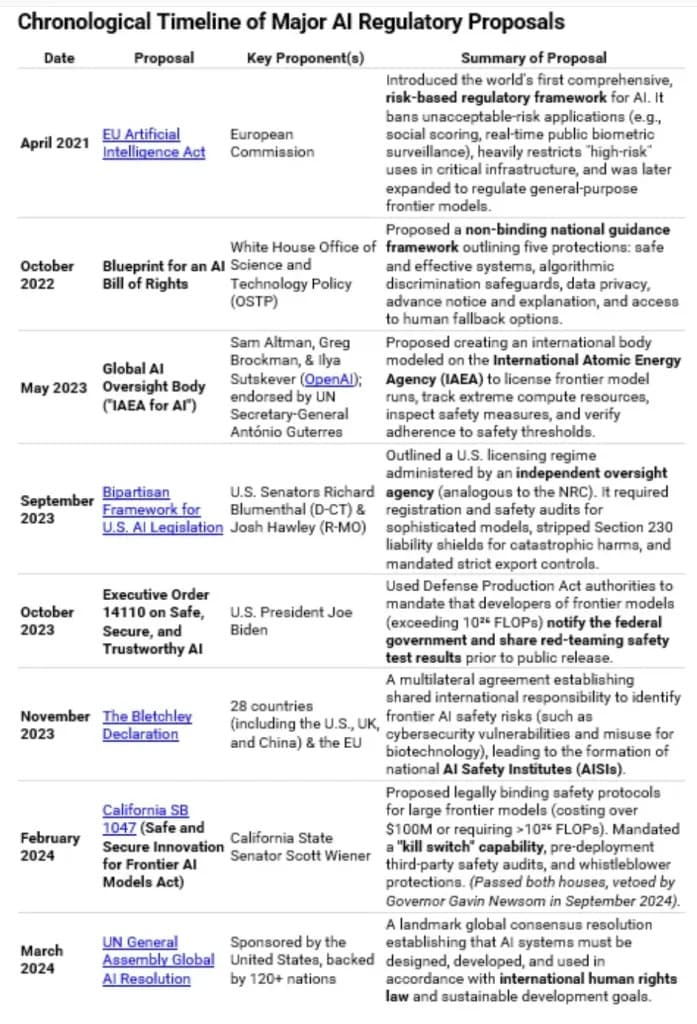
International and domestic efforts to regulate AI have accelerated: the European Commission proposed a risk-based approach in 2021 that focused on restricting "high-risk" uses; the U.S. Office of Science and Technology Policy (OSTP) published guidance in October 2022 proposing five criteria to guard against AI risks tied to privacy and nondiscrimination; and in May 2023 industry proposed a UN-style oversight body modeled on the International Atomic Energy Agency. A bipartisan Senate bill also proposed an agency modeled after the U.S. Nuclear Regulatory Commission (NRC) for AI licensing.
In October 2023 President Biden signed Executive Order 14110 requiring notice for large AI systems and sharing of safety-test results. That EO was rescinded on January 20, 2025 by President Trump and replaced on January 21, 2025 with Executive Order 14179 directing removal of barriers to AI commercialization. States sought to act too: California considered bills (including verification organizations) and Colorado passed SB 24-205 as a risk-based state statute, but state action has been constrained by federal preemption concerns aimed at avoiding a patchwork of conflicting laws.
Why Nuclear-Style Oversight Is Ill-Suited To AI
Nuclear regulation depends on distinctive, hard-to-replicate materials (like enriched uranium) and long construction timelines. AI depends on chips, code, datasets and models that are easily copied and transmitted globally in minutes. Training cycles are measured in days or weeks, not years. Inspection regimes built for nuclear materials cannot detect or police many AI risks. The dual-use nature of AI—where the same datasets and algorithms can be constructive or harmful—complicates enforcement further.
Near-Term Tools And Emerging Legal Risks
Practical near-term tools include federal preemption to avoid conflicting state rules and export controls on sensitive code and hardware. Those controls are imperfect and can be evaded by motivated actors with internet access, but they remain one of the few centralized levers available.
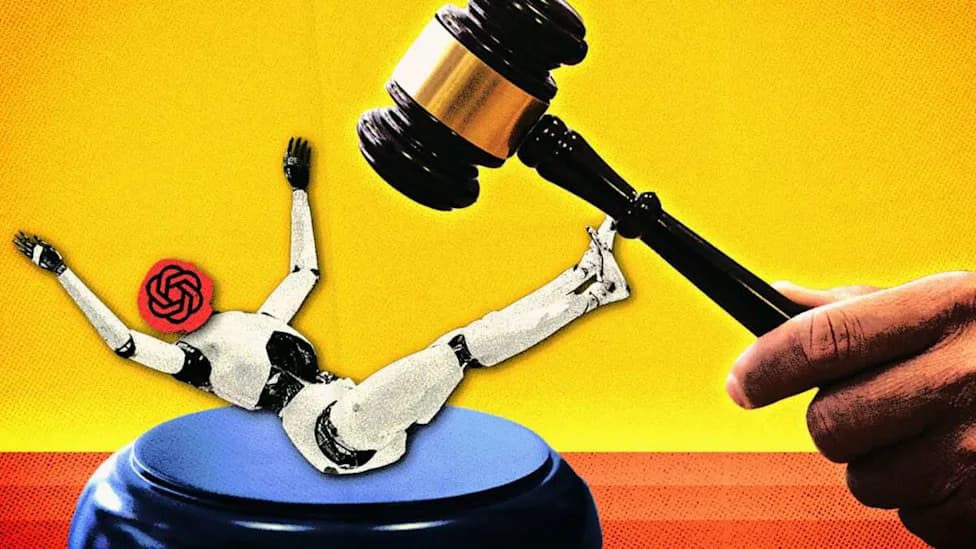
Legal pressures are already emerging: lawsuits allege AI systems have manipulated vulnerable children and contributed to addictive design patterns. Industry pushes for liability protections risk undermining accountability and could slow the development of sound regulatory approaches if adopted prematurely.
Conclusion
It is still too early to settle on a single, heavy-handed regulatory architecture for AI. History suggests that adapting existing laws, informed by scientists and technologists, and using targeted tools (preemption, export controls, measured liability rules) is a better path than applying ill-suited models wholesale. My expectation is that within a year the public conversation will be clearer, and regulators will have better evidence about which approaches work—while civilization survives the interim.
About the Author
Professor Victoria Sutton (Lumbee) is a law professor at Texas Tech University. In 2005 she became a founding member of the National Congress of American Indians Policy Advisory Board to the NCAI Policy Center, helping position Native American communities to lead on policy matters affecting Indigenous peoples in the United States. Read more: https://profvictoria.substack.com/
Help us improve.