The Trump administration's proposal to exclude certain immigrants from the 2030 census apportionment counts could produce unintended consequences, a New York Times analysis found. Using FWD.us and Pew estimates, the Times modeled scenarios in which Texas and Florida might each lose a seat while Minnesota, Oregon and Ohio could gain seats. Experts attribute the results to shifting immigrant settlement patterns, and legal challenges invoking the 14th Amendment are likely. Census totals will affect House seats, Electoral College votes and federal funding beginning with representation set after the 2030 census.
NYT Analysis: Trump Plan To Exclude Some Immigrants From 2030 Census Could Cost Red States Seats
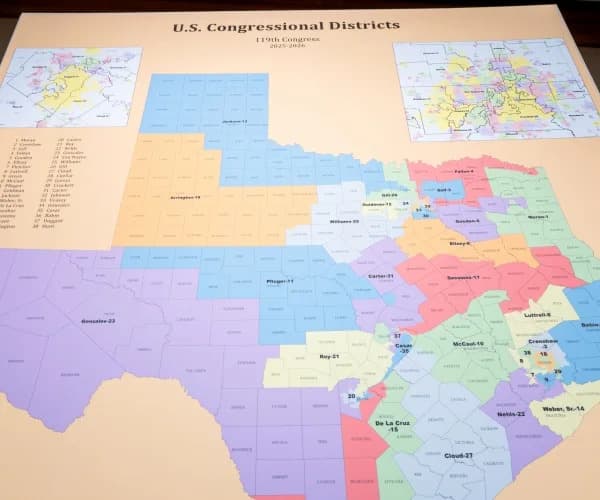
A U.S. Congressional District map is seen as the Senate Special Committee on Congressional Redistricting meets to hear invited testimony on Congressional plan C2308 at the Texas State Capitol on Aug. 6, 2025, in Austin, Texas. (Brandon Bell/Getty Images)
The Trump administration's proposal to exclude certain immigrants from the population totals used to apportion U.S. House seats after the 2030 census could produce unexpected political consequences, potentially costing some Republican-leaning states seats, a New York Times analysis published Saturday found.
What the Analysis Shows
The Times modeled reapportionment outcomes using alternative population estimates. Using 2024 estimates from immigration advocacy group FWD.us, the analysis found that Texas and Florida would each lose a seat they would otherwise gain under a full population count, while Minnesota and Oregon would each gain a seat.
When the Times applied Pew Research Center's 2023 estimates, the results shifted slightly: Texas again would forfeit a potential seat and Minnesota would gain one, while Ohio could gain a seat at Rhode Island's expense.
Jeffrey Passel, a senior demographer at Pew, told the Times, "This isn't exactly what I think the powers that be expected."
Why These Shifts Occur
The findings reflect long-term changes in immigrant settlement patterns. In recent decades, undocumented immigrants and other noncitizen populations have increasingly settled in the Southeast and Midwest rather than concentrating only in traditional gateway states. That geographic shift means excluding certain immigrants from apportionment counts would not automatically favor the currently Republican-dominant states many expected.
The Times' review suggests the policy could exclude up to about 5% of the U.S. population from apportionment counts. Under FWD.us estimates, roughly 9% of residents in Texas, Florida, and New Jersey could be omitted from totals used to assign House seats.
Broader Stakes and Legal Questions
Census totals determine each state's number of House seats and Electoral College votes and influence the distribution of federal funding. Even very small population differences can change reapportionment outcomes; for example, New York would have retained an additional House seat after the 2020 census if just 89 more residents had been counted.
The administration's plan is expected to face constitutional challenges. The 14th Amendment requires apportionment based on "counting the whole number of persons in each state," a provision that legal challengers are likely to invoke.
Context: Redistricting Battles
The 2030 census will set House representation beginning in 2032, and the proposal arrives amid an intense, yearslong partisan fight over maps and representation. Following the 2020 census, Republican-controlled states including Texas and Florida adopted maps favorable to Republicans, while Democrat-controlled states including Illinois and New York pursued Democratic-favorable maps. Recent mid-decade moves and court challenges have intensified the struggle, producing major district shifts for millions of Americans.
Bottom line: The Times' modeling indicates that excluding certain immigrants from apportionment counts would not necessarily deliver predictable partisan gains and could produce unintended losses for some Republican-leaning states.
Help us improve.