The new study shows that tiny traces of lead in ancient inks can make charred Herculaneum scrolls readable using a three‑step workflow: X‑ray fluorescence to find lead, X‑ray tomography to image the rolls in 3D, and AI to detect subtle contrasts. Researchers created modern mock scrolls with leaded ink, carbonized them, and successfully reconstructed letters even at very low lead levels. The paper, published Sept. 16, 2026 in PLOS One, recommends screening scrolls for lead first to prioritize safe, noninvasive reading and protect fragile artifacts.
Lead Traces May Unlock 2,000‑Year‑Old Herculaneum Scrolls — New X‑Ray + AI Method
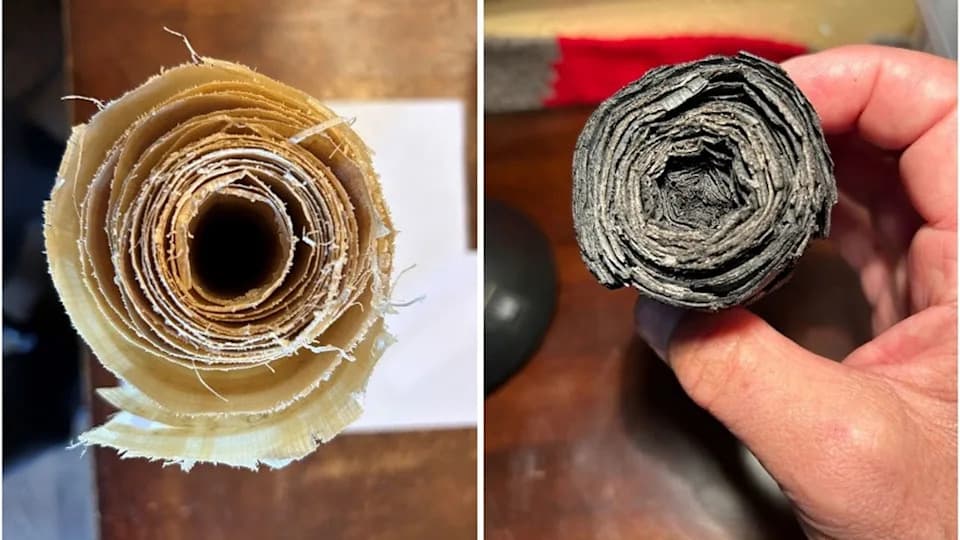
Several papyrus scrolls before carbonization (left) and after carbonization (right). The tight rolling and waviness of the carbonized scrolls make them challenging for algorithms to read. . | Credit: Seiler et al., 2026, PLOS One, CC0
Nearly two millennia after Mount Vesuvius buried Herculaneum, researchers report a promising noninvasive way to read charred papyrus scrolls: detect tiny traces of lead in ancient ink and use X‑ray imaging plus artificial intelligence to reveal letters that are otherwise invisible.
The study, published Sept. 16, 2026 in PLOS One, tested whether lead‑bearing inks survive the carbonization that turned many Herculaneum scrolls into brittle, blackened rolls. A team led in part by Douglas Seiler, a research affiliate at the University of California, Berkeley, produced modern mock scrolls written with leaded ink, carbonized them to mimic the effects of the A.D. 79 eruption, and then applied combined X‑ray techniques and custom AI to search for writing.
How the Method Works
First, the researchers used X‑ray fluorescence (XRF) to map elemental composition across the scrolls and confirm the presence of lead in some inks. Next they applied X‑ray tomography to build high‑resolution three‑dimensional images of the rolled material. Finally, customized software and machine‑learning algorithms analyzed those 3D scans to detect subtle contrasts between carbonized papyrus and lead‑containing marks.
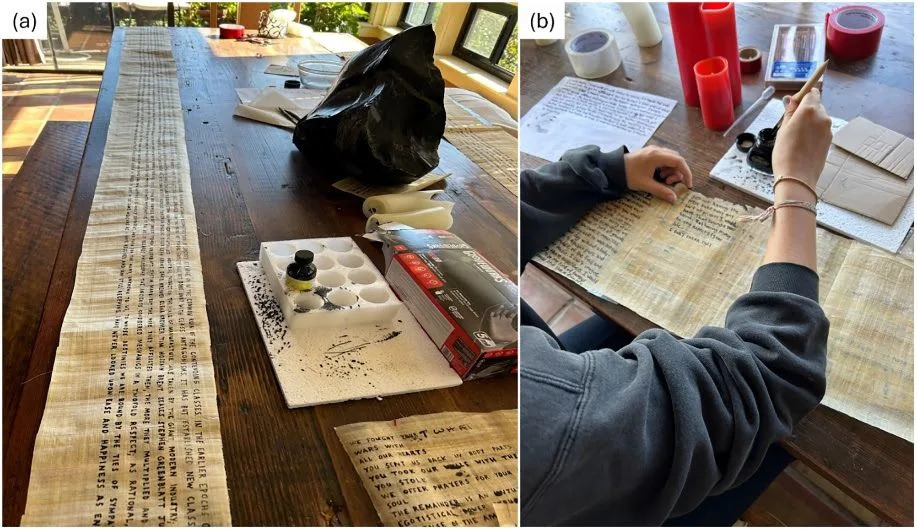
The papyrus scrolls are prepared with inks of varying lead concentrations that an AI algorithm will detect via X-ray tomography. | Credit: Seiler et al., 2026, PLOS One,CC0
"It's amazing what you can get electrons to do," Douglas Seiler said, describing how element mapping and imaging can reveal otherwise invisible marks.
Results and Significance
In laboratory tests the approach detected and, in many cases, reconstructed letters written with lead‑bearing inks even when lead concentrations were very low. While the method did not recover every character, it produced readable contrasts in cases where traditional X‑ray techniques struggle—chiefly because both the papyrus and many inks are carbon‑based and therefore difficult to distinguish.
The authors recommend conservators screen original scrolls with XRF for lead signatures before attempting detailed tomography and AI‑driven reconstruction. That workflow could help prioritize candidate scrolls for further study while minimizing physical handling and risk to priceless artifacts.
Context
The roughly 2,000 papyri from a seaside villa at Herculaneum — uncovered in the 18th century and long held in Italian collections — include philosophical works attributed to Epicurean and Stoic authors and other classical texts. Previous successes using digital unrolling and imaging have recovered some passages, but reading remains sporadic because of the low contrast between carbonized writing and the substrate. This lead‑detection technique may expand the readable corpus of early Roman‑era writings trapped by the eruption.
Why It Matters: By combining element mapping, 3D X‑ray imaging and AI, researchers now have a low‑risk way to select and read scrolls that contain lead‑based inks — increasing the odds of recovering lost ancient texts without physically opening fragile rolls.
Help us improve.