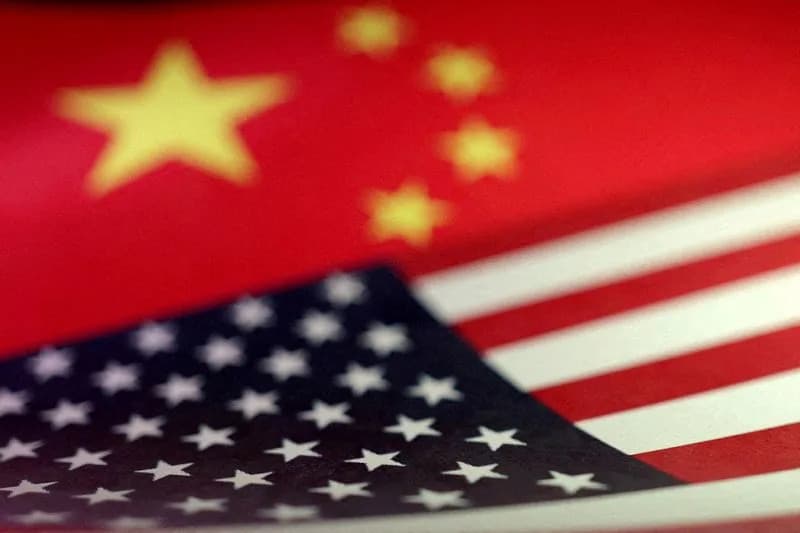
The People's Daily urged that AI must not become "a monopoly of great powers" and called on the U.S. and China to cooperate on risk management and a non-discriminatory development environment. The paper accused the U.S. of double standards over the industry practice of "distillation" and reiterated China's support for open-source approaches. It said both countries are key drivers of frontier AI and expressed willingness to hold "constructive and professional" talks ahead of planned bilateral meetings.
People's Daily: AI Shouldn't Be A "Monopoly Of Great Powers" — Calls For U.S.-China Cooperation
FILE PHOTO: Words "AI Artificial Inteligence", keyboard, and a robotic hand in this illustration taken June 5, 2026. REUTERS/Dado Ruvic/Illustration/File Photo
China's official newspaper, the People's Daily, published a commentary on Wednesday arguing that artificial intelligence should not be treated as a "monopoly of great powers" and urging the United States to cooperate with China to manage AI risks and foster a non-discriminatory development environment.
The commentary said the U.S. and China are the two primary drivers of frontier AI research and global adoption, noting that disagreements over AI policy and industry practices are expected to feature prominently in upcoming bilateral talks next week.
The paper recalled earlier U.S. accusations that China had engaged in large-scale intellectual property theft from American AI labs. It also highlighted Beijing's preference for open-source approaches, saying Chinese authorities provide access to open-source models to domestic and foreign companies, including those from the United States.
"Artificial intelligence is a new domain for human development, not a monopoly of great powers, and must not become an arena for zero-sum competition," the commentary said. It was published under the pen name "Zhong Sheng" ("Voice of China"), often used to express official foreign-policy views.
The People's Daily criticized what it called a double standard on "distillation"—the industry practice of training smaller models using the outputs of larger ones to lower development costs. The paper said U.S. firms frequently "distill" Chinese models, and argued that when American companies do so it is framed as an "industry standard practice," while similar actions by Chinese companies are labeled an "attack."
"By elevating an industry standard practice to a national-security issue, the U.S. seeks dominance over the sector under the guise of combating distillation," the commentary added. Despite the criticism, it said China remains willing to engage in "constructive and professional" discussions with the United States to promote open, inclusive and beneficial AI development.
(Reporting by Reuters Beijing newsroom; original commentary appeared in the People's Daily.)
Help us improve.