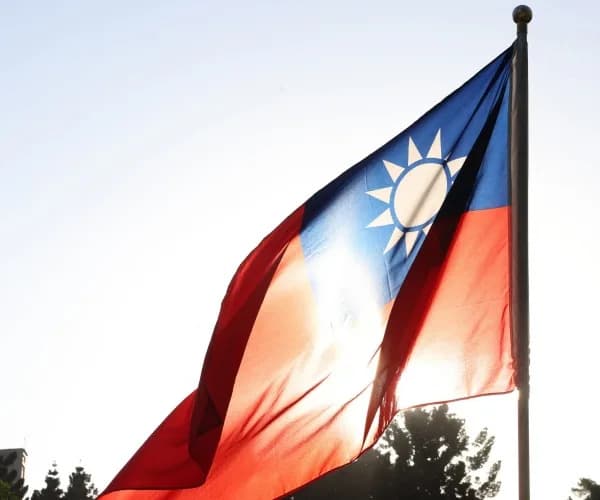
Summary: Paraguay remains Taiwan's only formal ally in South America after 69 years of diplomatic ties. Recent agreements, including a 10 MW pilot AI data center and trade gains that pushed exports to Taiwan to $342 million in 2025, show early progress. The crucial next step is scaling private investment and bringing Taiwanese firms into a 100 MW second phase to create higher-skilled industries that leverage Paraguay's hydroelectric power and Taiwan's strengths in semiconductors and AI.
Paraguay Is Taiwan’s Key Test In Latin America — Can Loyalty Become Industry?
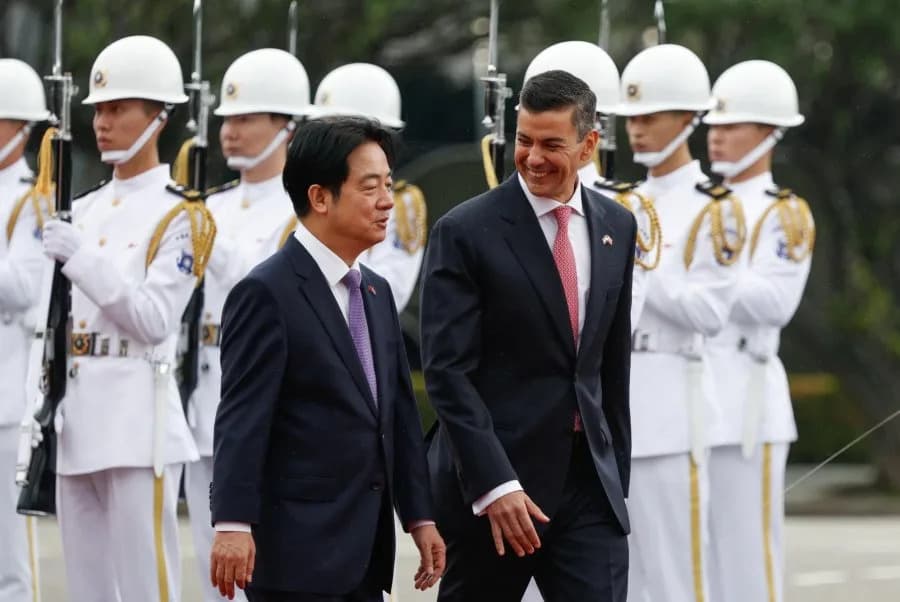
Taiwan President Lai Ching-te (L) and Paraguay President Santiago Pena (R) react as they review honor guards during a welcome ceremony in front of the presidential office Taipei, Taiwan, on May 8. File Photo by Ritchie B. Tongo/EPA
When the third Taiwan-Paraguay Technology Forum met at Paraguay's Central Bank on Sept. 11, artificial intelligence was the headline — the same field at the center of one of the most ambitious accords between Asunción and Taipei in May. Recent education exchanges and new trade and investment commitments suggest the relationship is moving from diplomacy to concrete industrial cooperation.
Recent Milestones
Earlier in September, 87 engineering students from the Taiwan-Paraguay Polytechnic University arrived in Taipei to begin a year of study at Taiwan Tech. In May, President Santiago Peña visited Taipei and the two governments signed a set of agreements including a mutual legal assistance treaty, a cybersecurity accord and a memorandum on a sovereign artificial intelligence computing center.
Trade And Early Economic Wins
Paraguayan exports to Taiwan reached about $342 million in 2025, nearly 50% higher than the prior year; beef accounted for roughly $271 million and pork about $49.6 million. Taipei has opened its market to Paraguayan poultry and now buys most of Paraguay's pork exports. At the same time, China remained the largest source of Paraguayan imports in 2025, supplying more than one-third of total imports.
The AI Center And Private Investment Prospects
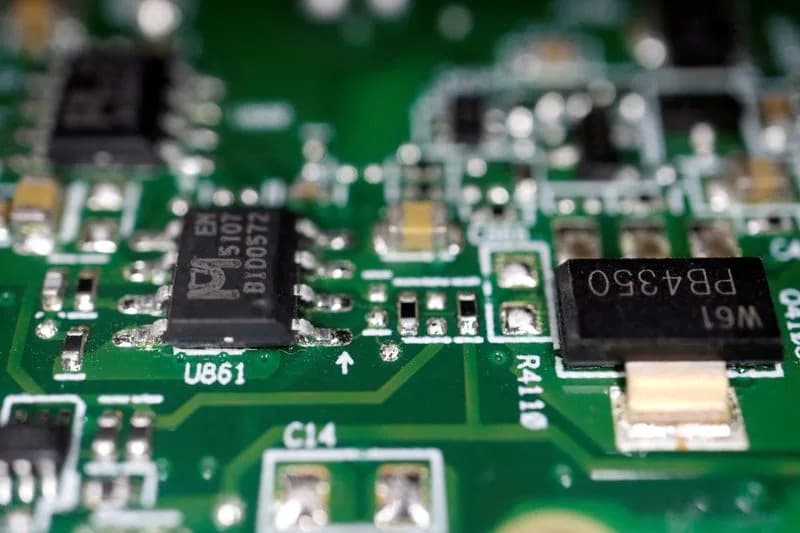
The proposed AI computing center is structured as a 50-50 partnership: a 10-megawatt pilot facility will sit on government land near Asunción, where Paraguay contributes infrastructure and low-cost hydroelectric energy while Taiwan supplies advanced computing equipment and technical support. A planned second phase of roughly 100 megawatts aims to attract private capital and industry partners.
Private projects are already emerging. Taiwanese bus maker Master Bus plans a production facility linked to the Taiwan-Paraguay Smart Technology Park in Minga Guazú, with a proposed $30 million investment and the potential to create 2,000–2,500 direct jobs assembling electric buses in the Ciudad del Este area.
Why This Partnership Matters
For Paraguay, the choice is not simply between markets: it is about how much sustained, high-value economic capacity a diplomatic partner helps build at home. For China, Paraguay would be one of many trade relationships. For Taiwan, Paraguay is one of its most consequential partnerships globally and its sole formal foothold in South America.
Experts and policymakers argue the next phase must scale private investment and attract Taiwanese firms into areas that match Paraguay's competitive advantages — notably semiconductors and AI that can leverage Paraguay's low-cost hydroelectric power and central South American location. Doing so would produce more visible, higher-skilled jobs and make the partnership a practical example of democratic economic cooperation.
Outlook
Building industries at scale will be the test of whether 69 years of diplomatic loyalty can translate into long-term economic transformation. If Taipei and Asunción succeed in mobilizing private capital and industry partners for the AI center's second phase, Paraguay could become a regional model that prompts other governments to ask how to achieve comparable results.
Author's note: This analysis draws on official trade figures and public announcements related to the Taiwan-Paraguay partnership and reflects the authoring organization's regional perspective.
Help us improve.