Physicist Níckolas de Aguiar Alves reexamined Star Trek: The Next Generation's famous 'Picard Maneuver' from Season 1, Episode 9 and found the stunt would create three apparent images of the Stargazer, not two. The extra apparition arises because the ship accelerates twice — once to warp and once to stop — producing an additional observable light-emission event. While faster-than-light travel is fictional, the scenario is a helpful and accurate thought experiment for teaching aspects of relativity and light-travel delays.
Star Trek Physics: Why Picard's Maneuver Would Create Three Stargazers — And Be Even More Deceptive
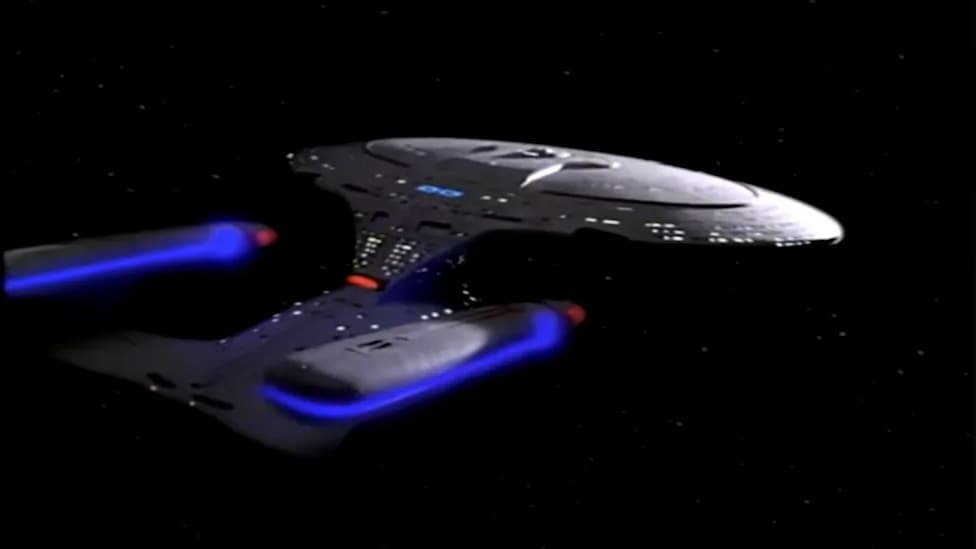
Technically, a 'Picard Maneuver' would generate more than two images of the USS Enterprise.
Physicist Níckolas de Aguiar Alves of Brazil's Federal University of ABC revisited a famous moment from Star Trek: The Next Generation and found the show's on-screen logic actually understates the effect. In Season 1, Episode 9, "The Battle," Captain Jean-Luc Picard executes what fans call the 'Picard Maneuver' to trick an unseen attacker by appearing to teleport the ship Stargazer from one location to another.
The televised explanation is simple: if a ship briefly travels faster than light from an observer's perspective, light-travel delays could make the attacker see two images of the Stargazer — one where it started and one where it reappeared. That doubled image could cause the attacker to keep firing at an afterimage instead of the real ship.
The Physics, Simplified
De Aguiar Alves shows that, under the episode's hypothetical assumptions, the maneuver would actually produce three apparent images rather than two. The crucial detail is that the Stargazer did not instantaneously change velocity; it accelerated to warp speed and then decelerated to a stop closer to the enemy. Those two separate changes in velocity create distinct light-emission events, which an observer could register as three apparent positions of the ship.
"And after I drew one or two diagrams, I started noticing, 'Hey, I think I've thought about something like this before,'" de Aguiar Alves told Ars Technica.
While faster-than-light travel remains a staple of science fiction and is widely considered impossible by current physics, the thought experiment is useful. De Aguiar Alves actually encountered the idea while working on a particle-physics problem that involved an effective slower speed of light; sketching the scenario led him to realize the episode's depiction could be sharpened.
Why It Matters
The correction from two apparitions to three is more than a trivia point: it changes the geometry of what an attacker would see and therefore increases the chance that an enemy would be fooled. Beyond franchise lore, the segment serves as a clear, accessible classroom example for thinking about relativity, signal delays, and how motion and acceleration affect observed positions.
Bottom line: Even if real-world physics rules out superluminal travel, the 'Picard Maneuver' remains an excellent illustration of light-travel effects — and, according to de Aguiar Alves, the maneuver would be even more effective than the show suggested.
Help us improve.