Oshen's 4ft autonomous sailboat, the C‑Star PC13, has completed the Microtransat Challenge, becoming the first uncrewed vessel to cross the Atlantic under the contest's strict unassisted rules. The craft departed Gran Canaria on May 7 and arrived in Barbados after 127 days and 3,555 miles, weathering Tropical Storm Dolly and 30ft waves. The achievement builds on prior attempts and positions Oshen to expand fleets for hurricane detection and long‑term ocean monitoring with NOAA.
Tiny 4ft Robot Sailboat Completes Historic Uncrewed Atlantic Crossing, Winning Microtransat
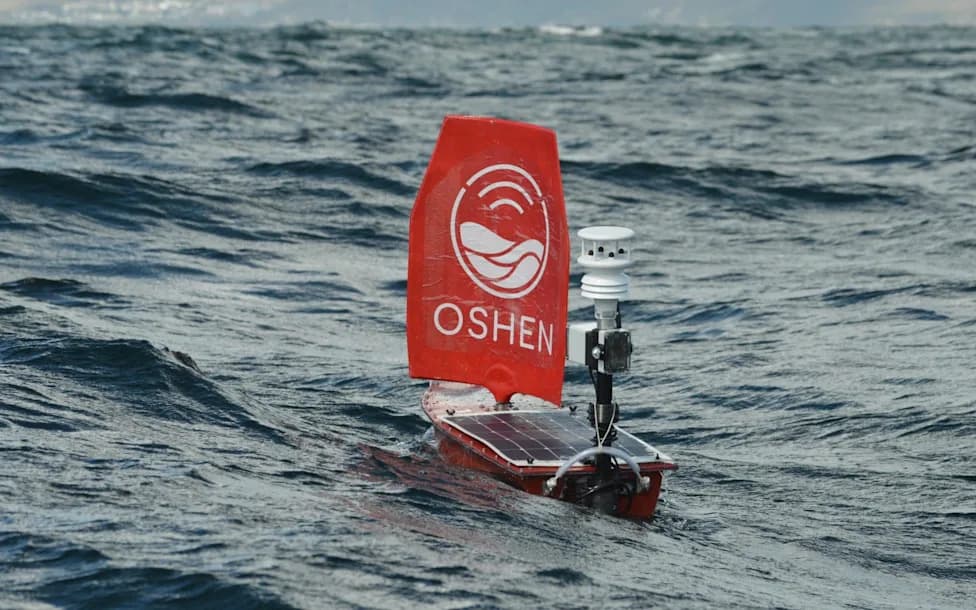
The Oshen C-Star PC13 Drone Boat has completed the first fully automated crossing of the Atlantic
A 4ft autonomous sailing vessel developed by Oshen in Plymouth has completed the first fully uncrewed crossing of the Atlantic, claiming the Microtransat Challenge prize after 16 years and dozens of attempts.
The Voyage
The Oshen C‑Star PC13 departed Gran Canaria on May 7 and finished the 3,555‑mile journey in 127 days, arriving in Barbados. Along the way the tiny craft endured Tropical Storm Dolly and waves up to 30ft. PC13 navigated busy shipping lanes and corrected an intermittent steering issue to reach the designated finish area, becoming the first vessel to meet the contest's strict unassisted criteria.
How It Works
C‑Stars are primarily sail‑powered and use wind for propulsion. They also carry a small solar‑powered thruster for light‑wind situations, but Microtransat rules prohibit use of any auxiliary propulsion during the challenge. Before launch, teams upload waypoints into the vessel's navigation computer; thereafter the boat makes autonomous decisions with onboard navigation software to reach those points without human intervention.
Challenges and Reliability
Near the midpoint of PC13's voyage the vessel began steering erratically. Oshen's team believes excessive rudder friction was the likely cause, but the craft self‑corrected and continued steadily thereafter. Oshen reached this milestone on its third crossing attempt after earlier failures: the 2023 attempt lasted 20 days and covered just 6.2 miles, while a 2024 attempt remained afloat for 277 days and reached roughly three‑quarters of the route before losing its sail in heavy seas. Those experiences informed design improvements to hull strength, sail systems and the autonomous software that continuously evaluates wind, currents and battery status.
Science, Weather Monitoring and Future Plans
Beyond the Microtransat achievement, C‑Stars serve as mobile sensor platforms that record sea surface temperature, air temperature, air pressure, humidity, salinity and water density. Last year a C‑Star entered Hurricane Humberto to provide real‑time data to the US National Oceanic and Atmospheric Administration (NOAA), surviving for hours inside the hurricane's eyewall and transmitting valuable forecast information.
Oshen currently operates a constellation of boats in the Caribbean on an extended hurricane detection mission with NOAA and plans to deploy its largest fleet next year to monitor climate tipping points in the North Atlantic. The company also envisages future payloads such as hydrophones to detect illicit submarine activity or to locate vessels that have switched off transponders.
About the Microtransat Challenge
The Microtransat Challenge, founded in 2010 by Dr Mark Neal (Aberystwyth University) and Dr Yves Briere (Institut Supérieur de l'Aéronautique et de l'Espace), seeks to determine how quickly an autonomous sailing boat can cross the Atlantic under strict rules. Entrants must cross unassisted, cannot be influenced after launch, and are limited to boats no longer than 7ft 10in—constraints that limit solar array area and onboard power for computers and thrusters.
Anahita Laverack, Oshen's chief executive and co‑founder, said: "We are thrilled to have finally completed the Microtransat. Even in the final hours, after so many days at sea, we weren't certain that PC13 would reach the designated finishing zone. This result validates the team's work and sets the stage for permanent ocean monitoring constellations."
Help us improve.