India told its Supreme Court it may adopt stricter red hexagonal front-of-pack warnings in a single step, abandoning an earlier two-phase proposal that required breaches in two nutrients before labelling. The FSSAI indicated it could implement the tougher rule so that any product high in added sugar, salt or saturated fat would carry a red warning. The move intensifies a national debate over industry lobbying, per-serve vs. per-100g thresholds, and mounting obesity concerns; the court said it would issue an order before Friday.
India Signals One-Step Rollout of Tough 'Red Hexagon' Food Warnings, Raising Stakes for Big Food
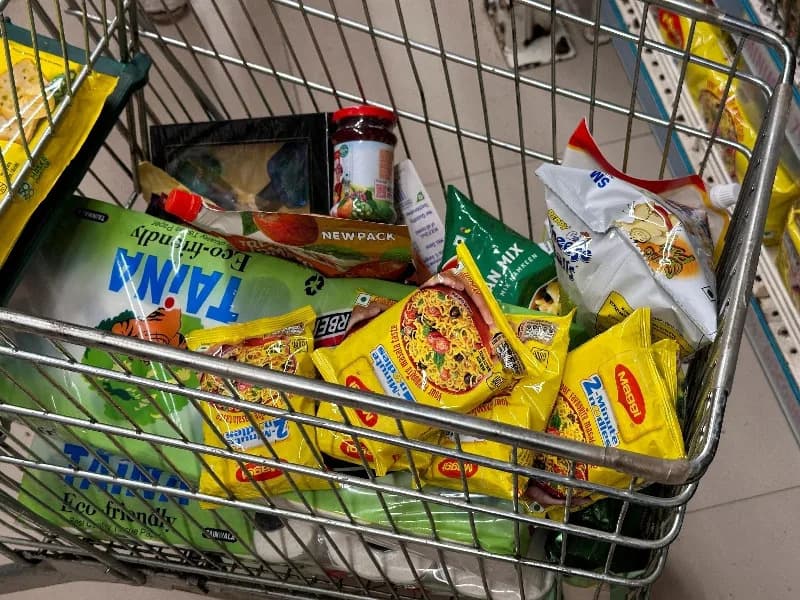
FILE PHOTO: Packets of Nestle Maggi 2-Minute Noodles in a shopping cart in Mumbai, India, August 19, 2026. Picture taken with a mobile phone. REUTERS/Francis Mascarenhas/File Photo
New Delhi — India moved closer on Thursday to requiring stricter red front-of-pack warning labels on packaged foods in a single step, reversing an earlier, industry-friendly phased approach and representing a potential setback for major food and beverage companies operating in the country.
The Food Safety and Standards Authority of India (FSSAI) told the Supreme Court it could implement the tougher rules "in one go" after justifying a two-phased rollout in earlier filings. Under the new approach discussed in court, any product that is high in added sugar, salt or saturated fat would carry a red hexagonal warning label, rather than requiring excesses in two nutrients before a warning is applied.
Court Hearing and Regulatory Shift
The change was presented during a hearing of petitions from health activists, who have repeatedly criticised the FSSAI for delays in implementing stronger front-of-pack warnings as obesity rates rise. Justice J.B. Pardiwala pressed the regulator on the rationale for phasing, stressing that labels should not allow products to escape scrutiny. “It has to be sugar and salt. Only then will you ask them to put a label?” he asked, emphasising the word "and."
The FSSAI's counsel, Additional Solicitor General Brijender Chahar, told the court the authority is prepared to roll out both phases "in one go," meaning a red label would apply if a product is high in even one of the three nutrients.
Industry Response and Public Health Debate
The proposed move intensifies a national debate that has grown since reporting that industry lobbying influenced an earlier, weaker proposal. Major multinationals and domestic firms — including Nestle, Unilever, PepsiCo, Coca-Cola, ITC and Dabur — have significant stakes in India's roughly $100 billion food and drinks market. Industry groups have argued for per-serve labelling (as proposed in the United States) rather than nutrient thresholds per 100 grams, saying some staples and condiments would be unfairly flagged under a 100-gram benchmark.
The All India Food Processors' Association urged regulators to adopt per-serve calculations, with its counsel illustrating how products such as pickles are consumed in smaller portions than 100 grams. Health campaigners and non-profits, by contrast, insist on the 100-gram standard, arguing it is simpler, harder to manipulate and better aligned with international practice in many countries.
Public Health Stakes and Next Steps
A Lancet study cited at the hearing warned that as many as 450 million Indians could be overweight or obese by 2050, highlighting the public health concerns driving activist calls for stronger warnings. The Supreme Court said it was "concerned with the health of people, more particularly growing children," and asked stakeholders to cooperate in the public interest. The judges indicated they would issue a written order before Friday.
(Reporting by Aditya Kalra; additional reporting by Arpan Chaturvedi; editing by Tom Hogue, Kate Mayberry and Sharon Singleton)
Help us improve.