Students using the Gemini North telescope on Maunakea discovered the interacting galaxy pair NGC 7253 and named it Nā 'Uhane Māhoe Huki Pū i ke Ola — “The Twin Spirits Pulling Together Creating Life.” The system lies about 200 million light-years away in Pegasus and is notable for the clear spiral structure visible in both galaxies as they interact. The students linked the name to both the physical merger and their cultural and communal experiences at Maunakea, and the interaction is expected to trigger bursts of star formation.
Twin Spirits Entwined: Students Discover Interacting Galaxies NGC 7253 (Nā 'Uhane Māhoe Huki Pū i ke Ola)
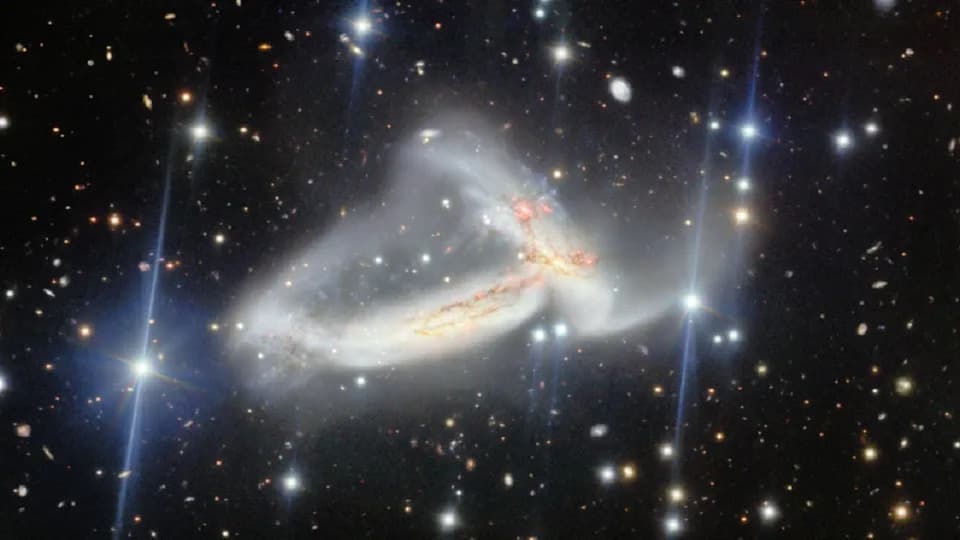
Nā 'Uhane Māhoe Huki Pū i ke Ola is the Hawaiian name given to this image of NGC 7253 — a pair of spiral galaxies caught in each other's gravity. This image was captured by the Gemini North telescope on Maunakea. | Credit: International Gemini Observatory/NOIRLab/NSF/AURA
This striking image of NGC 7253 — two spiral galaxies drawn together by their mutual gravity — carries the Hawaiian name Nā 'Uhane Māhoe Huki Pū i ke Ola. Astronomers captured the photo with the Gemini North telescope on Maunakea.
It can be almost impossible to grasp the scale of a single galaxy: many span hundreds of thousands or even millions of light-years. Now imagine two such giant systems slowly merging — a majestic, slow-motion dance that astronomers captured in extraordinary detail in this photograph.
The interacting pair was identified by students using Gemini North on Maunakea. The student team, from Waiākea High School and the Volcano School of Arts and Sciences, participated through the Project Hōkūlani internship program. Maunakea is a world-class observing site that is also the focus of important cultural and community concerns; the students' work took place in that complex context.
The students named the system Nā 'Uhane Māhoe Huki Pū i ke Ola, translated as “The Twin Spirits Pulling Together Creating Life.” They explained that 'Uhane (spirit) expresses how the experience of stargazing, summit visits, and learning at Maunakea inspired them. "Huki Pū" refers to the physical pull of the galaxies and to communities working together, while "i ke Ola" points to the life-giving potential of galactic interactions, which often trigger new star formation.
"'Uhane (spirit) was an important theme for our group. Our experiences throughout the week — 'oli (stargazing), visiting the summit and learning about the awesome scientific discoveries made possible by Maunakea — ignited our own spirits as we prepare for life after high school," said Samantha Silva-Sampaio, one of the student discoverers, in a statement.
The system is cataloged as NGC 7253 and lies roughly 200 million light-years from Earth in the northeastern sky region astronomers call Pegasus. In Hawaiian star lore this area is associated with the constellation Ka Lupe o Kawelo.
One remarkable feature of the image is how clearly both spiral galaxies retain defined structure even as they interact. High-resolution observations like this let astronomers study the details of tidal arms, dust lanes, and regions of intense star formation.
Galaxy mergers are common across the universe. Because galaxies are mostly empty space, direct collisions between stars are rare; instead, interstellar gas and dust collide and compress, often sparking bursts of star formation. Over time, those newborn stars can give the merged remnant a bright, glittering appearance. Our own Milky Way and the nearby Andromeda Galaxy are expected to interact in the far future, producing similar processes on a grand scale.
"'Uhane in this image reminds us that astronomy is not just science or spirit; it's both at the same time," said Manu Silva-Sampaio, another student involved in the discovery.
Credit: International Gemini Observatory/NOIRLab/NSF/AURA
Help us improve.