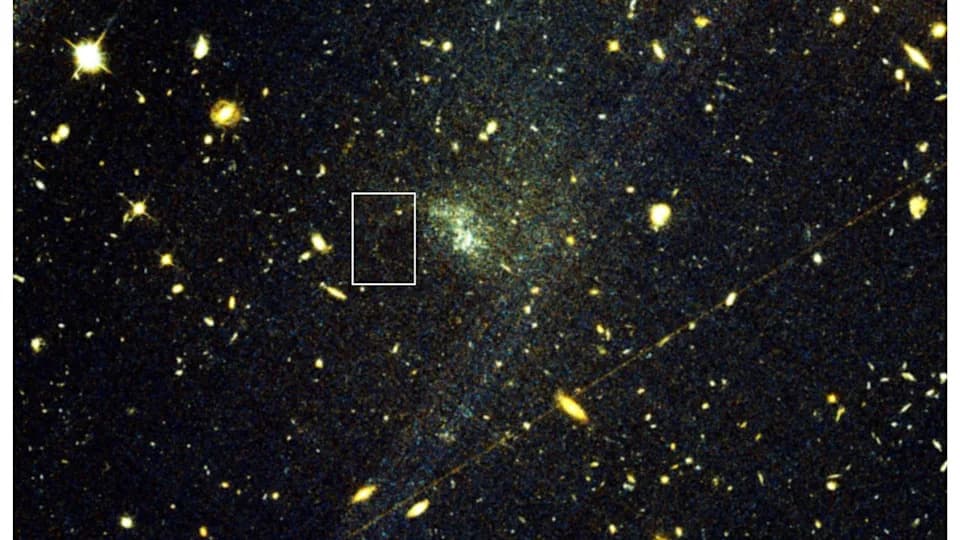
A VST survey led by INAF has cataloged nearly 50 extremely faint dwarf galaxy candidates—"ghost galaxies"—around three host galaxies (NGC 5068, NGC 5084, NGC 5087) at roughly 17, 80, and 100 million light-years. The findings extend dwarf counts well beyond the Local Group and provide fresh observational tests of tensions in the standard cosmological model, such as the "missing satellites" problem and unexpected planar alignments of satellites. While confirmation and follow-up are required, the new catalog offers important data to compare observations with simulations.
Chile Telescope Reveals Nearly 50 Faint 'Ghost' Galaxies Orbiting Three Distant Hosts

Photo Credit: iStock
A team of astronomers using the VLT Survey Telescope (VST) at ESO's Paranal Observatory in Chile has cataloged nearly 50 extremely faint dwarf systems—often called "ghost galaxies"—around three much larger galaxies. The survey, led by Italy's National Institute for Astrophysics (INAF), adds valuable data to a long-standing debate about how many small galaxies should exist around massive hosts and how they are distributed.
Observations and Findings
The INAF-led study identified candidate dwarf companions around NGC 5068, NGC 5084, and NGC 5087. These primary galaxies represent different morphological types: NGC 5068 is a spiral (~17 million light-years), NGC 5084 is a lenticular (~80 million light-years), and NGC 5087 is an elliptical (~100 million light-years). The results appear in the journal Astronomy & Astrophysics.
Detections were made possible by the VST's wide-field imaging and careful searches for very low surface-brightness objects. Because dwarfs with masses of about a billion suns or less are intrinsically faint, most well-documented examples have been found much closer to Earth—especially within the Local Group—making these more distant detections noteworthy.
Why This Matters
Dwarf galaxies provide critical tests of the standard cosmological model. One key tension is the "missing satellites" problem: many simulations predict more small companion galaxies around massive hosts than observers have historically found. Another puzzle is the unusual geometry of satellite systems—dwarfs around the Milky Way and some other galaxies are sometimes seen in thin, flattened planes rather than being isotropically distributed.
By extending systematic searches beyond the Local Group, the new catalog gives astronomers additional data points to determine whether apparent over- or undercounts of dwarf satellites and the presence of planar alignments are local curiosities or universal features that models must explain.
Next Steps
These nearly 50 candidates do not settle the debate but provide fresh targets for follow-up observations. Spectroscopy and deeper imaging will be needed to confirm which objects are true gravitationally bound satellites and to measure their velocities and stellar content. Such follow-up will refine comparisons with cosmological simulations and help determine whether theoretical models require adjustments.
Bottom line: The VST survey substantially increases the sample of faint dwarf systems discovered beyond the Local Group, offering new leverage to test galaxy-formation theories and the distribution of dark matter on small scales.
Help us improve.