Austria has enacted a nationwide ban on "traditional Muslim" head coverings for girls under 14 in public and private schools as the new term begins. Supporters say the measure protects children and advances gender equality; critics, including the Islamic Community in Austria (IGGÖ), argue it infringes religious freedom and singles out Muslim girls. Teachers are required to hold talks with pupils and guardians, with repeated breaches triggering child services notification and potential fines of up to €800. The IGGÖ plans to support legal challenges, citing a 2020 Constitutional Court ruling that overturned an earlier ban.
Austria Enforces Headscarf Ban For Girls Under 14 As Schools Reopen

[Getty Images]
As the new school year begins, Austria has brought into force a law that bans "traditional Muslim" head coverings — described by lawmakers as including hijabs and burkas — for girls under 14 in both public and private schools nationwide.
What the Law Says
The legislation, introduced by the three-party coalition of the conservative People’s Party (ÖVP), the Social Democrats (SPÖ) and the liberal Neos, is presented by supporters as a measure to protect children and promote gender equality. Under the guidance, teachers who see a pupil wearing a headscarf must carry out a sequence of conversations with the student and their legal guardians. If the practice continues, child services must be notified and, as a last resort, guardians could face fines of up to €800 (£685).
Government Rationale
Integration Minister Claudia Bauer (ÖVP) defended the law, saying the headscarf can be "a sign of oppression and a means of controlling girls from the earliest childhood." Coalition backers frame the ban as a reaffirmation of gender equality and a protection for young girls.
Opposition And Legal Challenges
The Austrian Islamic Community (IGGÖ) and its representative Carla Amina Baghajati oppose the ban. Baghajati told the BBC the organisation "firmly opposes the ban," arguing it "unjustifiably restricts the fundamental right to freedom of religion and disproportionately affects Muslim girls." The IGGÖ has pledged to support legal challenges by families who believe their rights are being infringed and who wish to bring cases to the Constitutional Court.
Austria's Constitutional Court previously struck down a related ban on headscarves in primary schools in 2020 on the grounds that it violated the country's commitment to religious neutrality.
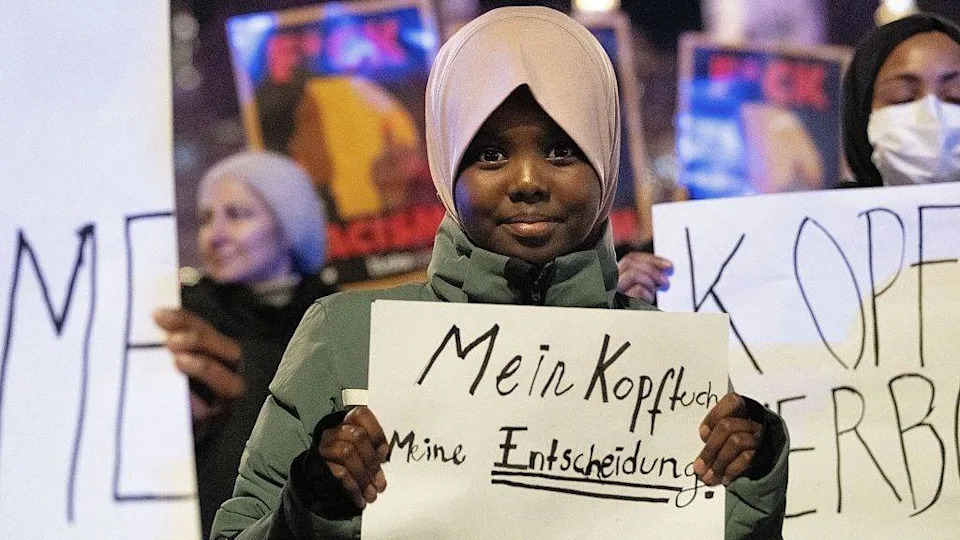
An 11-year-old student protests the ban in Vienna back in February with the banner "meine Kopftuch, meine Entscheidung" - "my headscarf, my decision" [Getty Images]
Practical Concerns And Political Fallout
Some teachers have voiced unease about being asked to enforce the law. Green Party MP Sigi Maurer criticised Education Minister Christoph Wiederkehr (Neos), accusing him of offloading conflict-management onto already overburdened teachers and effectively asking them to act like police officers.
The far-right Freedom Party (FPÖ) says the new measure does not go far enough and is calling for a blanket ban on headscarves and face coverings for both students and teachers. FPÖ politician Ricarda Berger declared there was "no place for political Islam in Austria, and certainly not in our schools." Chancellor Christian Stocker (ÖVP) has also spoken of tougher measures, calling for a constitutional ban on political Islam and saying he did not "want to live in an Islamic state."
European Context
Observers compare the Austrian law with long-standing French rules that ban conspicuous religious symbols — including headscarves, turbans and kippas — from state schools. Commentators note a difference in that the Austrian law specifically targets head coverings commonly worn by Muslim women. Austria already joins other European countries such as France, Belgium and Denmark in prohibiting the full-face veil (niqab or burka) in public.
"Such approaches may generate political attention, but they rarely solve the underlying problems,"
Baghajati warned, expressing concern about a broader European trend of addressing complex social challenges through symbolic measures aimed at minority groups.
Public Reaction
The law has prompted protests — including an 11-year-old who demonstrated in Vienna holding a banner that read "meine Kopftuch, meine Entscheidung" ("my headscarf, my decision"). The issue has sharply divided public opinion and is likely to prompt legal battles and ongoing debate about religious freedom, gender equality and school responsibilities.
Help us improve.