In 2009, tourism operators reported an uptick in humpback "fluking" in the Whitsundays, prompting a joint citizen-science and research effort. Scientists combined counts, seafloor mapping, temperature monitoring, satellite tracking and aerial surveys to find that the area is a key calving ground. The fluking behaviour was linked to breeding and birthing, and the discovery helped establish the Whitsundays Whale Heritage Area within the Great Barrier Reef Marine Park.
Why Australia’s Humpback Whales Were 'Fluking' — A Maternity Mystery Solved
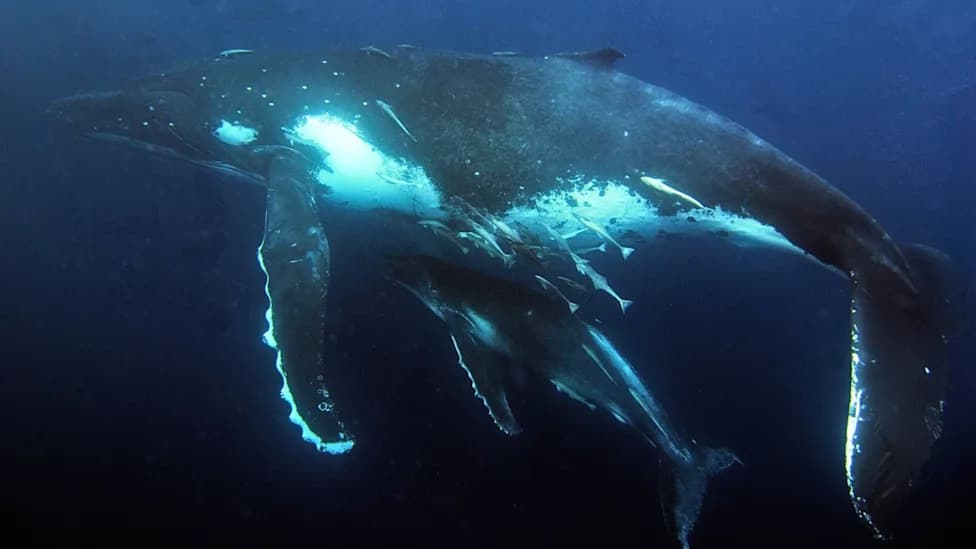
A mother humpback whale and calf near the Great Barrier Reef.
In 2009, tourism operators along Australia’s northeastern coast began noticing an unusual surge in a behaviour called “fluking,” in which a humpback whale (Megaptera novaeangliae) rolls tail-up while floating inverted and holds its fluke above the water. Perplexed by the repeated displays, operators contacted researchers and set in motion a coordinated investigation that ultimately solved a long-standing puzzle about humpback whales on the Great Barrier Reef.
The activity was concentrated in the Whitsundays, an island-studded region between the Great Barrier Reef and Australia’s north-eastern shoreline.
"It was an unusual behaviour they had never seen before. Not even the whale scientists knew what it meant at the time," said Crystal Lacey, Master Reef Guides program manager. "So that uncertainty sparked a major research effort, which combined citizen science through the tourism operators' observations, and scientific research. It was one of the region's largest citizen science efforts."
The collaborative programme combined systematic observations from tourism operators with rigorous scientific methods. Operators counted adults and calves, while researchers conducted seafloor mapping, monitored water temperatures, tracked whales by satellite telemetry and performed aerial surveys of the area.
Those combined efforts revealed that the Whitsundays are among the Great Barrier Reef's most important humpback calving grounds — in effect, a previously unrecognised maternity area for the species. The behaviour operators labelled "fluking" was linked to breeding and birthing activity: the sheltered, warm, shallow waters of the Whitsundays provide an ideal environment for females to give birth and nurse newborn calves.
As a result of the research findings, authorities moved to strengthen protections for the area, culminating in the establishment of the Whitsundays Whale Heritage Area within the Great Barrier Reef Marine Park.
Humpback whales occur in all the world’s oceans and are a favourite with whale-watchers because they often come close to shore and display dramatic surface behaviours. Humpbacks mate belly-to-belly in what is often described as a "hugging" posture. Females have a gestation period of about 11–12 months, typically give birth every two to three years, and deliver calves tail-first.
Why this matters: The discovery highlights the value of combining citizen science with formal research, improves our understanding of humpback reproductive behaviour, and informs conservation measures that protect critical habitats for vulnerable calves.
Help us improve.