Astronomers have discovered a massive ten‑sided atmospheric wave encircling Saturn’s southern mid‑latitudes after the planet’s tilt brought the region into clear view from 2023–2025. The decagon is a repeating bend in a fast eastward jet—each side spans roughly 10,000 miles and the jet blows near 260 mph—whose corners strengthen, weaken and shift on month‑long cycles. A nearby red storm appears linked to the wave, and computer simulations show strong, curved jets can form polygonal patterns when perturbed. Unlike Saturn’s long‑lived north‑pole hexagon, the southern decagon appears relatively unstable and newly formed.
Saturn's New 'Decagon': Astronomers Spot a Massive Ten‑Sided Atmospheric Wave
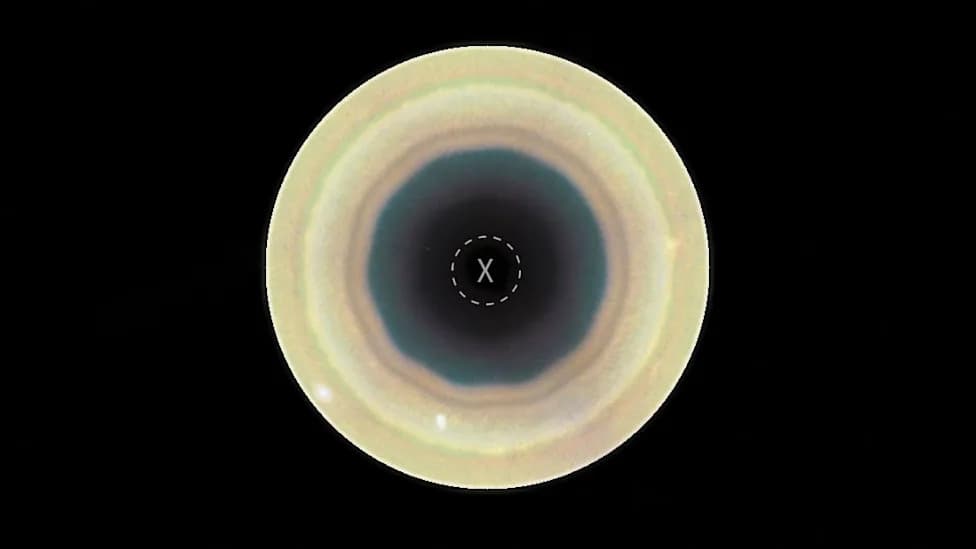
The Hubble Space Telescope sees a new 10-sided atmospheric wave surrounding Saturn's south pole. - NASA / ESA / Agustin Sánchez-Lavega / Amy Simon / Michael Wong / Alyssa Pagan
A team of astronomers has identified a vast, ten‑sided pattern encircling Saturn’s southern mid‑latitudes: a decagon of alternating bright and dark cloud contrasts produced by a repeating atmospheric wave in a fast‑moving jet stream.
Observations and Timing
The feature became visible only after Saturn’s axial tilt swung the southern hemisphere back toward Earth, giving the Hubble Space Telescope and large ground‑based observatories clear views from 2023 through 2025. The discovery and analysis appear in Science Advances.
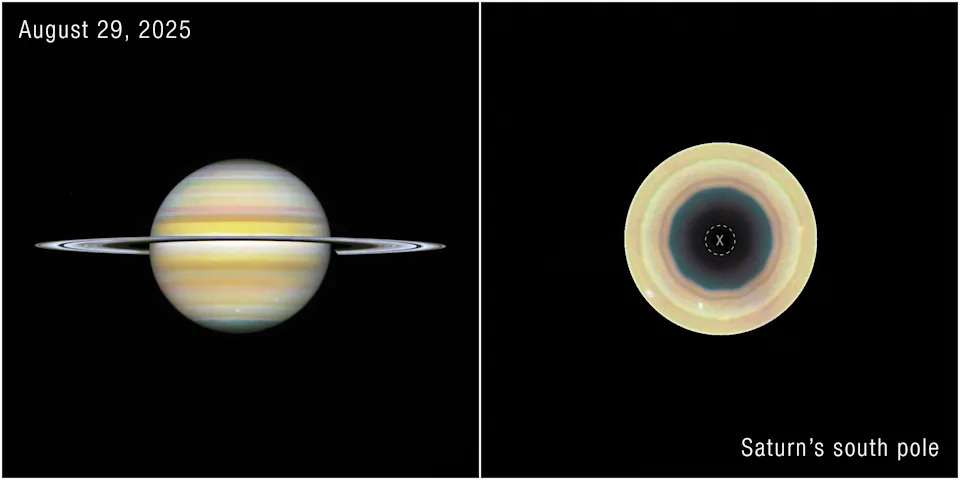
When Saturn's tilt swung the south pole back toward Earth, Hubble finally gained a clear view of the strange atmospheric wave pattern.
What the Decagon Is
Rather than a solid ring, the decagon is a global atmospheric wave: a repeating bend in a powerful eastward jet. The jet oscillates slightly toward the pole and then the equator as it circulates; where the flow bends one way, clouds pile up and brighten, and where it bends the other way, clouds thin and darken. The pattern produces the visual impression of straight sides and sharp corners, although no features are literally knife‑edged.
Scale and Behavior
Each facet of the decagon spans roughly 10,000 miles, and the underlying jet stream moves at about 260 mph. The decagon’s corners strengthen, weaken and migrate slowly, cycling on roughly month‑long timescales. Hubble images from 2023 showed only faint hints of corners; by 2024 and 2025, all ten points were visible, though their brightness and definition vary.
Each facet of the decagon stretches about 10,000 miles.
Storm Connection and Models
Just north of the decagon sits a red storm a few thousand miles across—distinct from Jupiter’s Great Red Spot—that appears bright in some visible wavelengths and dark in ultraviolet. The strongest corners of the decagon cluster near this storm, suggesting the storm and the wave may exchange energy within the same jet and that the storm could help trigger or modulate the polygonal pattern.
Researchers tested mechanisms with numerical simulations of Saturn’s weather layer. By initializing the jet and applying perturbations—lines of small bumps, a localized storm analogue, or an imposed ten‑wave pattern—models showed that strong, curved jets can produce polygon‑like waves when nudged, even if no single simulation reproduced every observed detail.
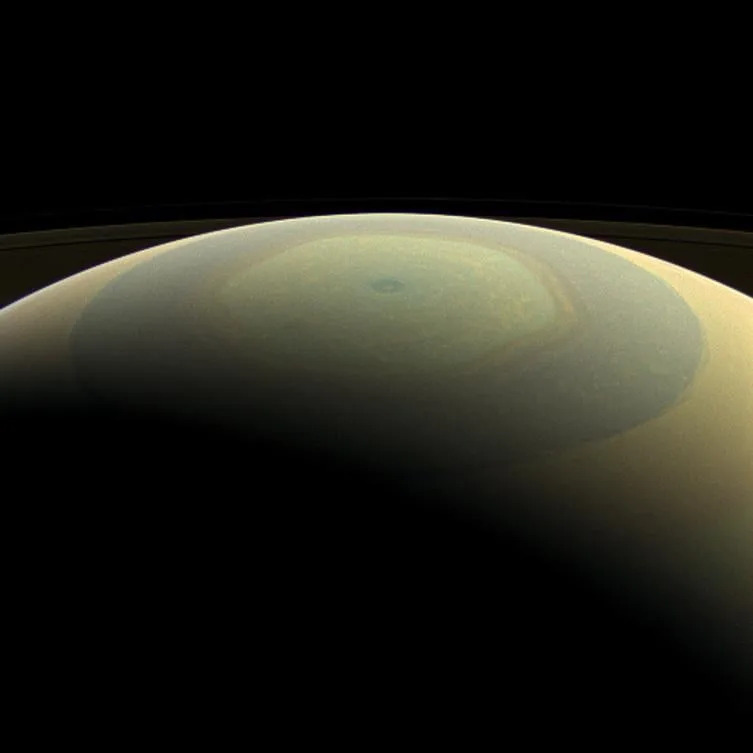
NASA's Cassini spacecraft photographed Saturn's hexagonal atmospheric wave pattern ringing its north pole in July 2013.
Comparison With the North‑Pole Hexagon
Saturn’s famous north‑pole hexagon—first seen in Voyager images and later photographed by Cassini—has persisted since the early 1980s and remains relatively steady in shape and position. The newly observed southern decagon appears more ephemeral: it formed recently, varies in intensity and position, and was not evident in Cassini data from 2004–2017. "The most intriguing part to me is that this seems to have just formed recently," said Amy Simon of NASA Goddard Space Flight Center. Agustín Sánchez‑Lavega, lead author of the study, noted that Cassini images showed no sign of a long‑lived southern polygonal formation.
Why This Matters
Understanding why some giant‑planet jets settle into tidy geometric structures while others fragment into turbulence is an active area of planetary science. Jupiter’s poles, for example, host clustered cyclones arranged in ring‑like, sometimes polygonal patterns. Tracking Saturn’s southern decagon through the seasons will help scientists learn how jets, storms and sunlight interact to produce—or dissolve—large‑scale atmospheric patterns on gas giants.
Source: Science Advances; Hubble Space Telescope observations; analysis by an international team of planetary scientists.
Help us improve.