
JWST and Gemini North reveal that Centaur 450P/LONEOS is developing a dust coma and releasing carbon dioxide while water vapor and carbon monoxide remain undetected. A 1992 Saturn encounter shifted the object into a warmer orbit, and thermal models suggest that crystallization of amorphous water ice at ~140–160 K released trapped CO₂ that powers dust ejection. JWST measured a CO₂ production rate near 6.99 × 10^24 molecules/s at 7.16 AU and found water‑ice grains ≈5.9 μm with ~33% ice by volume. Continued monitoring will test whether this Centaur evolves into a Jupiter‑family comet.
JWST Sees an Icy Centaur Wake Up: CO₂ Emission Signals a Transition Toward Cometary Activity
JWST detected CO₂ and icy dust around Centaur 450P/LONEOS, revealing how a frozen outer solar system body may become comet-like. (CREDIT: Shutterstock)
More than 3 billion miles from Earth, astronomers have caught a small, frozen world beginning to behave like a comet. Observations with the James Webb Space Telescope (JWST) and Gemini North show the Centaur 450P/LONEOS developing a dust coma and emitting carbon dioxide gas, while gaseous water and carbon monoxide remain undetected.
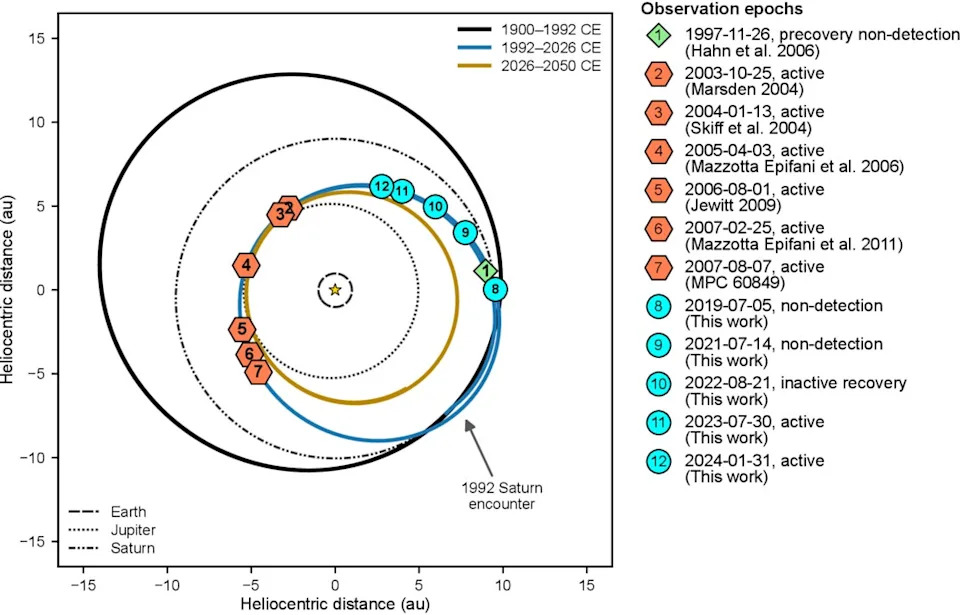
450P's orbital history is visualized with this diagram. The Centaur had a close approach to Saturn in 1992 that changed its long-term trans-Saturnian orbit (black curve) into one with a perihelion closer to Jupiter (blue). (CREDIT: Charles Schambeau et al, Planetary Science)
The University of Central Florida–led team, led by planetary scientist Charles Schambeau, argues that 450P offers a rare, well-documented example of how a sudden orbital change can expose a primitive outer‑Solar System object to stronger solar heating and trigger activity.
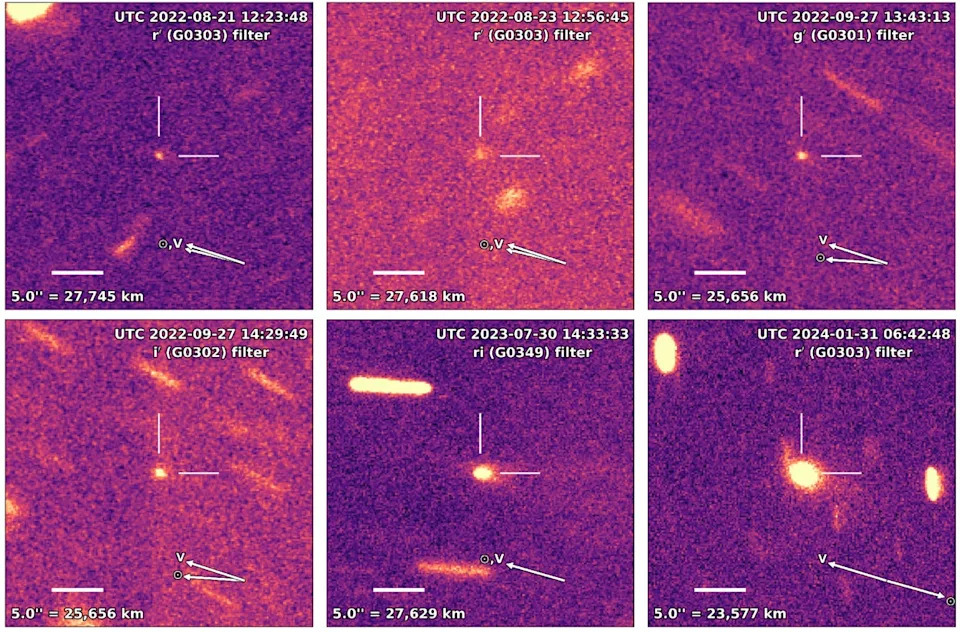
Gemini-N GMOS images of 450P. The top left and top middle panels display the recovery images when the Centaur appeared inactive and that were used to estimate the nucleus's radius. (CREDIT: Charles Schambeau et al, Planetary Science)
Key Observations
When astronomers recovered 450P in August 2022 after roughly 15 years without a detection, Gemini North images showed a point‑like source that yielded a nucleus radius estimate of ≈1.8 ± 0.5 km. As the object moved inward, Gemini imaging revealed the onset of a coma between about 7.83 and 7.23 astronomical units (AU) from the Sun, and dust production increased from roughly 4 kg/s (July 2023) to ~8 kg/s (January 2024).
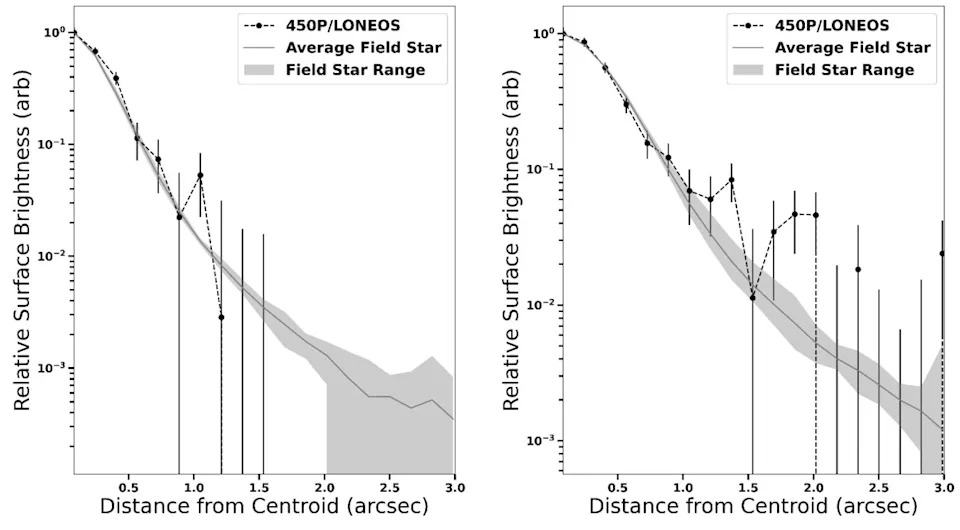
Normalized radial surface brightness profiles of the Gemini-N 450P images on 2022 August 21 (r'; left panel) and 2022 September 27 (g'; right panel). (CREDIT: Charles Schambeau et al, Planetary Science)
Crucially, JWST's Near‑Infrared Spectrograph (NIRSpec) observed 450P on 2023‑09‑03 at 7.16 AU and detected a strong carbon dioxide emission band at 4.26 micrometres. The team derived a CO₂ production rate of about 6.99 × 10^24 molecules per second. No gaseous H₂O or CO lines were detected above the observation limits.
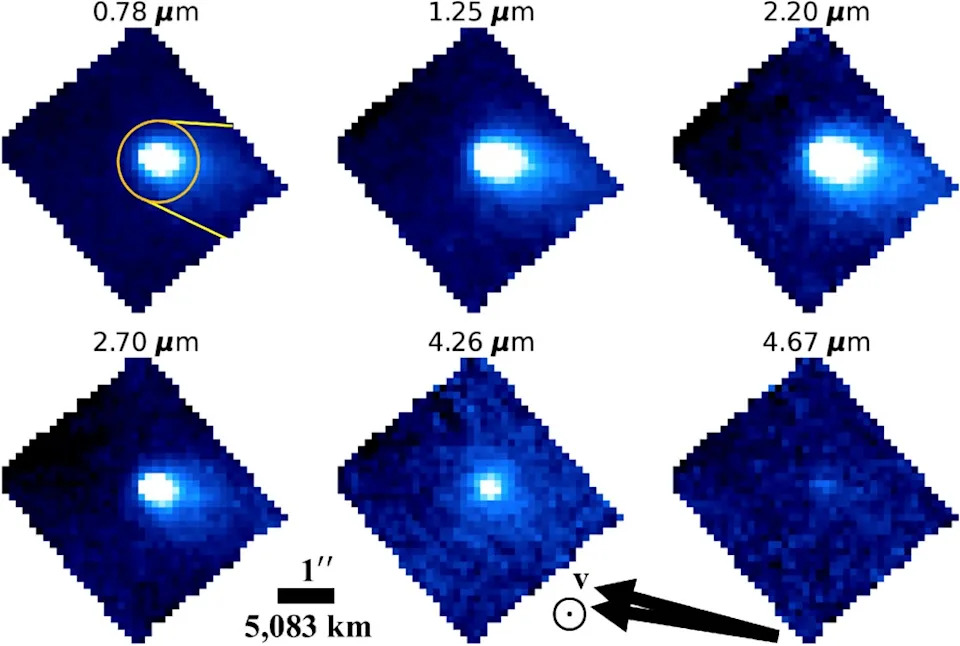
Wavelength-integrated image panels of 450P extracted from the JWST NIRSpec IFU datacube at different bandpasses (the effective wavelength is listed directly above each panel). (CREDIT: Charles Schambeau et al, Planetary Science)
What the Chemistry and Dust Tell Us
Webb also found absorption features in the coma attributable to solid water ice. Spectral modeling favors relatively large icy grains (≈5.9 μm across) with an estimated ~33% water ice by volume. A subtle feature near 3.1 μm hints that some of this ice may be crystalline.
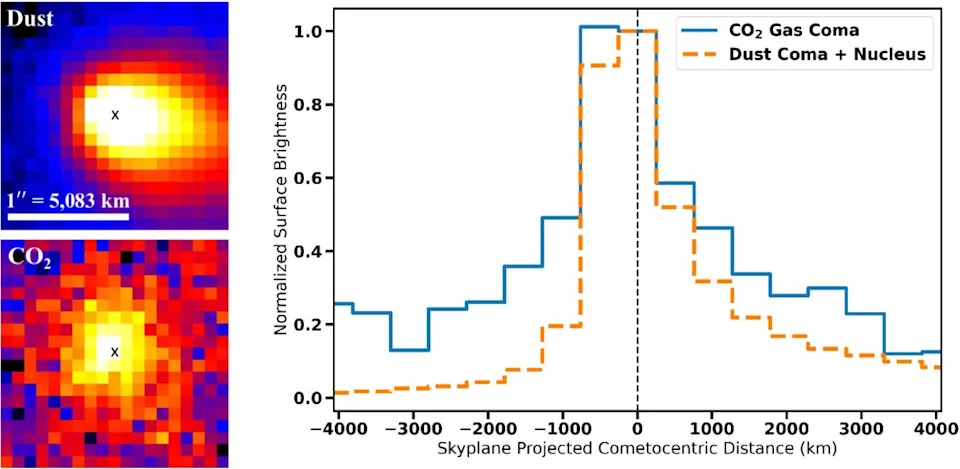
Measurements of the dust and CO2 gas emission in 450P's coma. The left two panels display the dust and CO2 gas surface brightness maps. The right panel displays radial surface brightness profiles for CO2 (solid blue line) and dust (dashed orange line) plotted against projected cometocentric distance. (CREDIT: Charles Schambeau et al, Planetary Science)
Because 450P is too cold at these distances for vigorous water‑ice sublimation, the detection of CO₂ is an important clue: carbon dioxide can drive activity at lower temperatures and plausibly loft dust from the surface.
Orbital History and Thermal Interpretation
Orbital reconstructions show that a close encounter with Saturn in 1992 produced a rapid semimajor‑axis change (an “a‑jump”) that moved 450P from a more distant trans‑Saturnian orbit to one with perihelion nearer Jupiter. That orbital shift increased the solar energy reaching the object and altered its subsurface thermal balance.
Thermal models indicate that easily accessible deposits of pure CO₂ could have been depleted to depths of >200 m before the 1992 encounter, so the team favors a complementary explanation: amorphous water ice, which can trap volatile gases, warms and crystallizes at roughly 140–160 K, releasing trapped CO₂ that percolates through porous layers and carries dust into space.
Limitations and Next Steps
The interpretation is strongly supported but not proven: only one JWST gas measurement is available so far, and the authors note that repeated observations and more refined thermal modeling are needed to fully constrain the processes at work. Continued monitoring with Webb and ground‑based facilities can reveal whether CO₂ and dust output continue to rise and whether H₂O or CO eventually appear in detectable amounts.
Orbital calculations in the study also predict a close approach to Jupiter of roughly 0.5 AU in July 2026, an encounter that could stabilize 450P's orbit for on the order of 200 years; the actual effects of that future encounter remain to be observed.
Studying objects like 450P helps bridge our understanding from distant trans‑Neptunian bodies to the short‑period comets seen near the Sun, illuminating how volatile chemistry and orbital perturbations drive small‑body evolution.
Help us improve.





















