Researchers at the Potsdam Institute for Climate Impact Research, with Senckenberg collaborators, find annual burned area in Europe could rise by about 39% by 2100 under current emissions trajectories, with far larger increases if warming reaches 3.6°C. The report highlights that hotter, drier and windier conditions are already straining firefighting capacity; roughly 550,000 hectares had burned across the EU by 12 August. Experts call for emissions reductions plus greater investment in prevention, early detection, firefighting and nature-based forest management to reduce future risk.
Europe Could See Roughly 39% More Land Burned Annually By 2100, Study Warns
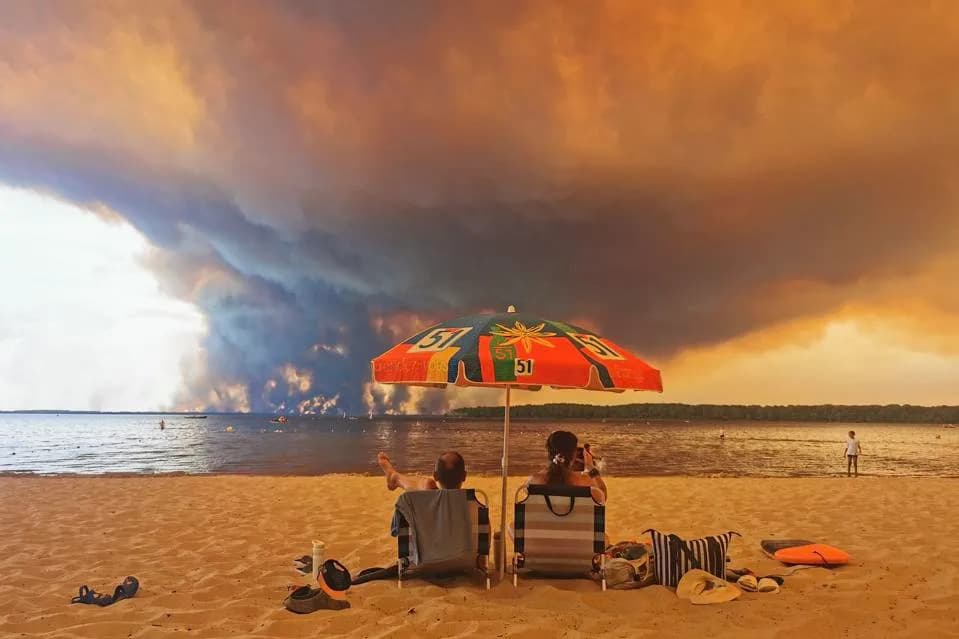
TOPSHOT - Beachgoers sit on the beach of Moutchic in Lacanau, southwestern France on July 24, 2026, as clouds of smoke rise into the sky from a wildfire. The fire raging in the northern part of the Arcachon Basin in Gironde, southwest France, has swept through more than 3,400 hectares, according to the latest figures released by the prefecture. More than 20,000 residents and tourists have been evacuated from this part already devastated by flames in 2022. Scientists have long warned that climate change caused by human use of fossil fuels will make periods of drought more intense and longer-lasting, creating the ideal conditions for wildfires. (Photo by Maximilien LAMY / AFP via Getty Images)AFP via Getty Images
Summary: A new study led by the Potsdam Institute for Climate Impact Research (PIK), with contributions from the Senckenberg Society for Nature Research, projects a substantial rise in the area burned by wildfires across Europe by the end of the century. Rising temperatures and drier, windier conditions driven by human-caused climate change are the primary drivers of the increase.
The analysis estimates that, under current emissions trajectories, the annual area affected by wildfires in Europe could increase by about 39% by 2100 compared with today. Even a relatively modest warming scenario of roughly 1.8°C produces widespread increases in burned area; a higher-emissions scenario with global warming of around 3.6°C would drive much larger and more frequent fires, particularly in the Mediterranean and across Western and Central Europe.
Current Season And Context
The report arrives amid another severe fire season. According to the European Forest Fire Information System (EFFIS), about 550,000 hectares had burned across EU countries as of 12 August — roughly two-and-a-half times the long-term average for this point in the year. Recent blazes in southwest France’s Arcachon Basin have consumed more than 3,400 hectares and prompted the evacuation of over 20,000 residents and visitors.
What Experts Say
"Our results indicate widespread increases in burned area even under comparatively low warming of around 1.8°C," said PIK researcher and lead author Maik Billing. He added that under higher emissions, fires become far more prevalent and destructive.
PIK co-author Kirsten Thonicke warned that hot, dry and windy spells can quickly overwhelm firefighting resources. "With climate change, conditions could become so extreme that we really hit limits to what we can do to prevent and fight fires once they get to a certain size," she said.
Thomas Hickler of Senckenberg said increased investment in wildfire management — prevention, detection and suppression capacity — can make a significant difference in many scenarios. But he cautioned that if fires enter truly extreme behaviour, containment capacity may break down and the threshold for that is not yet known.
National Examples And Prevention Strategies
In the U.K., Claire Belcher of the University of Exeter noted unusually high ignition risk in early July, when large areas were placed on red wildfire alert and the university’s FireInSite model recorded its highest ignition-risk reading since development. July conditions in parts of the U.K. met the "30:30:30 rule" — roughly 30°C, 30% relative humidity and 30 km/h winds — a combination that sharply increases fire risk.
Sarah Carter of the World Resources Institute’s Global Nature Watch highlighted landscape and forest-management practices that can reduce vulnerability: preserve historic water systems, avoid clearcutting in dry areas, create fire breaks, rewet degraded wetlands, and reduce large monocultures of a single tree species. In some locations, introducing or encouraging herbivores can help maintain a mix of young and old trees without intensive mechanical intervention.
Policy Implications
The study underscores two parallel priorities: global emissions reductions to limit long-term increases in fire-prone conditions, and stronger local and regional investment in prevention, early detection, firefighting capacity and nature-based landscape stewardship. Without both mitigation and improved management, Europe faces substantially greater burned area and mounting risks to communities, infrastructure and ecosystems.
Photo caption: Beachgoers watch smoke rise from fires near Lacanau, southwestern France. (Maximilien Lamy/AFP via Getty Images)
Help us improve.