Summary: President Donald Trump has publicly threatened military action against Oman, saying in May that the country "will have to blow them up" and later telling Fox News he might "bomb the s— out of Oman" if it interferes. Senator Marco Rubio sought to downplay the episode in June, saying relations "is fine," but reporting suggests ties are strained as Oman holds talks with Iran over transit through the Strait of Hormuz. The episode highlights public contradictions at the top of U.S. foreign policy and raises questions about Washington's approach to Gulf diplomacy.
Trump Threatens Military Action Against Oman, Undermining Official Reassurances
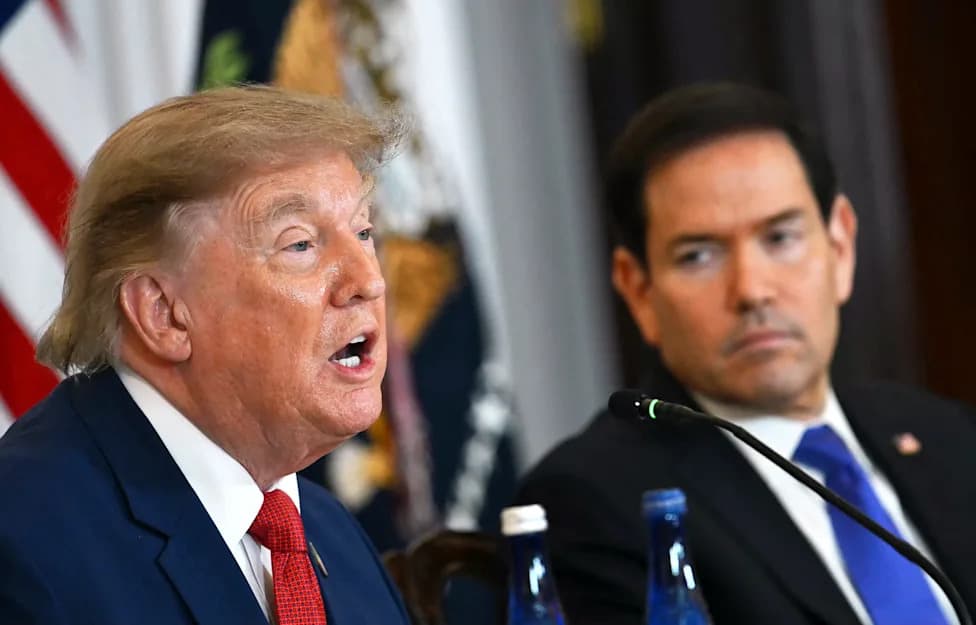
Secretary of State Marco Rubio listens as President Donald Trump speaks during a roundtable on Aug. 7, 2026, at the Department of State.
In May, during a White House Cabinet meeting, President Donald Trump made a startling remark about Oman's role as a diplomatic interlocutor with Iran: "Oman will behave just like everyone else, or we'll have to blow them up." The comment raised immediate questions about intent and awareness, given Oman's long-standing relationship with the United States.
Despite the awkwardness, the State Department later used its social channels to promote the president's remark. In the weeks that followed, Senator Marco Rubio attempted to calm tensions, telling reporters in June that U.S. relations with Oman "is fine" even after the president's threatening comment.
Escalation
Two months later, tensions appeared to rise. On Fox News, the president said he was prepared to "bomb the s— out of Oman" if the country "got in the way." A senior Middle East diplomat familiar with Oman-Iran talks told MS NOW that Oman's stated objective in those discussions is to find a solution that would reopen commercial transit through the Strait of Hormuz.
"I don't think they behave very well," the president said of Omani officials at a later White House event, "but we handle them very easily, just like we do other things."
That bellicose rhetoric renewed speculation about why the president would threaten a U.S. partner. The Wall Street Journal reported that Oman, which borders the Strait of Hormuz to the south, has been in talks with Iran to permit more commercial traffic through the waterway—talks that U.S. officials said could relieve pressure on global energy markets and ease domestic gasoline prices. According to the Journal, some within the administration fear Oman could assist Iran in negotiating a nuclear deal more favorable to Tehran, a prospect that reportedly has angered the president.
Broader Implications
Whether the president will act on these threats remains unclear. The original piece lists other regions that have reportedly seen U.S. military action during the administration's second term, naming Venezuela, Yemen, Syria, Nigeria, Somalia and Iran, along with several attacks on civilian vessels in international waters.
Observers noted a broader pattern: critics say the president sometimes appears warmer toward traditional adversaries than toward certain allies. Former Secretary of State Hillary Clinton commented on Bluesky that "The president is making U.S. policy friendlier to North Korea and Russia than Canada and Oman. Are you kidding me?"
With Senator Rubio's June reassurance in mind, the episode highlights internal contradictions at the top of U.S. foreign policy. Public disagreements between the president and other senior figures create uncertainty about Washington's diplomatic posture at a time of heightened tensions in the Gulf.
Reporting note: This article synthesizes reporting from MS NOW and The Wall Street Journal and notes public statements by the president and other political figures. Some details are drawn from those original reports and quoted comments.
Help us improve.