The Tiber's recent low levels have revealed the remains of Pons Neronis, an ancient bridge near St Peter's Basilica that may predate Emperor Nero and could have been built by Caligula around 39 AD. Archaeologists say the bridge had fallen out of use by the late 3rd or early 4th century and no longer appears in later Roman registers. Officials report the Tiber's urban flow has dropped below 80 m3/s versus a historical average near 150 m3/s, a decline linked to prolonged drought and low Apennine snow, part of a broader water crisis in Italy.
Drought Reveals Ancient 'Nero's Bridge' Near St Peter's as Tiber Falls to Historic Low
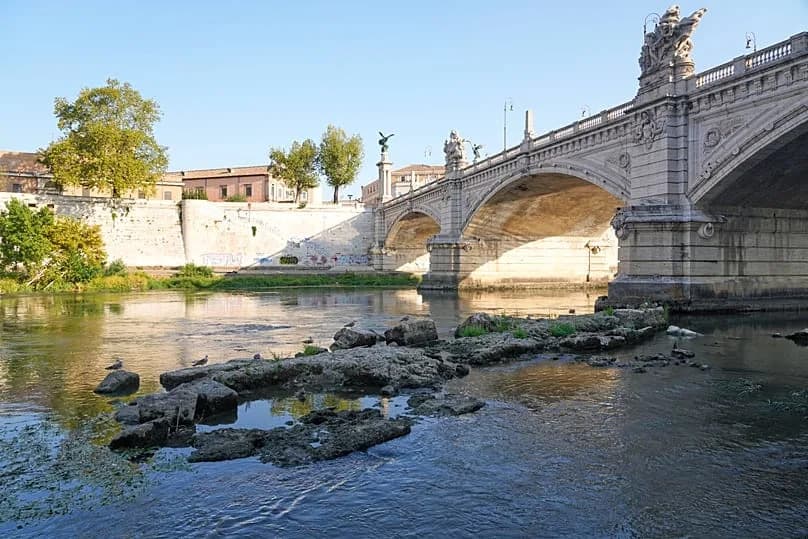
The ruins of the ancient Roman Neronian bridge, emerge from the riverbed of the Tiber river due to drought, in Rome, Thursday, Aug. 13, 2026. - Gregorio Borgia - AP
The recent drought in Rome has pushed the Tiber to unusually low levels, exposing the submerged remains of the ancient bridge commonly called Pons Neronis, or Nero's Bridge, close to St Peter's Basilica. The sudden reappearance of the masonry offers a rare archaeological view and underscores mounting water stresses across Italy.
Archaeology and Origins
Archaeologists from Rome's cultural heritage superintendence say the surviving structure may predate Emperor Nero. Antonella Bonini detailed the bridge's route and associations, noting its proximity to Agrippina's villa and the circuses of Caligula and Nero.
Bonini: The bridge runs by the villa of Agrippina, past Caligula's circus and then Nero's circus, and it has traditionally carried Nero's name because he is the best-known figure associated with this area.
Many scholars believe the crossing was built earlier, possibly by Caligula, to link Agrippina's estate on the opposite bank with the area now occupied by Santo Spirito Hospital near the Vatican. Bonini says the bridge may already have existed by 39 AD.
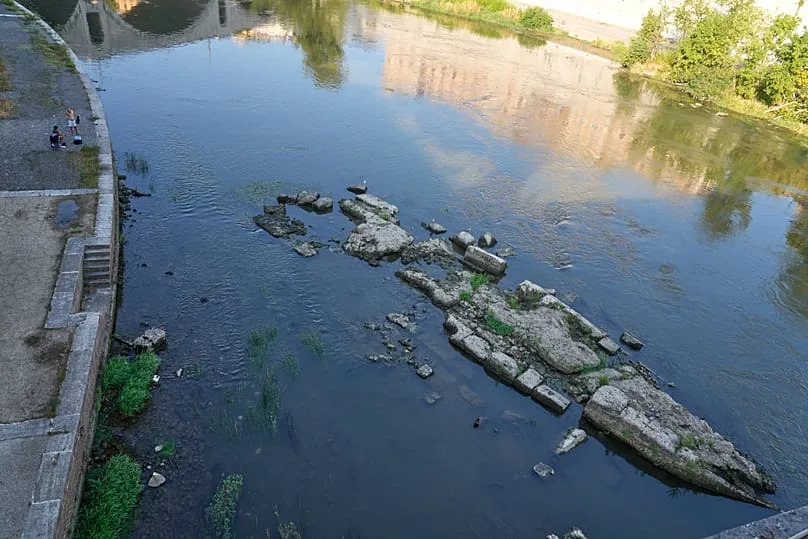
The ruins of the ancient Roman Neronian bridge, emerge from the riverbed of the Tiber river due to drought, in Rome, Thursday, Aug. 13, 2026. - Gregorio Borgia - AP
Historical Use and Decline
Evidence suggests the bridge had fallen out of use by late antiquity. Bonini notes that in the Cataloghi Regionari — registers of Rome's neighborhoods compiled between the Diocletian and Constantinian ages — the Pons Neronis no longer appears. Instead, the Pons Aelius (the bridge connecting Hadrian's mausoleum, now Castel Sant'Angelo, with the city center) is listed, indicating the older crossing was abandoned by the late 3rd or early 4th century.
Modern Water Crisis Reveals Ruins
Giovanni Giganti, coordinator of Rome Civil Protection's water management center, says the Tiber's flow in the urban stretch has fallen below 80 cubic meters per second, compared with a historical average of roughly 150 m3/s. He attributes the drop to a prolonged summer drought and a shortage of Apennine snowpack, factors that have contributed to a wider water crisis across Italy.
Giganti: The Tiber is facing a rather important low-water phase. This is due to a series of factors including the prolonged drought of these summer months and the scarcity of snow on the Apennines.
The ruins were photographed emerging from the riverbed on Aug. 13, 2026, giving archaeologists and the public an unusual opportunity to study ancient river infrastructure. While the exposed stones provide a striking reminder of Rome's layered past, they also highlight contemporary climate and water-management challenges.
Photo credit: Gregorio Borgia/AP
Help us improve.