Key points: The Fourth Criminal Court in Damascus sentenced Wassim al‑Assad to death in mid‑August 2025 after finding him guilty of premeditated murder, torture and crimes against humanity linked to operations that targeted civilians in Eastern Ghouta and al‑Mleiha. Arrested in June 2025 after returning from Lebanon, he was acquitted of drug‑trafficking charges for lack of direct evidence. The verdict includes confiscation of his assets and follows death sentences for Bashar, Maher and Atef Najib, a development seen as a test of Syria's transitional justice process.
Wassim al‑Assad Sentenced to Death for War Crimes in Syria — What We Know
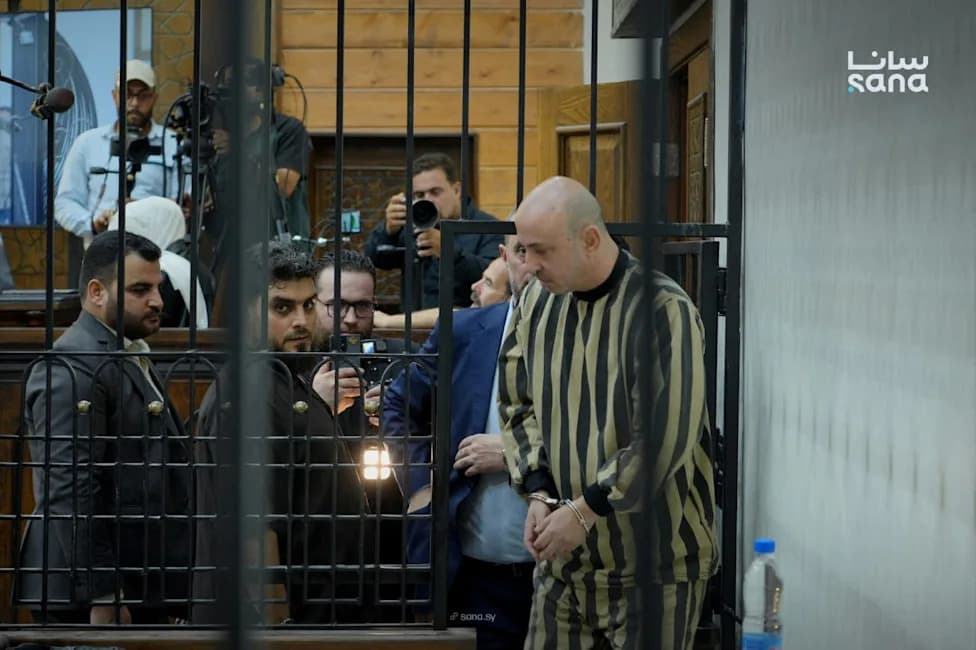
Wassim al-Assad, cousin of ousted Syrian President Bashar al-Assad, is led into a defendant's cage in a Damascus courtroom for his sentencing on August 18, 2026 [Handout/Syrian Arab News Agency via AFP]
Syria's Fourth Criminal Court in Damascus has sentenced Wassim al‑Assad, a 46‑year‑old cousin of ousted president Bashar al‑Assad, to death after finding him guilty of premeditated murder, torture and crimes against humanity tied to the country's 14‑year civil war. The ruling, delivered in mid‑August 2025, came about a week after death sentences were imposed on Bashar al‑Assad, his brother Maher and cousin Atef Najib.
Background
Wassim al‑Assad was born in Latakia on Syria's Mediterranean coast and is a member of the country's Alawite minority. He has long been accused of organizing and directing pro‑regime paramilitary groups that operated from the early days of the 2011 uprising. Bashar al‑Assad was toppled in a rapid rebel advance on Damascus in December 2024; he, Maher and other family members subsequently fled to Moscow and have lived in exile under close Russian supervision.
Charges, Trial and Verdict
The court found Wassim al‑Assad guilty of participating in military operations that targeted civilian areas, notably in Eastern Ghouta and the town of al‑Mleiha, where many civilians were killed. Judge Fakhr al‑Din al‑Aryan said the defendant committed "multiple murders and murder accompanied by torture and brutality … classified as crimes against humanity and war crimes," and that the court established beyond doubt that an armed group linked to him carried out abductions and killings.
Wassim al‑Assad was arrested in June 2025 after returning from Lebanon. He was acquitted on drug‑trafficking charges — including allegations of overseeing production and smuggling of the amphetamine‑like drug Captagon — after the court found insufficient evidence of his direct involvement. The court also ordered the confiscation of his assets.
Context and Significance
The trial, which opened in April 2025, is being watched as an early test of Syria's transitional justice process under the transitional government led by President Ahmed al‑Sharaa, a former opposition leader. The proceedings come amid efforts to hold members of the former regime accountable for abuses committed during the 14‑year conflict that killed hundreds of thousands and displaced millions.
On August 11, 2025, the same court handed down death sentences to Bashar and Maher al‑Assad and to Atef Najib — the latter tried in person after his detention in January 2025 and widely blamed for the 2011 Deraa crackdown that helped ignite the war. Those verdicts prompted celebrations outside the Damascus courthouse.
What This Means
Supporters of the new authorities see the rulings as a step toward accountability for decades of authoritarian rule. Critics of the transitional government, however, have warned about delays and stressed the need for transparent, impartial proceedings that meet international standards of due process. Observers also note the broader geopolitical implications: key former leaders remain in exile and Syria's path to reconciliation and reconstruction will hinge on both domestic justice measures and international engagement.
Help us improve.