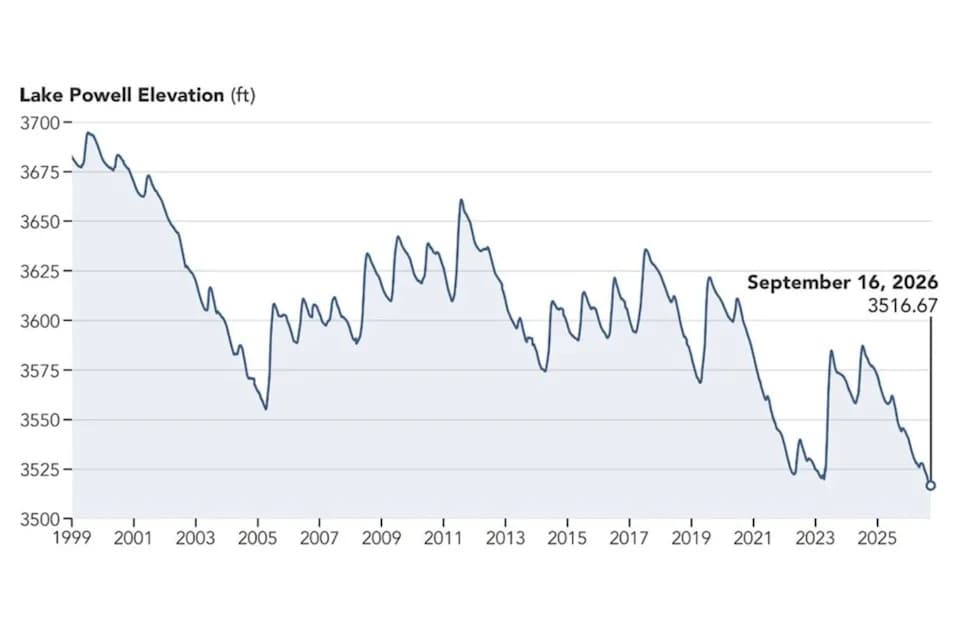
Lake Mead has fallen to a new record low and may drop another five feet, a decline that could reduce Hoover Dam’s power output by about 70%. The Metropolitan Water District of Southern California expects its Colorado River allocation to be cut by more than 30% as officials push conservation measures. Agriculture in the Imperial Valley, which uses roughly 75% of the state’s Colorado River water, faces the prospect of unplanted fields and added economic strain. Officials say coordinated conservation and alternative planning will be necessary to manage water and power shortfalls.
Lake Mead Drops to Record Low — Five-Foot Fall Could Cut Hoover Dam Power by ~70% and Force Major Water Cuts
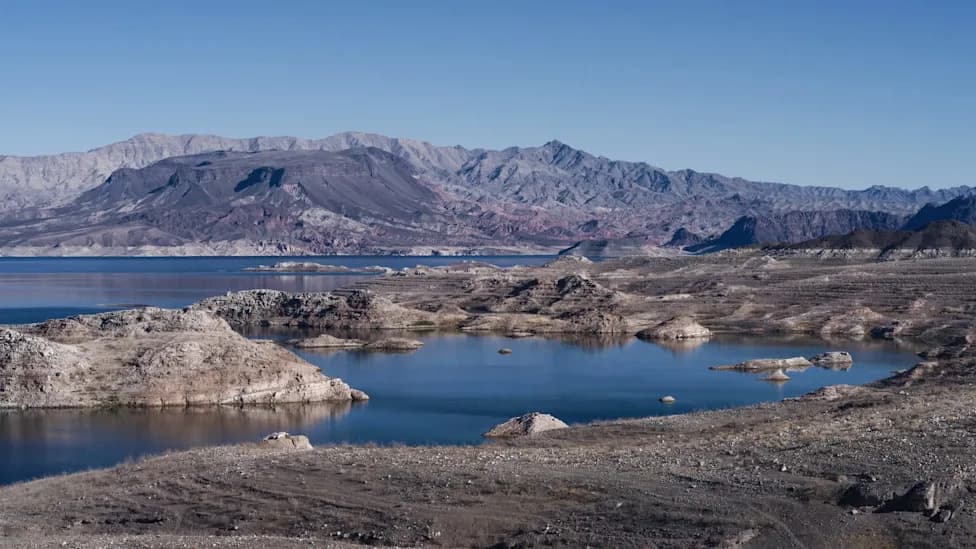
Photo Credit: iStock
A fresh decline in Lake Mead has pushed the reservoir to a new record low, prompting Southern California water managers to warn of wide-ranging impacts on both water supplies and electricity generation.
Lake Mead, the nation’s largest reservoir, is fed by the Colorado River and supplies roughly half of the water used by the Metropolitan Water District (MWD) of Southern California. Officials told ABC30 that the reservoir has slipped below its 2022 record low after a brief 2023 respite from above-average mountain snowfall and runoff.
Forecasts show Lake Mead could fall about five more feet. That additional decline would sharply reduce hydroelectric output at Hoover Dam—by roughly 70%, officials say—because lower water levels reduce the dam’s ability to generate power efficiently.
Potential Consequences
The loss of Hoover Dam generation is significant because the facility provides highly flexible, on-demand power that utilities use to meet peak electricity needs. If most of that capacity becomes unavailable, utilities will need to replace it with other sources that may be more expensive or less flexible, likely raising energy costs for Southern California customers.
Agriculture also faces serious impacts. Growers in California’s Imperial Valley rely on roughly 75% of the state’s Colorado River water; deeper conservation cuts could force some farmers to leave fields unplanted. That would increase economic strain in rural communities that depend on farming jobs and income and could reduce food production at a time when many households are already coping with rising grocery prices.
Why This Is Happening
Bill Hasencamp, MWD’s manager of Colorado River resources, said conditions briefly improved in 2023 because of stronger-than-expected snowfall and runoff, but that relief proved temporary as upper-basin snowpack again fell short of expectations. "It’s scary. I won’t lie," Hasencamp said.
Response: Conservation and Cuts
As part of efforts to stretch limited Colorado River supplies, MWD officials expect the district’s allocation from the river to be reduced by more than 30%. Officials are implementing and planning conservation measures that could tighten water use across urban landscapes, industry and agriculture. In farming regions, those measures can involve painful trade-offs: fewer planted acres mean lower incomes and reduced local economic activity.
"A lot of rural communities are not interested in changing, and it's difficult to change. People don't like change, but we have to change, and we have to change quickly," an official said.
Officials emphasize that managing reservoir levels and balancing water and power needs will require coordinated conservation, possible policy changes and planning for alternative power sources. The evolving situation at Lake Mead will likely remain a focal point for water and energy planning across the Southwest.
Help us improve.