AI is shifting intelligence from an individual trait to a human-plus-tool capability. Distributed intelligence gives students who can collaborate with AI a competitive edge, because they can iterate, validate, and reason with machine outputs. Educators must broaden assessments to measure judgment, evaluation, and iterative thinking, not just visible effort like hours spent or handwritten pages. Preparing students to use AI responsibly is now an essential literacy.
AI Isn't Just Cheating — It's Redefining How Students Learn
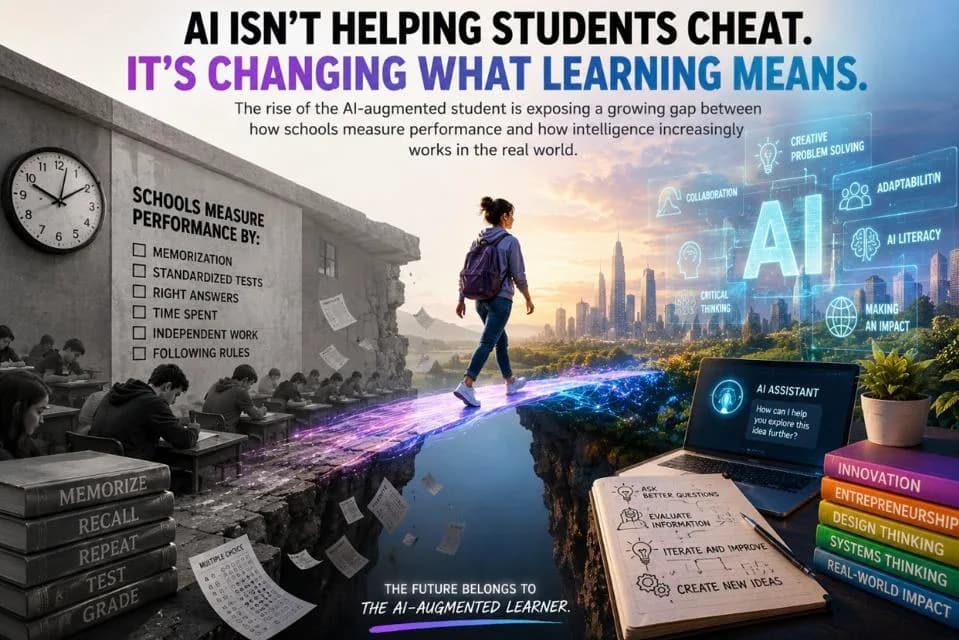
The rise of the AI-augmented student is exposing a growing gap between how schools measure performance and how intelligence increasingly works in the real worldDana Williams, American High School
The highest-performing students today are not simply memorizing more or working harder in old ways — they're learning differently. By using AI as a thinking partner, they test ideas faster, explore deeper complexity, and combine human judgment with powerful tools to reach outcomes that previously required far more time or expertise.
Distributed Intelligence: The New Baseline
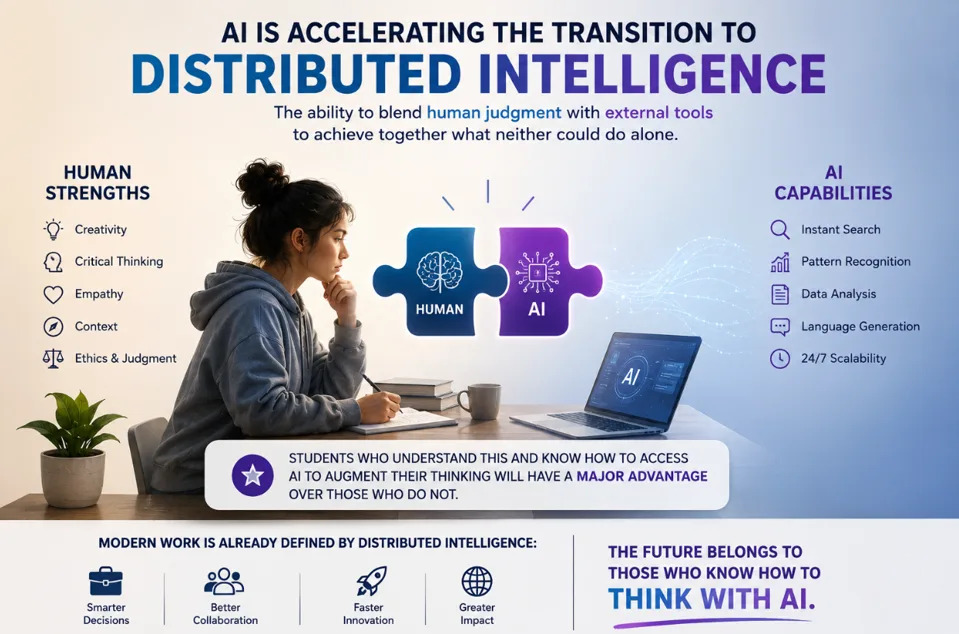
Most public debate about AI in schools focuses on cheating. The larger, subtler story is cognitive: AI is accelerating a shift toward distributed intelligence — the capacity to blend human judgment with external tools to accomplish things neither could achieve alone. Students who learn to collaborate with AI will have a clear advantage over those who don't.
Effort Migration: What Changed — And What Stayed Valuable
AI changes how effort looks. Tasks that once required hours of research or drafting can now take minutes, and that visible effort has long been how we judged rigor. But effort isn't disappearing; it's migrating. High-performing AI users spend significant time on skills we rarely measure: crafting precise prompts, comparing and evaluating outputs, spotting errors and biases, iterating drafts, and making judgment calls about quality and direction. I call this phenomenon effort migration.
Rigor should be defined not only by visible labor but by the quality of judgment, validation, and iteration that students bring to their work.
What Employers Are Already Asking For
Distributed intelligence already defines modern work. Business leaders augment analysis with AI-driven synthesis; engineers integrate AI into workflows; researchers surface patterns across massive datasets; clinicians explore AI-assisted diagnostics. According to Microsoft's 2024 Work Trend Index, 75% of global knowledge workers already use AI at work, and a related report found 66% of business leaders would avoid hiring candidates without AI skills. LinkedIn's Workplace Learning Report also emphasizes adaptability and skill development as top priorities — yet many workers lack formal AI training.
Dana Williams, American High School
Rethinking Academic Integrity
The debate about AI and cheating is often polarized into pro- and anti-AI camps. A more productive frame centers on intellectual ownership: can students explain their reasoning, defend conclusions, identify errors in AI-generated content, and demonstrate understanding beyond producing a polished essay? As professional work becomes more human-plus-tool oriented, academic integrity policies should shift from policing tool use to assessing demonstrated comprehension and judgment.
What Schools Should Do Next
Education can absorb new technologies as it has in the past: calculators and the internet changed practices without replacing core learning. But schools must update how they assess and teach. That means designing tasks and rubrics that measure critical evaluation, prompt engineering, iterative refinement, and ethical judgment. It also means giving students guided practice with AI so they learn to validate outputs, detect bias, and integrate AI responsibly into their thinking.
Ultimately, the debate about AI in education is less about technology and more about redefining intelligence for a human-plus-tool era. Schools that broaden their idea of rigor will prepare students for the world they will enter; those that cling to yesterday's metrics risk training learners for a job market that has already moved on.
Originally published on Forbes.com
Help us improve.