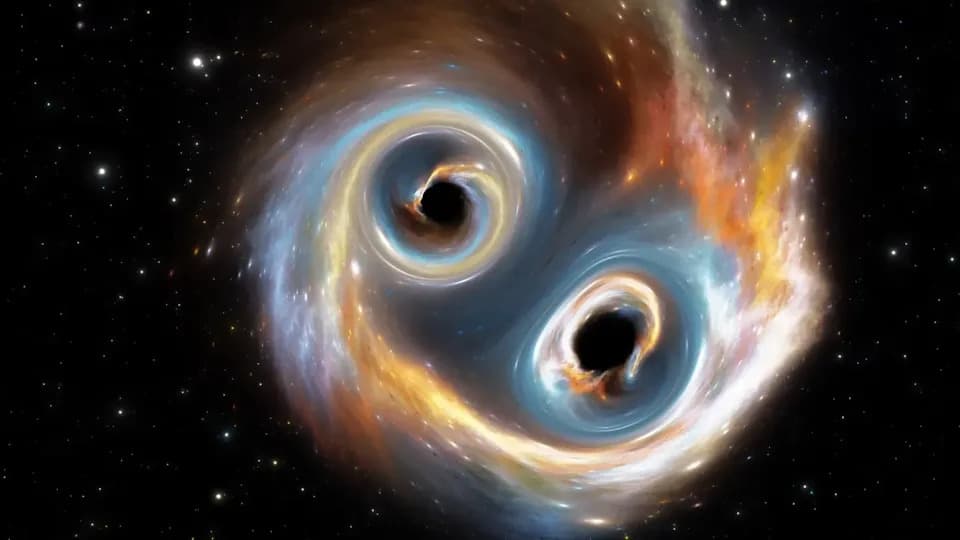
Astronomers using JWST have found three active black holes in galaxy J0148-4214, seen as it was 12.5 billion years ago. Two lie near the center (masses ~80 million and ~600,000 solar masses, separated by ~620 light-years) and a third of ~2 million solar masses sits ~5,500 light-years out. The configuration supports mergers as a fast growth channel for early supermassive black holes and could produce low-frequency gravitational waves detectable by future missions such as ESA's LISA.
Three Supermassive Black Holes Poised For Possible Merger In Distant Galaxy J0148-4214
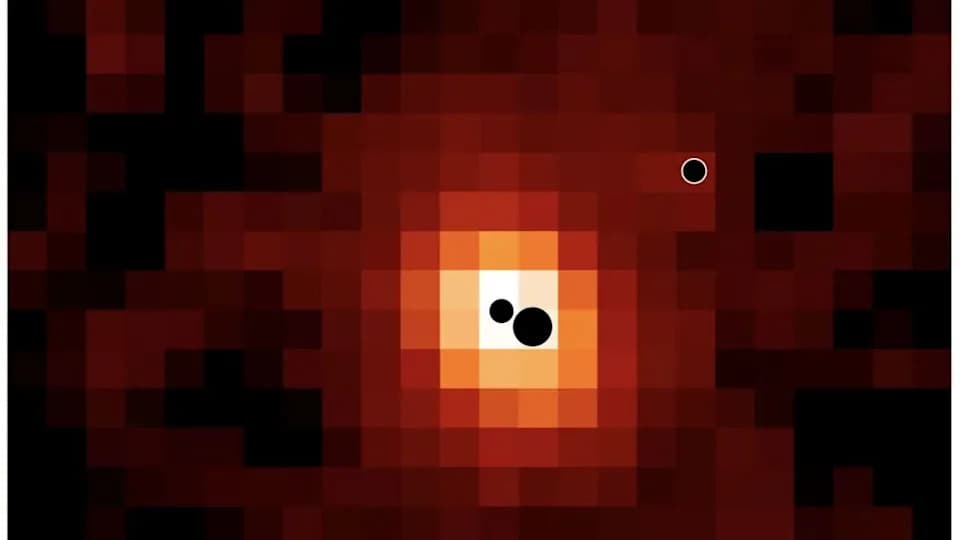
The distant galaxy J0148-4214, seen in the light of ionized hydrogen. The image appears pixelated because of the great distance to the galaxy. The black circles denote the relative locations of the three black holes. . | Credit: Hannah Übler
A team of astronomers using the James Webb Space Telescope (JWST) has identified three active supermassive black holes inside a single distant galaxy, offering strong evidence that mergers played a major role in the rapid growth of black holes in the early universe.
The galaxy, catalogued as J0148-4214, lies at redshift 5.0167: its light has taken about 12.5 billion years to reach us, so we see the system as it was roughly 1.3 billion years after the Big Bang. Because the black holes are too small and far away to be resolved directly, the discovery relied on spectra from JWST's Near Infrared Spectrograph (NIRSpec) in Integrated Field Spectroscopy (IFS) mode. The team detected high-velocity ionized hydrogen gas around three compact, energetic sources — the signature of accretion disks feeding active black holes.
Measured properties:
- The host galaxy's stellar mass is estimated at about 1.3 billion solar masses.
- Two black holes lie near the galaxy center, separated by approximately 620 light-years: one with an estimated mass of 80 million solar masses and a much smaller companion of roughly 600,000 solar masses.
- A third black hole sits about 5,500 light-years from the center and has a mass near 2 million solar masses — around half the mass of the Milky Way's central black hole, Sagittarius A*.
Despite its relatively small mass, the 600,000-solar-mass object appears to be accreting at a rate above the classical Eddington limit, implying a brief period of exceptionally rapid growth likely curtailed by strong radiative feedback. The JWST spectra also enabled estimates of accretion rates and the distribution of ionized gas that helped confirm the three active nuclei.
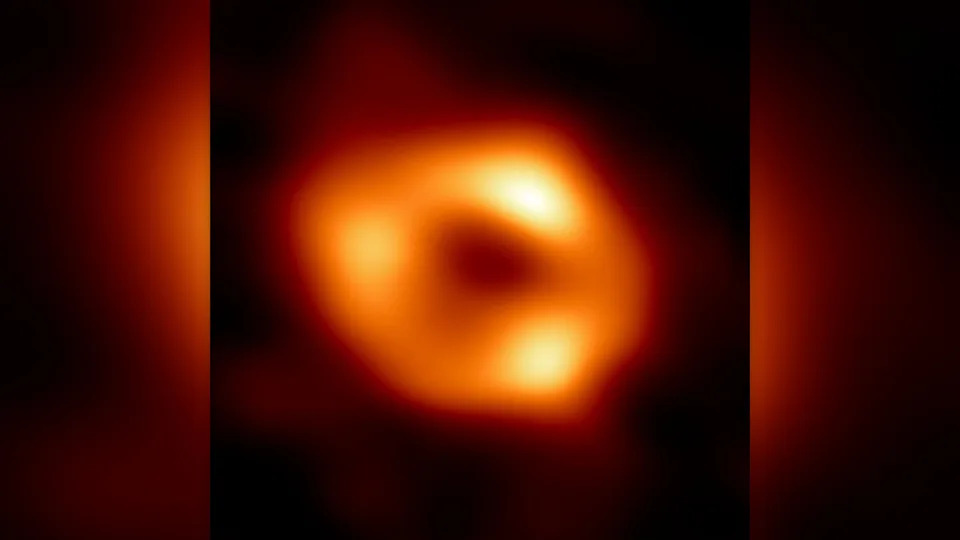
An image of Sagittarius A*, the supermassive black hole at the heart of the Milky Way. | Credit: EHT Collaboration
Dynamics and future prospects: The configuration hints that galaxy mergers brought multiple massive black holes together early in cosmic history. If the three eventually coalesce, their mergers would generate low-frequency gravitational waves — the long wavelengths that ground-based observatories like LIGO, Virgo and KAGRA cannot detect. The planned European Space Agency mission LISA (Laser Interferometer Space Antenna), currently targeted for the mid-2030s, is designed to measure such signals with its triangular constellation of spacecraft separated by about 2.5 million kilometers per side.
However, three-body interactions can produce complex outcomes. The system may be undergoing a three-body exchange in which close encounters redistribute energy and angular momentum: one object can be captured while another is ejected at high velocity. With current data the team cannot yet measure the full three-dimensional motion of the outer black hole, so it remains unclear whether it will spiral inward and merge or be flung out of the galaxy altogether.
"This is the first evidence of three active black holes in a single galaxy in the distant universe," said Hannah Übler of the Max Planck Institute for Extraterrestrial Physics, who led the study. Coauthor Roberto Maiolino (University of Cambridge) and others emphasize that these observations support black-hole merging as an efficient channel for rapid early growth.
The findings are reported in the journal Astronomy & Astrophysics.
Help us improve.