Summary: Global surveys show an overwhelming climate majority—about 89% wanting stronger action and 69% willing to contribute 1% of income—yet many governments are rolling back policies. The gap is explained by pluralistic ignorance and political math: politicians respond to intensity, attribution and concentration as much as size. The solution: visibility—make public support and responsibility for rollbacks obvious so the majority can turn its size into political power.
The Invisible 89%: Why a Global Climate Majority Keeps Losing Political Ground

Respondents were asked to estimate how many of their fellow citizens would be willing to contribute 1 percent of their income. The average guess: 43 percent. The actual share, again, is 69 percent, and in all 125 countries the average estimate fell below it. A majority willing to pay for climate action exists, and it believes it is a minority.getty
Two seemingly contradictory truths define today's climate politics: overwhelming public support for stronger climate action, and a steady rollback of meaningful policies. Understanding how both can be true requires looking past slogans to human psychology and political math.
The Paradox
A globally representative survey of nearly 130,000 people in 125 countries found that 89% want their governments to do more to fight global warming and 69% said they would be willing to contribute 1% of household income each month to climate action. The UN Development Programme's Peoples' Climate Vote—75,000 respondents in 77 countries—found similarly large majorities, with around 80% supporting stronger government action.
And yet: over the past year there have been at least 45 significant policy reversals and rollbacks across governments and international institutions. How can such a broad mandate fail to translate into sustained policy?
Why the Majority Keeps Losing
The answer is twofold: psychology and political arithmetic. The psychology shows up as pluralistic ignorance. When survey respondents were asked to estimate how many of their fellow citizens would be willing to contribute 1% of their income, the average guess was 43%—far below the true rate of 69%. In every one of the 125 countries surveyed the mean guess underestimated real support. Even a 2025 study of 191 attendees at the UN Environment Assembly—government representatives, UN officials, researchers, civil society and journalists—guessed only 38%.
"A majority willing to pay for climate action exists, but it believes it is a minority."
When people think they are in the minority, they tend to stay quiet. That silence begets more silence: the public appears apathetic and politicians assume little political cost for inaction or rollback.
The Political Math: What Politicians Actually Weigh
When a decision-maker considers a rollback, they calculate expected political punishment, which depends on four factors:
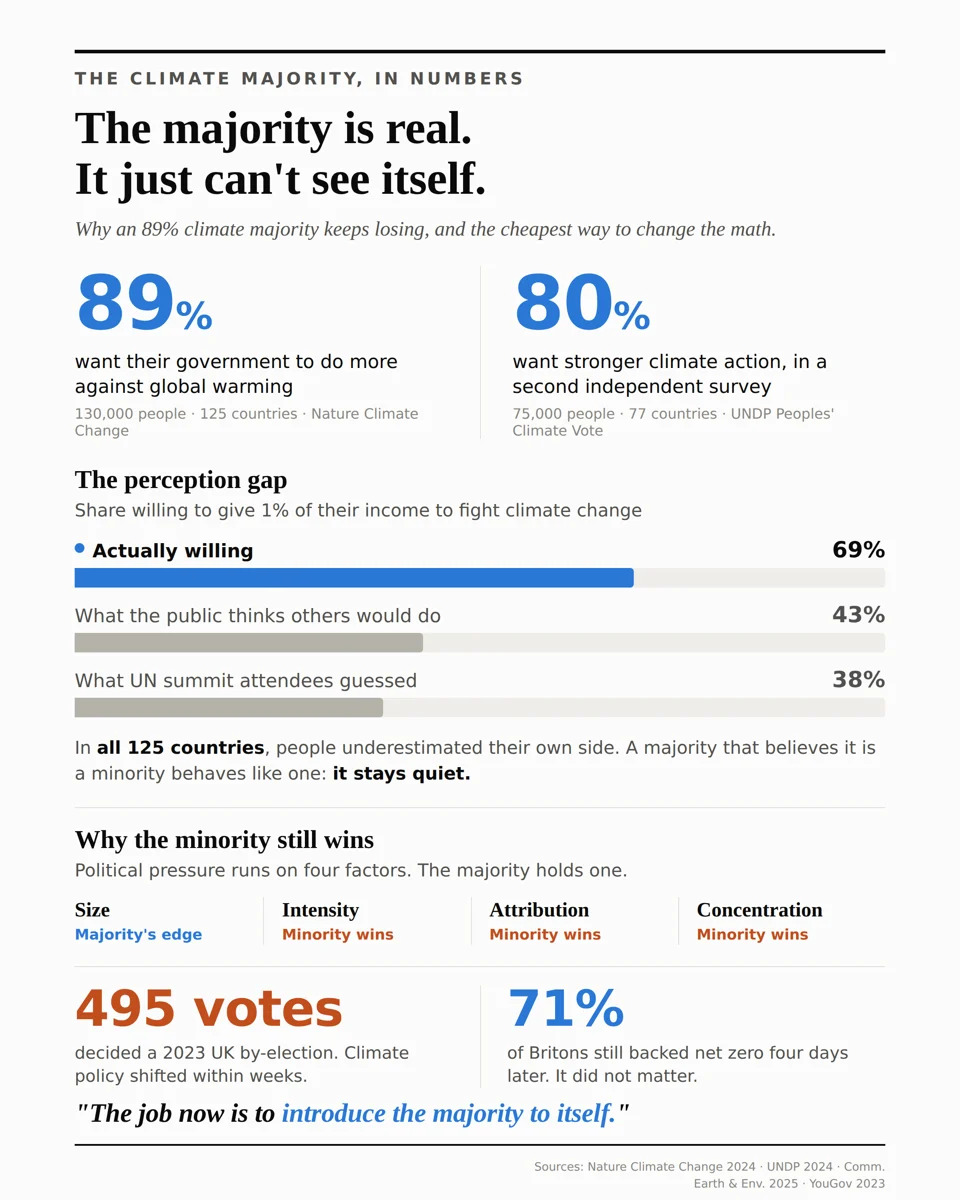
The chart shows how much support climate action really has, and how badly we misjudge it. 69 percent of people worldwide say they are willing to give 1 percent of their income to fight climate change (blue bar). But when asked how many others would do the same, the public guesses 43 percent, and even UN summit attendees guess just 38 (gray bars). The support is real but almost no one can see it.
- Size — How many people care (the majority wins here).
- Intensity — How many will change their vote over this single issue (small, angry groups often win here).
- Attribution — Whether voters can trace the harm to the decision-maker (immediate, visible costs are easier to blame on politicians).
- Concentration — Whether the aggrieved live in electorally decisive places (swing districts, capital protests, or organized industry lobbies).
Size matters, but it is not decisive. A much smaller, concentrated, and intensely motivated group can impose outsized political costs. This classic collective-action problem explains why tractors at the capital or voters in swing seats matter more than a dispersed national majority.
Concrete Examples
Consider Uxbridge: a July 2023 by-election in a London suburb was decided by just 495 votes and was widely interpreted as a backlash against an expanded charge on older, polluting cars. Within two months, the UK government delayed key net-zero policies and major parties shifted their messaging. Yet four days after the election a YouGov poll still found 71% of Britons supported net zero by 2050. A small, vocal, concentrated group changed political calculations despite a quiet national majority.
France's 2018 fuel-tax protests offer a similar lesson: concentrated, immediate losses mobilized voters and reshaped policy despite broader public support for climate goals.
The Practical Solution: Visibility
The good news is that the same four political levers point to remedies. The majority will rarely out-anger a minority built on concentrated, immediate losses. But one inexpensive, high-impact lever exists: visibility. When the majority becomes visible, both intensity and attribution rise.
Visibility is primarily an information problem and can be fixed. Research shows that when people learn how many others support climate action, they become more willing to act themselves. Practical steps include:
- Publicly declaring voting intentions tied to climate policy to make the majority visible.
- Media reports that clearly name and link politicians to rollbacks, increasing attribution.
- Business and civic leaders publicly committing to climate-friendly investments and policies, signaling changing political math.
Conclusion
The majority for stronger climate action already exists. The challenge is that it is diffuse, often unaware of its own size, and less intense on single-issue politics than smaller opponents. The remedy is straightforward: introduce the majority to itself. Make support visible, highlight responsibility for rollbacks, and raise the political costs of abandoning climate action. Once silence no longer reads as consent, rolling back climate measures will cease to be politically free.
This article was originally published on Forbes.com.
Help us improve.