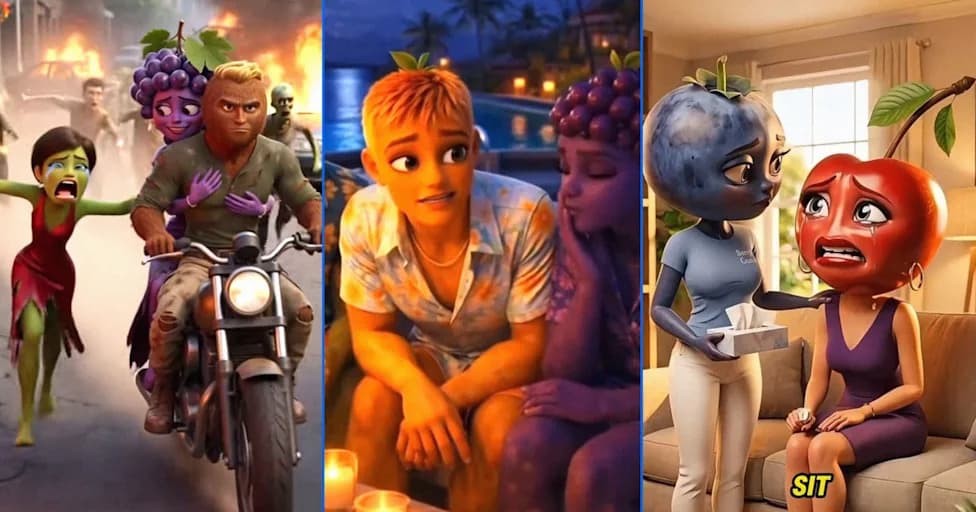
Researchers at GNET warn that a surge in AI-generated “fruitslop” videos — short clips that anthropomorphize fruit and vegetables — increasingly includes graphic scenes of torture and mutilation. Some reels frame violence around identifiable groups or ideologies, raising concerns that repeated exposure could normalize brutality for young viewers. The report is preliminary and does not prove causation, but highlights broader risks from bot-driven production and algorithmic amplification and calls for better moderation and media literacy.
Researchers Warn AI “Fruitslop” Videos Are Exposing Kids To Graphic Violence — GNET Sounds Alarm
TikTok / Futurism
What happens when an endless stream of AI-generated “fruitslop” videos reaches screen-dependent children? Researchers at the Global Network on Extremism and Technology (GNET) say the answer may be troubling: a growing volume of algorithmically amplified clips is showing increasingly graphic violence that could normalize brutality for young viewers.
What GNET Found
An analysis by GNET describes a surge of short, AI-produced clips that anthropomorphize fruit and vegetables into melodramatic characters. Many clips are frivolous or sexualized, but analysts report an uptick in what they call “AI fruit/vegetable gore” — scenes depicting torture, mutilation and other extreme violence.
“Violence-based AI slops reinforce a fascination with violence for violence’s sake,” the report states, warning that repeated exposure can create a pathway toward consuming more graphic audiovisual material and potentially toward online radicalization.
Not Always Generic Violence
GNET notes that some violent reels do more than shock: they portray violent characters as members of identifiable groups or ideologies, from criminal cartels to far-right movements or nihilistic factions. That framing, analysts argue, increases the risk that sensationalized violence could be linked to real-world groups or ideas.
Limits And Context
The report is a preliminary, surface-level review. GNET acknowledges it does not establish a causal link between watching these AI-generated videos and real-world violent behavior among children. The paper even references at least one AI-generated editorial by mistake, underscoring the challenges of researching synthetic-content ecosystems.
It is also important context that GNET is the research arm of the Global Internet Forum To Counter Terrorism (GIFCT), an initiative involving tech-industry participants that has faced criticism over content-moderation practices and potential bias.
Broader Risks
Analysts emphasize the systemic issue: automated production pipelines and bot-driven accounts can churn out enormous amounts of content that recommendation algorithms then amplify. Young viewers—whose media literacy is still developing—may be especially vulnerable to repeated exposure. The same generative-AI systems that produce whimsical or violent fruit animations could just as easily be used to push misinformation, electoral disinformation, racism or other social harms.
What Can Be Done
GNET’s findings, while preliminary, point to practical responses: improved moderation tools and detection of synthetic material, transparency from platforms about recommendation mechanisms, stronger age controls, and expanded media-literacy education for children and caregivers. These measures can reduce the risk that algorithmically promoted content normalizes extreme violence or other harmful narratives.
Bottom line: The rise of AI-generated “fruitslop” is a symptom of a larger problem—unchecked automated content production and amplification—that merits attention from parents, educators, platforms and policymakers.
Help us improve.