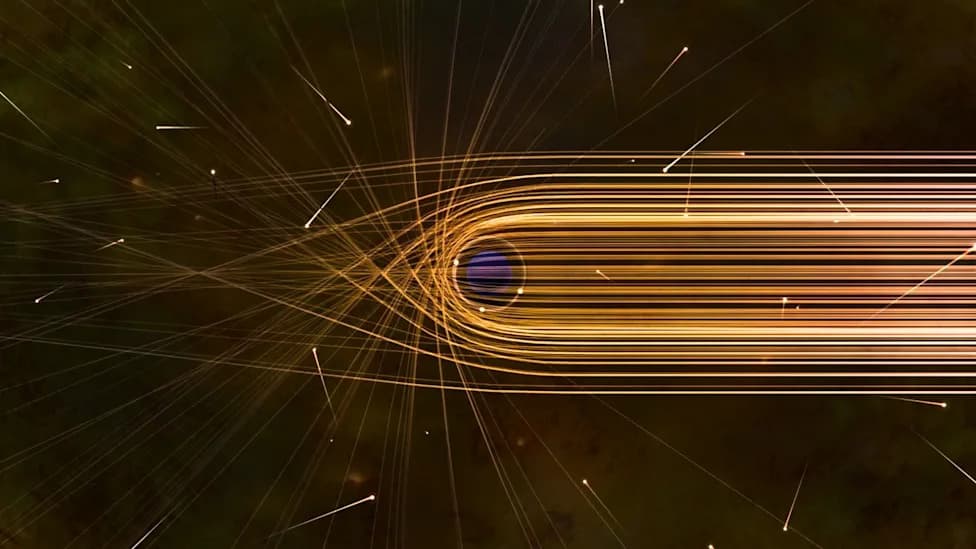
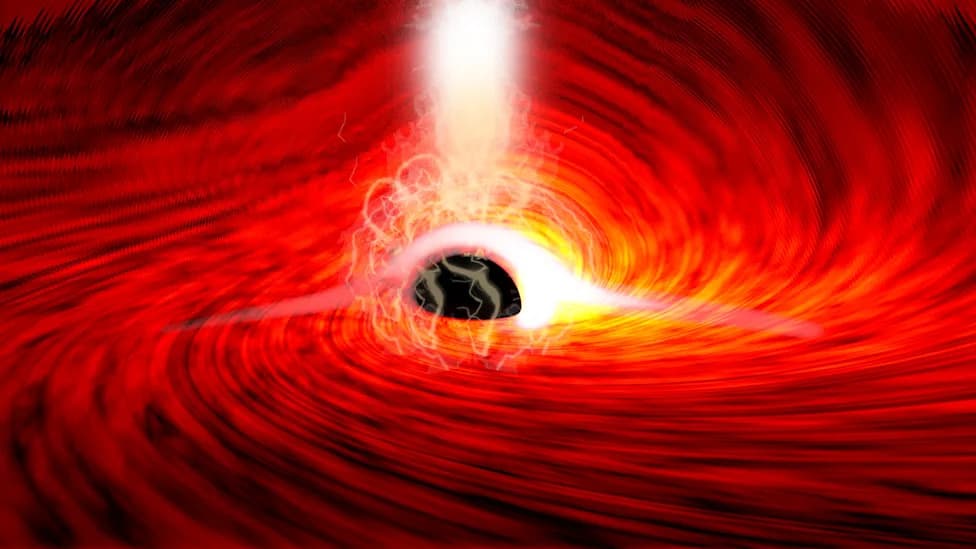
Brief Summary: A human might cross the event horizon of a supermassive, isolated black hole without being torn apart by tidal forces, because the horizon lies far from the central singularity. Stellar-mass black holes produce extreme tidal gradients that would spaghettify an infalling person long before the horizon. Most black holes are surrounded by lethal accretion disks, and by definition nothing inside an event horizon can send information back to the outside universe.
Could a Person Enter a Black Hole to Study It?
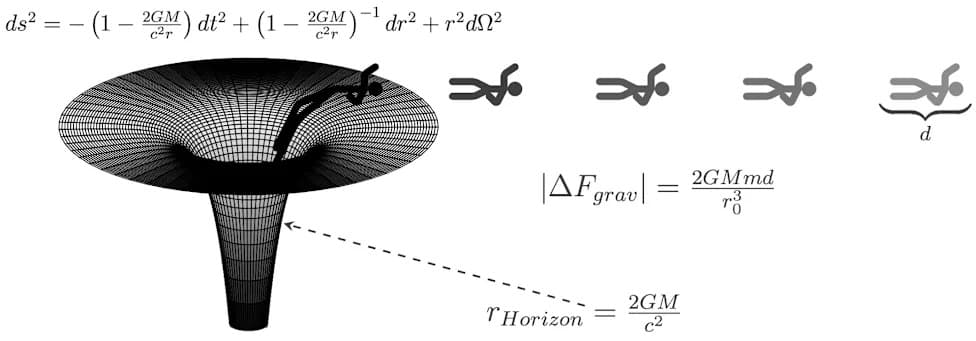
A person falling into a black hole and being stretched while approaching the black hole's horizon. Leo Rodriguez and Shanshan Rodriguez,CC BY-ND
Question: Could a human enter a black hole to study it?
Short answer: Under very specific conditions a person could cross a black hole's event horizon without being torn apart, but they could not send any information back to the outside universe.
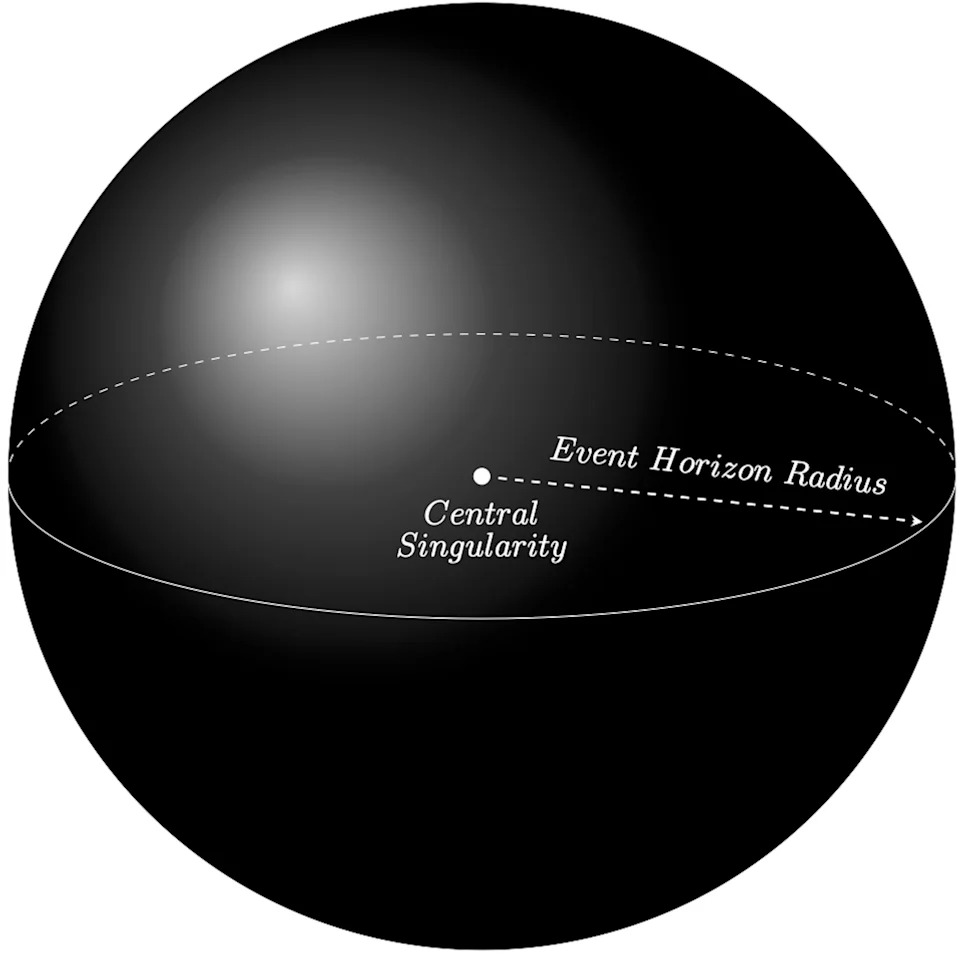
The distance from a black hole's center of mass to where gravity's pull is too strong to overcome is called the event horizon. Leo and Shanshan,CC BY-ND
What Is a Black Hole's Event Horizon?
The event horizon is the spherical boundary around a black hole beyond which nothing — not even light — can escape. Once you cross it, by the rules of general relativity you are trapped forever from the point of view of outside observers.
Size Matters: Stellar vs. Supermassive Black Holes
Black holes come in many sizes. A stellar-mass black hole (about the mass of the Sun) has an event horizon with a radius of roughly 2 miles (a few kilometers). The supermassive black hole at the center of our galaxy has a mass of about 4 million Suns and an event-horizon radius of roughly 7.3 million miles (about 11.8 million km).
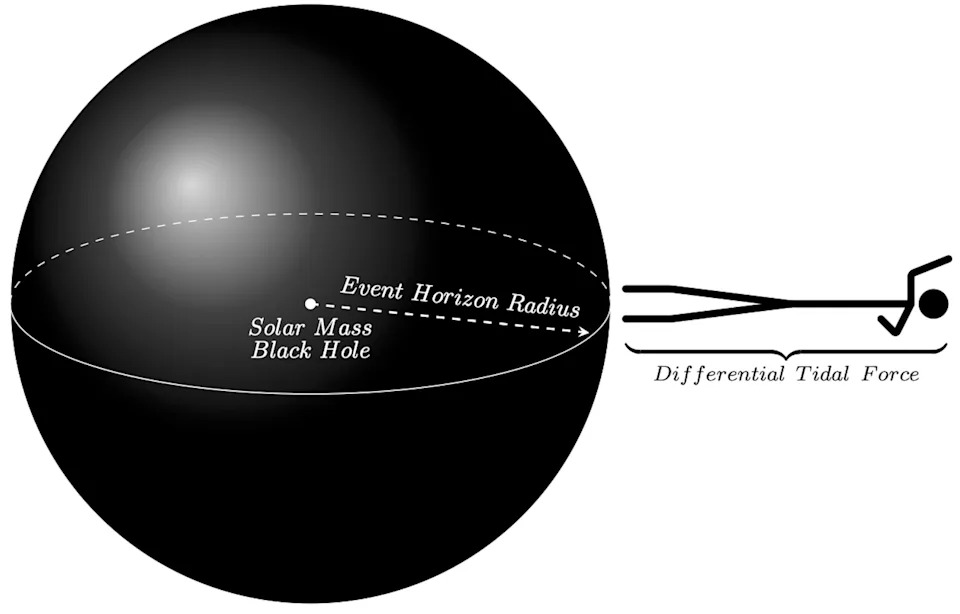
As the person approaches the event horizon of a a Sun-size black hole, the vast difference in gravitational pull between the inidvidual's head and toes causes the person to stretch into a very long noodle, hence the term 'spaghettification'. Leo and Shanshan Rodriguez,CC BY-ND
Tidal Forces and Spaghettification
The difference in gravitational pull between your feet and your head (tidal forces) depends on how close you are to the black hole's center. For a stellar-mass black hole, the event horizon lies very near the central singularity, producing enormous tidal gradients: a human falling feet-first would feel a vastly stronger pull at the feet than at the head and would be stretched and torn apart long before reaching the horizon — an effect often called spaghettification.
For a supermassive black hole, the event horizon is much farther from the center, so the tidal gradient at the horizon can be negligibly small. In that case, a person might cross the horizon without immediate tidal injury and would pass the boundary essentially unharmed (relative to tidal effects) — at least at the moment of crossing.
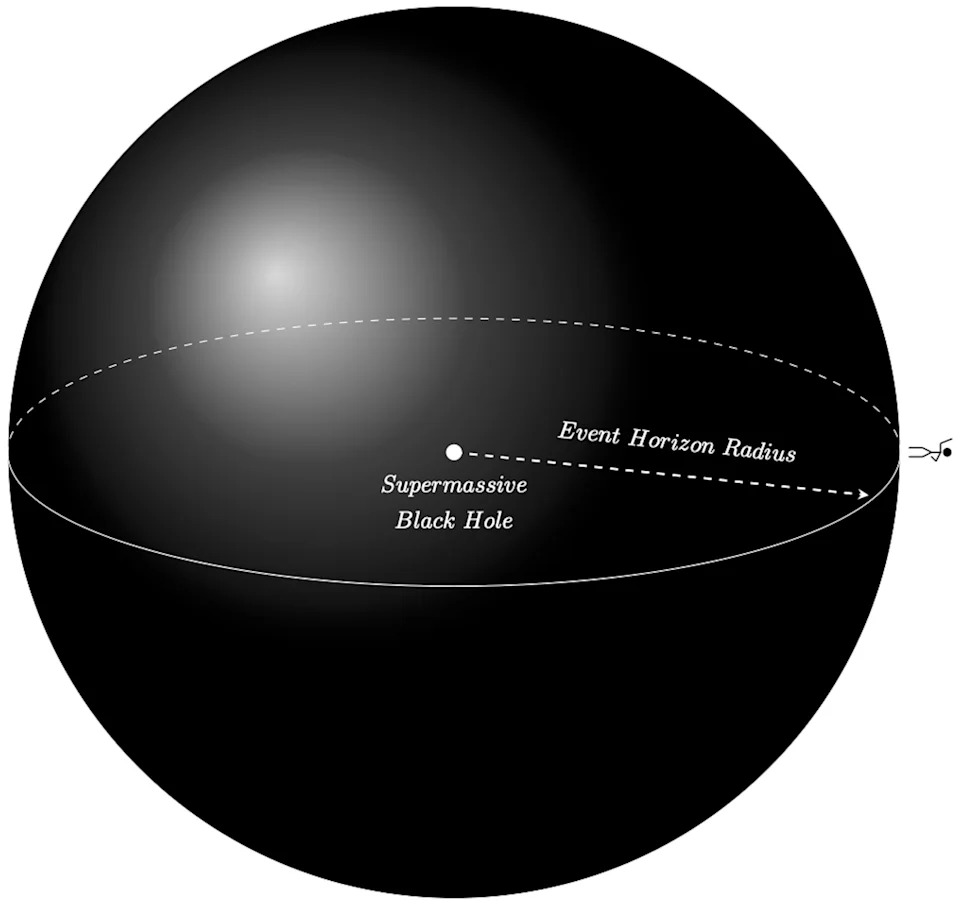
A person falling into a supermassive black hole would likely survive. Leo and Shanshan Rodriguez,CC BY-ND
Practical Hazards: Accretion Disks and Radiation
Most black holes that astronomers observe are surrounded by hot, turbulent accretion disks made of gas, dust, and shredded stars. Those disks emit intense radiation and high-energy particles that would be lethal long before anyone reached the event horizon. To have any chance of surviving an approach, you would need a truly isolated, non-feeding supermassive black hole with little or no surrounding hot material.
What About Reporting Back?
Even if an explorer survived the approach and crossed into an isolated supermassive black hole, classical general relativity forbids any signal from inside the event horizon from reaching the outside universe. That means any measurements or observations made inside would be permanently unavailable to outside observers. (There are active theoretical discussions about information and black holes — e.g., Hawking radiation and the information paradox — but no practical way to transmit classical data out from within the horizon.)
Conclusion
So: theoretically, a person could enter a supermassive, truly isolated black hole and cross the event horizon without being immediately destroyed by tidal forces. Practically, the journey is nearly impossible because of lethal accretion environments, and it would be scientifically futile for outside observers because nothing that happens inside the horizon can be communicated back.
Authors: Leo Rodriguez and Shanshan Rodriguez (republished from The Conversation)
Help us improve.