A new study in mice found that long-term memories can survive dramatic synapse loss during a two-day artificial hibernation because the brain selectively preserves higher-order network patterns. Synaptic pruning began within 30 minutes and exceeded 50% within 24 hours, yet mice retained contextual and spatial memories. Comparison with anesthetized mice — whose clustered connectivity was disrupted and whose memories were lost — points to hub-like outputs and clustered engram patterns as key substrates for memory persistence. Authors will probe the molecular basis of these clusters and test whether manipulating them alters memory retention.
Study in Artificially Hibernating Mice Suggests Memories Rely On Network Patterns, Not Just Strong Synapses
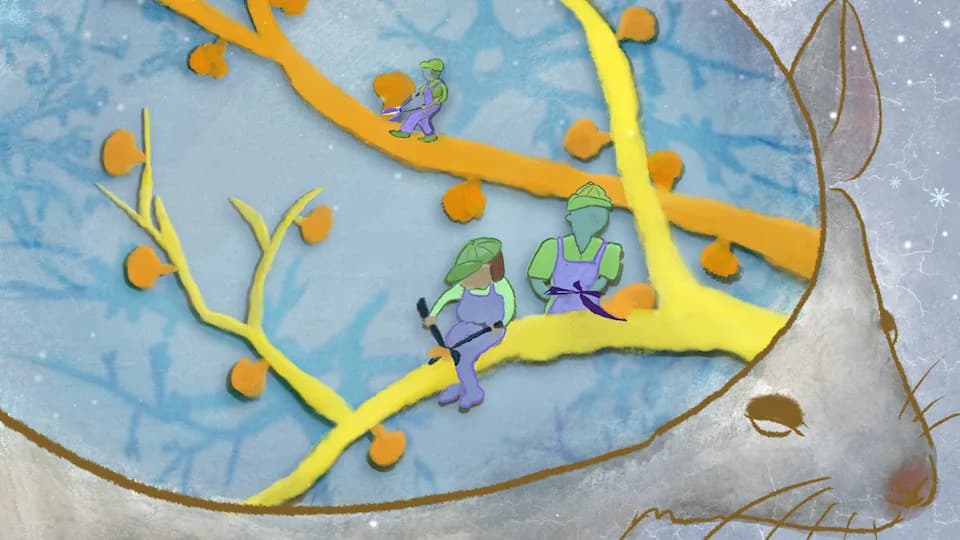
During hibernation, irrelevant connection points between brain cells are pruned away, leaving only the links necessary for long-term memory retention, a study suggests. | Credit: Luo-chu Yang
During an artificial hibernation-like state, mice lost more than half of their hippocampal synapses within 24 hours — yet retained memories formed before the shutdown. A new study led by Kazumasa Tanaka at the Okinawa Institute of Science and Technology, published in Science on Aug. 13, suggests that higher-order network patterns (clustered connections and hub-like outputs) — rather than individual, persistently strengthened synapses — are critical for long-term memory retention.
Rapid Synapse Pruning During Hibernation
The researchers induced a two-day artificial hibernation by activating a specific population of neurons previously implicated in natural torpor. Synapse remodeling began within 30 minutes, and by 24 hours more than 50% of synapses in the hippocampus had been pruned. Despite this dramatic structural loss, mice returned from the hibernation-like state with intact learned behaviors.
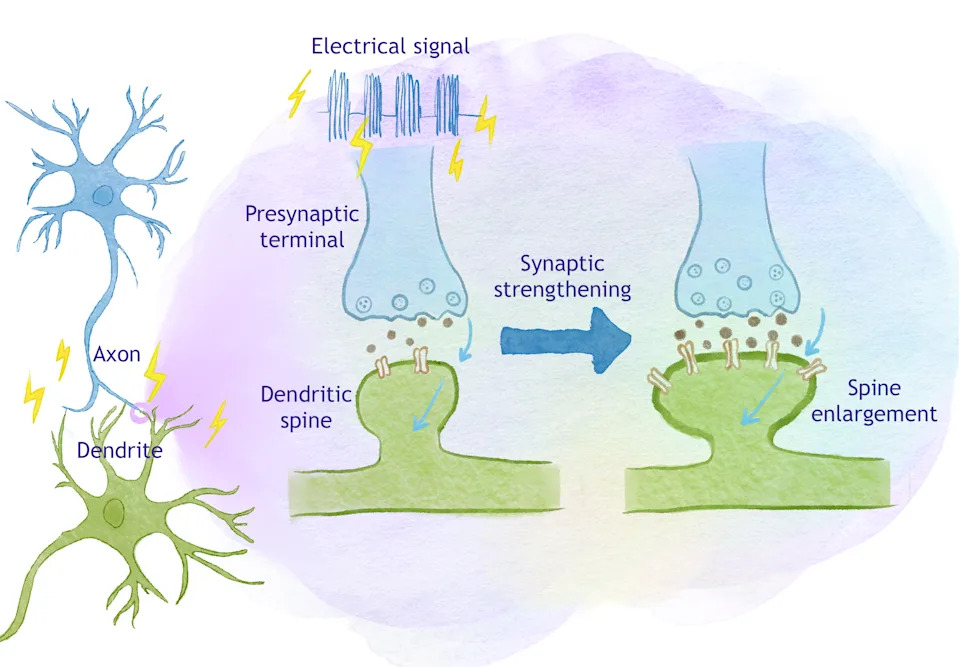
A typical synapse (left) where one brain cell connects to another (the axon of one connecting to the dendrites of the other). Each dendrite is covered in tiny protrusions called dendritic spines, which detect signals released from axons. When a particular synapse is very active, it can lead to physical changes (right). | Credit: Luo-chu Yang
Behavioral Tests: Memories Remain Intact
Mice were trained on two hippocampus-dependent tasks: contextual fear conditioning (associating a specific environment with a mild paw shock) and a spatial task to locate sugar pellets in a maze. After artificial hibernation, mice still froze in the shock-associated context and navigated the maze to find food, demonstrating preserved episodic and spatial memory.
What Survives the Pruning?
To understand why memories persisted, the team compared these mice with another group given long-term anesthesia combined with a molecule that blocks synaptic strengthening. Although the anesthetized animals experienced similar overall synapse loss, they failed to retain the learned behaviors. Microscopic analysis revealed a key difference: the hibernating brains selectively preserved specific connectivity motifs.
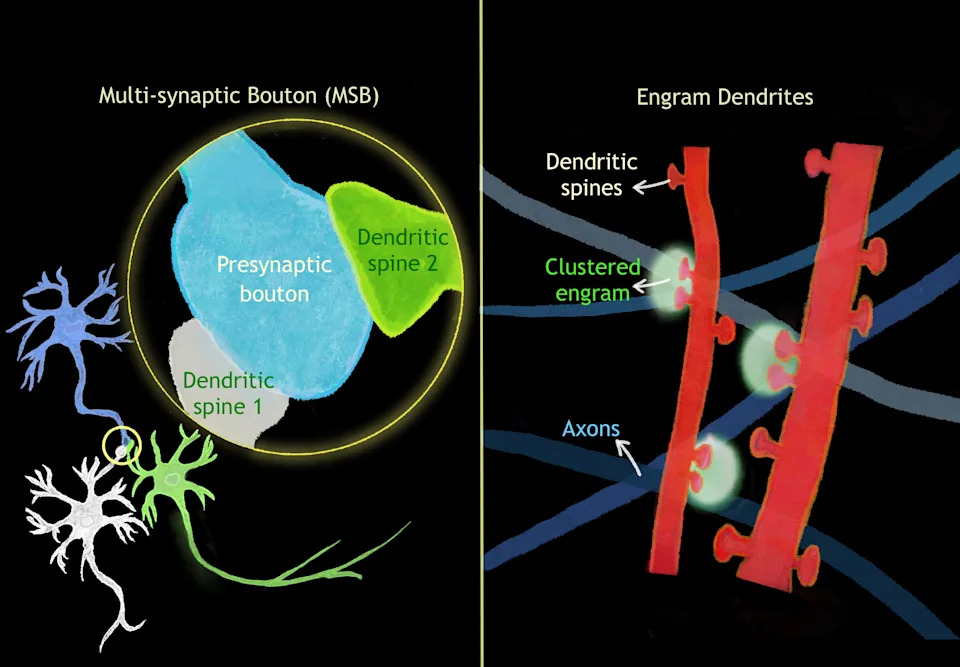
This diagram shows two characteristic patterns found in the study. On the left, one neuron sends messages to multiple dendritic spines on different cells. On the right, we see "clustered engram patterns," in which dendritic spines that all activate in relation to the same memory are located close together and connect to various axons. These two patterns were less likely to disappear during hibernation. | Credit: Luo-chu Yang
Two resilient patterns stood out:
- Hub Outputs: Single neurons that project to several neighboring cells, effectively broadcasting information.
- Clustered Engram Patterns: Groups of dendritic spines located close together that receive converging inputs from multiple axons.
These clustered topologies were preferentially spared during artificial hibernation but were disrupted under anesthesia. Importantly, the absolute size of dendritic spines did not predict survival; the spatial and network arrangement did.
Implications and Next Steps
The findings refine our understanding of how memories can remain stable despite continuous structural turnover. The authors emphasize that this work does not refute long-term potentiation (LTP) as a mechanism for forming memories. Rather, it suggests that long-term retention may rely on durable network motifs that survive large-scale pruning and allow memory traces to "drift" while remaining recoverable.
Future experiments will characterize the molecular makeup of these clusters, manipulate their formation to test causality, and investigate mechanisms by which the brain selectively spares them. The researchers also note potential applications for engineering: designing data-storage systems that preserve information despite aggressive pruning could draw inspiration from these biological network motifs.
Study Details: Artificial hibernation lasted two days. Synapse loss was detectable within 30 minutes and exceeded 50% within 24 hours. Behavioral tests included contextual fear conditioning and a spatial maze for food. Results published in Science on Aug. 13.
Help us improve.