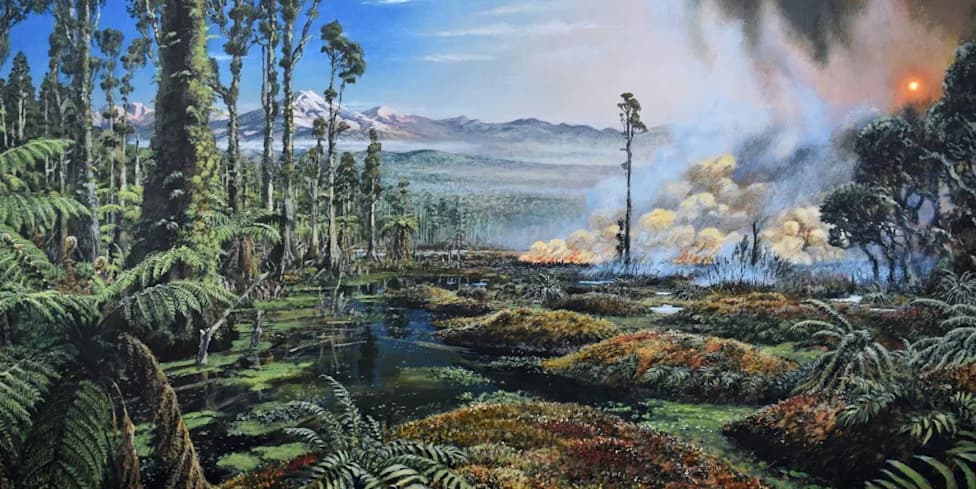
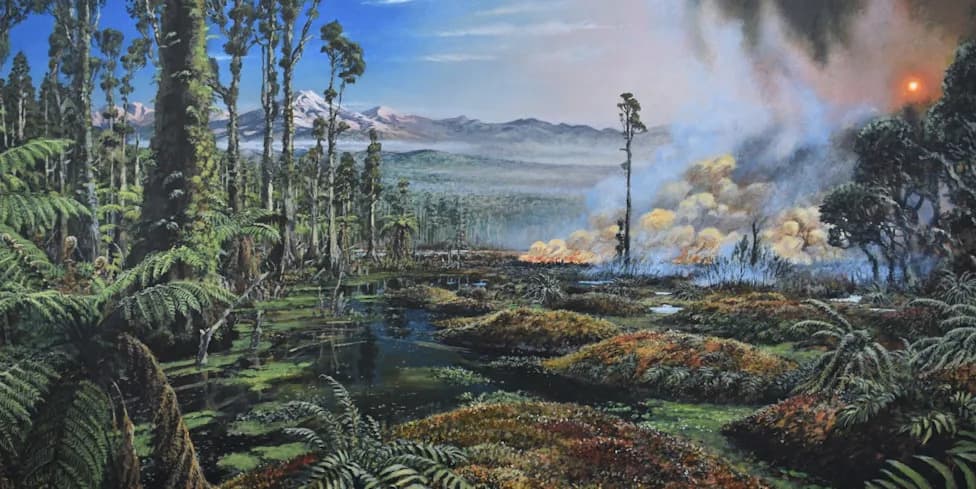
The study of fossilized leaf cuticles from the Paleocene–Eocene Thermal Maximum (~56 million years ago) shows that very large, sustained CO2 releases led to widespread forest collapse and canopy thinning, not lasting greening. Researchers estimate about 60% of standing vegetation biomass was lost during the PETM, which unfolded over ~130,000 years and warmed the planet by up to 8°C. The paper warns modern emissions are far faster and compounded by deforestation and fragmentation, so rapid cuts to fossil fuels are essential.
Fossils Show Massive CO2 Pulses Caused Forest Collapse — Not a ‘Greening’ of the Planet
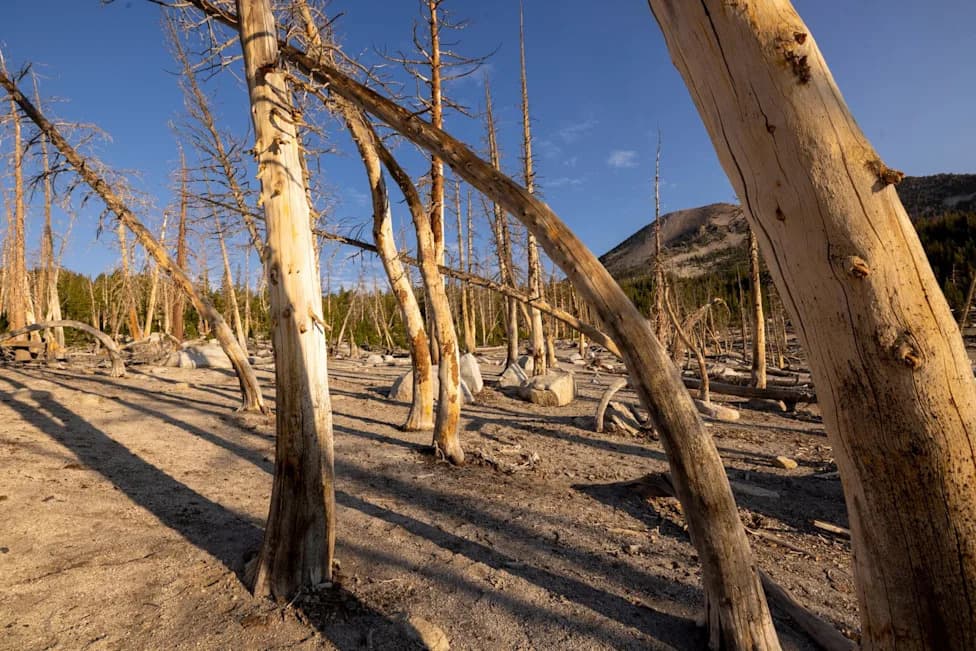
Dead trees are seen near Mammoth Lakes, California, in 2022.Photograph: David McNew/Getty Images
A new study using fossilized leaf cells from the Paleocene–Eocene Thermal Maximum (PETM) — a global warming event about 56 million years ago — finds that very large, sustained releases of carbon dioxide led to widespread forest decline and canopy collapse rather than a long-term greening of the planet.
What Researchers Did
Led by Regan Dunn of the La Brea Tar Pits and the Natural History Museum of Los Angeles County, the team analyzed fossil leaf cuticle fragments to reconstruct canopy density and vegetation change through the PETM. The PETM involved large natural carbon releases over roughly 130,000 years and global warming of up to about 8°C (14°F), making it the closest ancient analogue to modern carbon injections.
Key Findings
The study reports a dramatic retreat of forests during the PETM: canopies thinned, open landscapes expanded, and the authors estimate roughly 60% of standing vegetation biomass was lost at peak impact. Although modest CO2 increases can temporarily boost plant growth, the researchers found that long-term warming, drought, nutrient stress, pest outbreaks and greater fire risk ultimately reversed any short-term gains.
“What we see is that as the carbon dioxide ramped up, the forests became very dense but then subsequently collapsed, opening up dramatically,”
Dunn and colleagues warn that the PETM result — a browning rather than greening — has "chilling implications" for today because modern emissions are far faster and compounded by land-use pressures.
Implications For Today
The industrial era has driven atmospheric CO2 up by more than 50% in a little over a century. Unlike the PETM’s slower, volcanic-driven carbon release, current emissions are concentrated over decades and coincide with deforestation, forest fragmentation, intensive logging and altered fire regimes. Trevor Keenan of UC Berkeley, who was not involved in the study, said the paper is a "genuine advance" and that "warming won" in the PETM — warming overwhelmed any CO2-driven benefits.
The study and expert commentary emphasize that faster warming gives ecosystems far less time to adapt, and that modern forests face multiple simultaneous stressors — making the PETM a sobering, not reassuring, precedent.
Methods And Evidence
By quantifying the abundance and characteristics of preserved leaf cuticle fragments, the researchers inferred canopy density changes through time. This direct evidence of past canopy structure supports the conclusion that large, sustained carbon injections can trigger long-lasting forest collapse.
Conclusion
The PETM fossil record suggests that massive CO2 releases ultimately cause forests to thin and die back, leaving landscapes browner. The authors and external experts urge rapid cuts in fossil fuel emissions to avoid repeating or exceeding those outcomes — noting that on human timescales, recovery from such shifts can take far longer than a lifetime.
Help us improve.