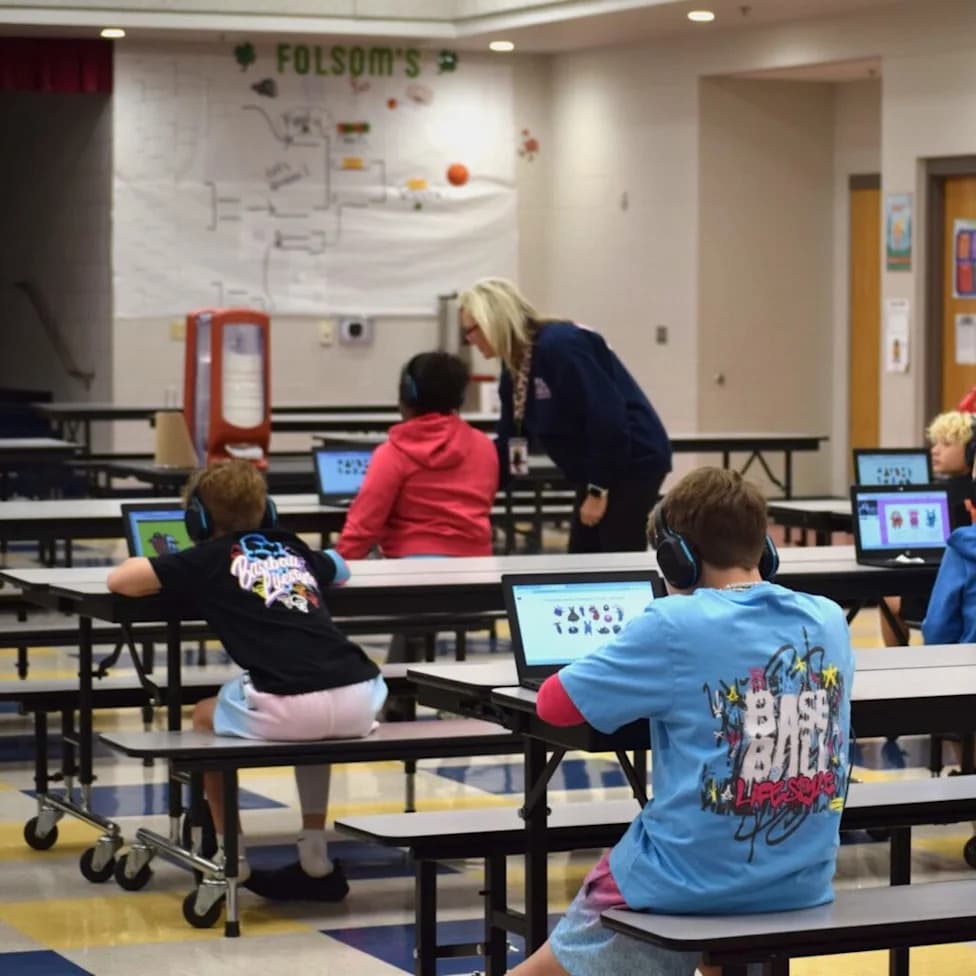
As a new school year begins, school districts across the United States are testing artificial intelligence tools to flag students who are falling behind, track attendance and try to boost reading scores. But many districts say they are overwhelmed by the rapid pace of AI product development and uncertain which tools are worth thousands—or millions—of dollars.
Billions At Stake. The broader U.S. education-technology market, which includes hardware, software and digital content, generated nearly $48 billion in revenue in 2024 and is expected to grow substantially in the coming years. The AI-in-education segment alone generated roughly $2.5 billion last year and analysts project rapid growth over the next decade.
Districts Pilot Tools to See If They Move the Needle. Some districts are running short, focused pilots to test whether AI tools produce measurable improvements. Sumner County Schools in Tennessee piloted Coursemojo, an AI literacy tool, in sixth-grade classrooms after middle-school reading scores plateaued. Superintendent Scott Langford said the district looked for tools that gave immediate, actionable feedback to teachers rather than attempts to replace classroom instruction.
Vetting, Privacy and Procurement Challenges. Many districts require vendors to sign data-processing agreements, complete security questionnaires and pass legal and privacy reviews before approval. Still, school systems often lack consistent best practices for contracting or bidding on AI products. Allentown School District in Pennsylvania uses a two-phase review that includes non-negotiables like student safety and explicit vendor assurances that student data won’t be sold or used to train AI models.
State and City Guidance Begins to Fill Gaps. A number of states and large school systems have started issuing AI procurement guidance. The Pennsylvania Department of Education advises districts to determine who controls data entered into AI tools, limit data collection to what is necessary, keep a human in the loop for grading and discipline, and measure whether a product improves outcomes. New York City Public Schools updated privacy and security reviews to include AI standards, and Chicago Public Schools released an AI guidebook while blocking unapproved third-party AI products on its network.
Legal and Financial Risks Are Real. Some AI deployments have already generated legal action and financial fallout. Families in Arizona and Kansas filed federal lawsuits against districts using the Gaggle monitoring platform, alleging constitutional violations. In Los Angeles, the superintendent resigned after the district paid $3 million for an AI chatbot from a company that later went bankrupt and faced fraud charges.
Regional Resources and Checklists. Regional groups and coalitions are stepping in to help. The Southern Regional Education Board published an AI procurement and evaluation checklist for K–12 schools, and the California Student Privacy Alliance offers a standardized data-privacy agreement and searchable vendor database to reduce contracting burdens for districts.
Experts Urge Caution and Human Oversight. Education leaders and researchers advise adult-led testing, alignment with learning science and ongoing human review of AI-generated content. Leslie Eaves of the Southern Regional Education Board cautions that "anything with AI is a risky click," urging districts to let adults evaluate tools first. Janice Mak of Arizona State University stresses accessibility, explainability and evidence that a product addresses a real instructional need. In one classroom pilot, a teacher found that an AI tool misread English learners and used the problem as a teachable moment about algorithmic bias.
Digital Hoarding and Budget Pressure. Districts also contend with years of accumulated edtech products: one report found systems had access to thousands of digital tools while students and teachers actively used only a handful. Shrinking budgets and the end of pandemic-era federal funding have prompted more rigorous evaluations of whether AI products align with cognitive science and proven teaching methods.
Bottom Line. AI offers promising ways to support instruction and identify struggling students, but its rapid evolution, privacy concerns and mixed evidence of efficacy leave school leaders juggling complex procurement, legal and ethical questions. Many districts welcome state or federal guidance to reduce the burden of vetting vendors and protecting students.
Stateline reporter Robbie Sequeira contributed reporting. Reach Stateline at [email protected].