Scientists warn that plans to deploy hundreds of thousands to a million AI data‑center satellites could sharply increase launches and reentries, injecting black carbon and metal oxides into the upper atmosphere where pollutants persist for years. That could amplify high‑altitude warming and affect ozone chemistry, but the exact risks and tipping points remain poorly understood. Researchers call for much more observation, modeling and international coordination before large‑scale deployment proceeds.
If SpaceX And Others Put Up A Million AI Data‑Center Satellites, What Would It Do To Earth's Atmosphere?
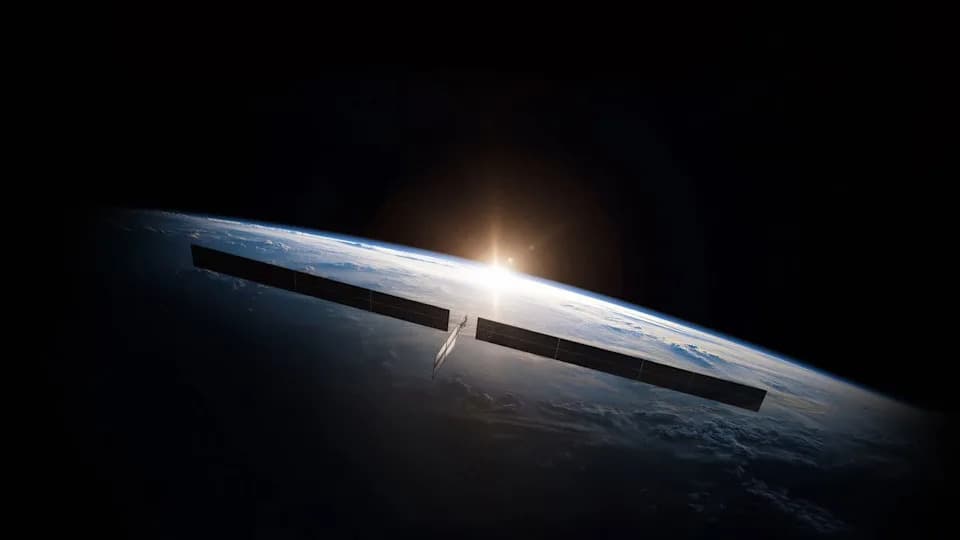
A rendering of one of SpaceX's planned "Starmind" AI satellites in orbit. | Credit: SpaceX
Proposals to place hundreds of thousands — possibly up to a million — AI data‑center satellites in orbit promise to shift energy‑hungry computing off the ground and into space. But many atmospheric and space scientists warn this plan could create new, poorly understood risks for Earth's upper atmosphere.
What Companies Are Proposing
SpaceX, Amazon and Blue Origin, among others, have filed applications with the U.S. Federal Communications Commission (FCC) to deploy very large constellations of orbital platforms designed to run AI workloads. Companies argue that orbiting data centers could exploit abundant solar power and dump waste heat to space, relieving terrestrial grids and cooling-water demands. Forecasts by the Electric Power Research Institute suggest AI facilities could account for as much as 17% of U.S. electricity use by 2030, which motivates industry interest in alternative approaches.
How Launches And Reentries Affect The Upper Atmosphere
Experts say the main environmental impacts will come from two phases: launch and reentry. Rocket plumes inject soot (black carbon), gases and other byproducts directly into the upper atmosphere. Reentering satellites — especially large, metal‑rich spacecraft that burn up on descent — add metal oxides and particulates at altitudes where atmospheric mixing and removal processes are slow.
"Launches and reentries are really the only things that humans do that deposit material directly into the upper atmosphere," said Aaron Boley, a space sustainability researcher at the University of British Columbia.
Key Concerns
Longer Persistence: Pollution injected into higher layers of the atmosphere can persist for years rather than days or weeks. For example, rocket‑borne black carbon may remain aloft for roughly three years, allowing concentrations to accumulate.
Warming And Chemistry: Black carbon at high altitude can absorb sunlight and contribute to warming. Aluminum and other metals from burning satellite hardware can oxidize into compounds (e.g., aluminum oxide) that may influence ozone chemistry — a concern reminiscent of the ozone depletion issues addressed by the Montreal Protocol.
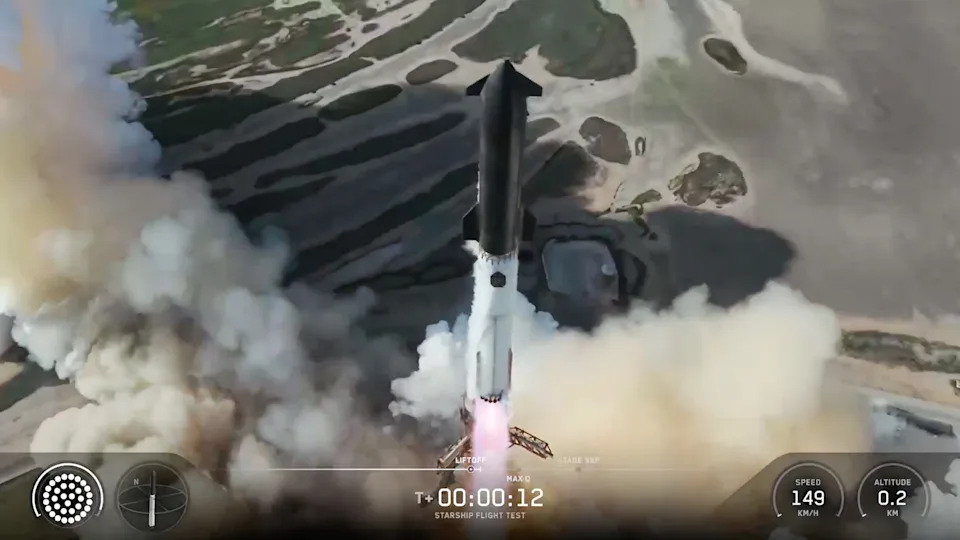
SpaceX's Starship megarocket launches on its 13th test flight, on July 24, 2026. | Credit: SpaceX
Scale And Turnover: The proposed AI satellites would be larger than many current small communications satellites. Estimates cited in the reporting suggest data‑center satellites could weigh up to about 7.5 metric tonnes and carry very large solar arrays. If operators replace hardware every ~5 years to keep pace with technology, reentry mass could amount to tens or hundreds of tonnes per year — materially increasing the mass of artificial material returning through the atmosphere.
Launch Volume And Emissions Estimates
SpaceX's Starship — a focal vehicle for these deployments — uses methane and liquid oxygen, which can burn cleaner than kerosene‑based rocket fuels. But because Starship is much larger and would fly far more often to populate or replenish a massive constellation, the total injected pollution could still rise substantially. Some estimates cited in reporting put one Starship launch at roughly 76,000 metric tons of CO2 equivalent (an estimate with considerable uncertainty), and deploying a million satellites could require on the order of tens of thousands of launches (one analysis suggested up to about 77,000 launches in total, or ~15,300 per year over several years), compared with only a few hundred orbital launches per year today.
Scientific Uncertainties And Research Gaps
Crucially, atmospheric chemists do not yet have precise models for many high‑altitude reactions involving rocket emissions and reentry byproducts. The thresholds (or tipping points) at which incremental emissions produce disproportionately large effects on ozone, radiative balance or other climate‑relevant processes remain poorly constrained. Researchers call for significantly more observations, laboratory studies and modeling before large‑scale deployment proceeds.
"We need way more observations and way more time to be able to look into that," said Eloise Marais, professor of atmospheric chemistry at University College London.
Other Impacts: Astronomy And Space Sustainability
Beyond atmospheric chemistry, astronomers warn that enormous satellite constellations will increase sky brightness and streaks that interfere with ground‑based observations. A recent European Southern Observatory study cautioned that if all planned constellations were built, certain types of surface‑based astronomical research could be severely hampered.
What Needs To Happen Next
Scientists and sustainability researchers urge a precautionary approach: fund targeted research (observations, lab chemistry and global models), assess full life‑cycle environmental costs (including launch frequency and on‑orbit replacement), and coordinate international regulatory guidance. Until the science better constrains impacts and thresholds, many experts say it would be premature to proceed with massive rollouts that could irreversibly alter the upper atmosphere.
Sources: Interviews with atmospheric and space‑sustainability researchers; forecasts from the Electric Power Research Institute; reporting and estimates discussed by Space.com, Ars Technica and other outlets. Numbers quoted are estimates and carry significant uncertainty.
Help us improve.