Paris has converted the 2,500 m² stone plaza outside the Hôtel de Ville into a microforest, planting more than 50 trees and about 20,000 plants. The project—Paris’s third microforest—uses heat-tolerant species like oak and honey locust to improve survival, increase stormwater absorption, and boost local flood resilience. It supports biodiversity, lowers urban heat, and advances the city’s goal to plant over 170,000 trees and expand water-absorbent surfaces.
Paris Replaces City Hall Stone Plaza With a 50-Tree Microforest to Cool and Drain the City
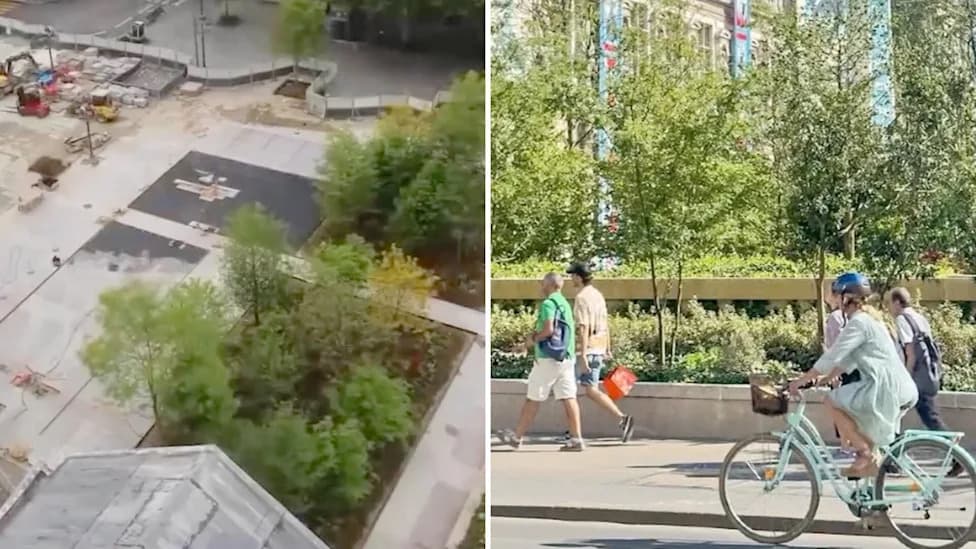
Photo Credit: Instagram
Paris has transformed the stone plaza outside the Hôtel de Ville into a microforest, ripping up concrete and planting trees and shrubs to convert a heat-reflecting square into a greener, more climate-resilient public space.
What changed: Planners removed much of the previous 2,500-square-meter stone surface and planted more than 50 trees and roughly 20,000 plants and shrubs. Designers prioritized locally appropriate, heat-tolerant species such as oak and honey locust to improve survival during hotter summers.
Why it matters
Replacing hardscape with soil and vegetation reduces surface and air temperatures by adding shade and evapotranspiration, and it helps stormwater soak into the ground instead of running off. That combination improves comfort on hot days and increases local flood resilience during heavy rains.
Biodiversity and livability
More soil, roots, and canopy create habitat for insects, birds, and other urban wildlife that struggle in fully paved environments. The result: cooler walks, more usable public squares, better air quality, and public spaces that feel more pleasant year-round.
This is Paris’s third microforest project, following Place de Catalogne and Bois de Charonne. The city aims to plant more than 170,000 trees to expand water-absorbent surfaces across roughly half the city as part of a broader climate resilience initiative.
Broader context
Depaving—removing unnecessary asphalt and concrete—has become a growing trend in cities worldwide. Projects in schoolyards, parking lots, medians, and civic spaces are being used to combine multiple benefits: cooling neighborhoods, improving drainage, expanding habitat, and making public areas more attractive and usable.
According to the Environmental Protection Agency, increasing vegetation and permeable surfaces reduces runoff and helps cities better manage heavy rainfall while mitigating urban heat.
Paris’s Hôtel de Ville redesign is a highly visible example of how relatively small, well-placed interventions can deliver environmental, social, and climate resilience benefits in dense urban settings.
Help us improve.