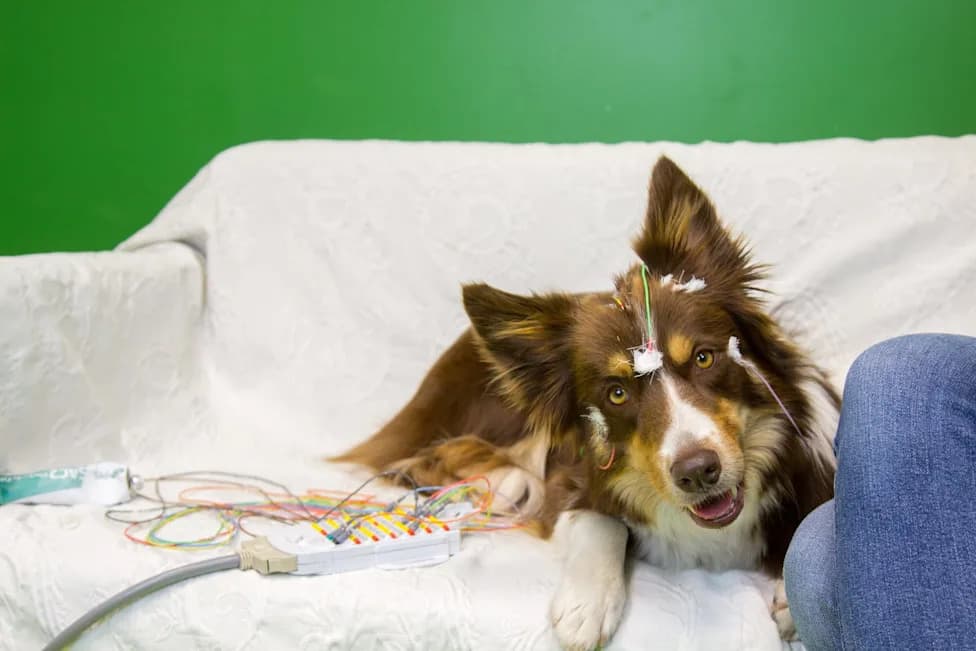
Researchers at the University of Vienna used fMRI to demonstrate that many dogs can identify human emotions by reading facial expressions. Fourteen highly trained dogs viewed images of faces while scanners recorded brain activity: happy faces activated the temporal cortex and caudate nucleus, while sadness, fear and anger engaged distinct regions. The study shows dogs process human emotions in more detail than a simple positive/negative split and suggests practical benefits for training and the human–dog bond.
Your Dog Really Can Tell When You're Happy — fMRI Reveals How Dogs Read Human Faces
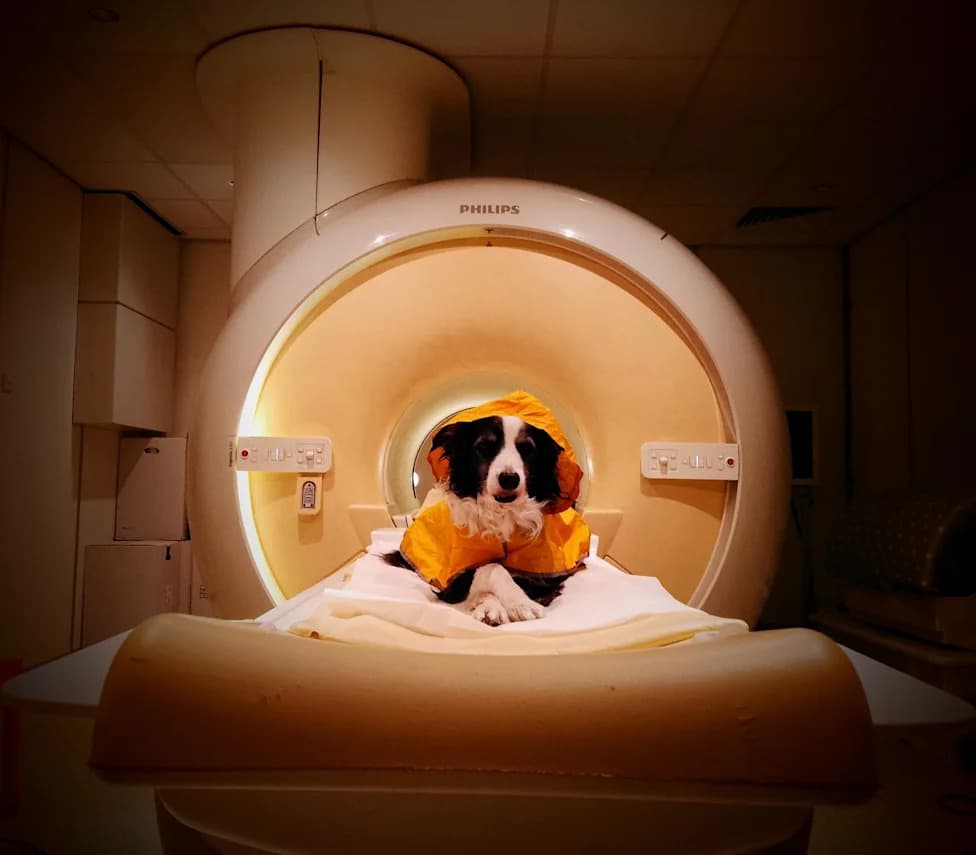
A very cooperative border collie undergoes an fMRI. —Photo by Laura Cuaya
If you've ever suspected your dog can sense when you're happy, sad, scared, or angry, recent research suggests you're partly right — but it's not telepathy, it's face-reading. A new study led by researchers at the University of Vienna used functional magnetic resonance imaging (fMRI) to show that many dogs can identify human emotions from facial expressions and revealed which brain regions are involved.
Training Dogs for the Scanner
Getting reliable images from a dog in an MRI scanner is a major challenge. The confined space and loud noises that unsettle many people can also affect dogs, yet the experiment required animals to remain almost completely still: at least six minutes in the scanner and movement under three millimeters. To meet that standard, researchers Rául Hernández Pérez and Laura Cuaya recruited 14 cooperative dogs (11 border collies, two golden retrievers and one Labrador, the latter three of which were service animals) and ran at least 20 training sessions each.
The training started with trust-building and short five-second holds in the posture needed for scanning, gradually extended over days to 10 minutes. Dogs were desensitized to headphones used to protect their hearing and rehearsed in a mock scanner before entering the real, noisy machine. "We reward them with treats, though some dogs prefer to play as a reward," said Cuaya, noting the careful, gradual acclimation required to collect usable fMRI data.
What the Scans Revealed
During scanning, dogs viewed photographs of human faces expressing happy, neutral, angry, frightened and sad emotions while researchers measured neural activation. Happy faces selectively activated the temporal cortex and the caudate nucleus. In humans, the temporal lobe helps with memory, face recognition and emotion processing, while the caudate is associated with reward, motivation and learning. Neutral faces did not produce the same response.
When shown a broader range of emotions, the dogs' brains showed more fine-grained responses rather than a simple positive-versus-negative split. Sadness and fear specifically engaged the right rostral suprasylvian gyrus (a region tied to visual processing). Anger and fear activated the right ectosylvian gyrus and the left splenial (splenal) gyrus — areas involved in integrating visual and auditory information, spatial orientation and episodic memory.
"We found that the dog brain is not only categorizing emotions as positive or negative, but instead can exhibit more detailed processing, responding in different ways to emotions," said Rául Hernández Pérez.
Why It Matters
These findings build on earlier studies showing dogs attend differently to emotional faces (for instance, looking more at the eyes when a person is happy) and may struggle reading faces of people who differ from their primary caregiver. Beyond expanding our knowledge of canine cognition, the results have practical implications: owners and trainers can combine treats with clear emotional signals — smiling, vocal praise, warm facial expressions — to reinforce learning and strengthen the human–dog bond.
The long relationship between humans and dogs — estimated at roughly 14,000 years — is deeply social. Understanding how dogs perceive human emotions can help us communicate more clearly with them and deepen that ancient partnership.
Help us improve.